Viral Hooks
Trending short videosSpeaker explains cage soccer trend
D

@dominyckb

Instagram · Talking Head Edit

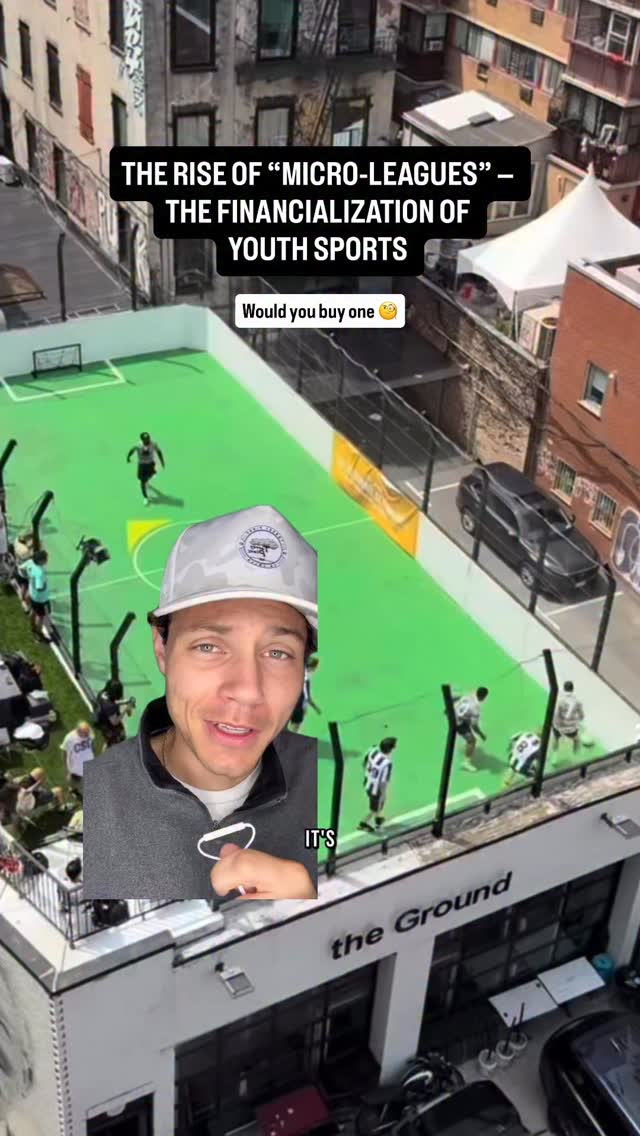
@dominyckb Cage soccer looks like football with less space. But that might be exactly why it works. A full-size soccer field needs roughly two acres, 22 players, and 90 minutes. Cage soccer compresses the whole thing. Fewer players. More touches. More goals. Less dead space. Less real estate. And that matters because the two resources becoming most expensive in modern cities are space and attention. Small-sided soccer facilities can generate dramatically more revenue per square foot than traditional full-size fields, while new formats like Kings League and Baller League are proving there’s demand for faster, more concentrated versions of the game. But I don’t think cage soccer is replacing football. It’s adapting football to the city. A cage can live inside a warehouse. On a rooftop. Under a highway. In a mall. In a parking lot. You don’t need another billion-dollar stadium. You need a box, a ball, and enough people who want to play. We spent the last century making sports bigger. Bigger stadiums. Bigger fields. Bigger crowds. The next sports boom might come from doing the opposite. Compress the space. Compress the time. Keep the interesting parts. Cage soccer isn’t football made smaller. It might be football made for the world we’re actually building. #soccer #sportsbusiness #sports #realestate #streetsoccer

View original on Instagram

The edit1 shot · 14 text
Shots Text1:12

Performance

Views
100.3K
Likes
4.2K
Comments
306
Engagement
4.4%
Outlier
11.1×
Length · 18 Sept 2026
1:12

Video #42581 · Talking Head Edit

Speaker explains cage soccer trendfrom @dominyckb

[01]

Overview

The speaker analyzes the rising trend of cage soccer, explaining its origins as an informal urban sport and its current explosion in popularity due to private equity investment. He breaks down the economic advantages, citing data that small-sided pitches generate 31 times more revenue per square foot than traditional fields, require less capital, and increase player engagement. The speaker provides examples like the Kings League and a new professional league in Dubai to illustrate the trend, compares its potential to Padel, and concludes with a call-to-action for aspiring entrepreneurs.

[02]

Simple outline

  1. 1Make bold future prediction
  2. 2Reveal core economic driver
  3. 3Show high-stakes validation
  4. 4Frame within macro-trend
  5. 5Activate interested community

[03]

Related videos

[04]

Classification

Concepts
Opportunity ExplainerBreakdown
Elements
B-Roll CutawayText OverlayDrone FootageShare CTA

[05]

Hook analysis

What stops the scroll in the first 3 seconds

Title hook · 55%

Cage Soccer is About to Have its Padel Moment...

Verbal hook · 10%

This is gonna be huge.

Visual hook · 35%

A high-angle drone shot reveals a vibrant green soccer cage starkly contrasted against gritty, graffiti-covered urban buildings, with the Brooklyn Bridge visible in the background, creating a visually compelling juxtaposition of sport and city.

[06]

Hook template

Steal this for your own video

[Niche Sport] Is About to Have Its [Breakout Comparison Sport] Moment...

  • — Pickleball Is About to Have Its Golf Moment...
  • — Padel Is About to Have Its Tennis Moment...
  • — Disc Golf Is About to Have Its Bowling Moment...

[07]

Hook and payoff

The promise the opener makes, and how the video pays it back

Hook

A high-stakes, forward-looking statement that creates immediate curiosity about the subject and the reasoning behind the prediction.

Payoff

A direct call to action that invites the audience to participate in the trend, connect with the creator, and share the information with a specific type of person, fostering community and virality.

[08]

Narrative framework

The structural pattern this video runs on

Framework

The Inevitability Engine

To build an irrefutable case for an emerging trend by layering historical context, economic data, operational advantages, and real-world validation, culminating in a macro-level explanation and a call to action.

  1. 1

    The Relatable Origin Story

    Establishes the subject's humble, often overlooked, or 'unofficial' past to create a familiar entry point for the audience.

  2. 2

    The Institutional Catalyst

    Introduces a significant turning point where established powers (e.g., finance, big business) begin to take notice, signaling a shift from niche to mainstream.

  3. 3

    The Core Economic Engine

    Presents the single most compelling, data-driven financial reason why the trend is viable and profitable, often using a powerful comparative metric.

  4. 4

    The Compounding Advantages

    Stacks additional operational and cultural benefits on top of the core economic driver, such as lower costs, higher engagement, or better alignment with modern consumer behavior.

  5. 5

    The Validation Gauntlet

    Provides concrete, high-stakes examples of major investments or adoption by influential entities, serving as undeniable proof of the trend's momentum.

  6. 6

    The Grand Unifying Theory

    Zooms out to connect the specific trend to a larger, undeniable macro-economic or societal shift, framing it as a logical consequence of a bigger story.

  7. 7

    The Contrarian Reality Check

    Briefly introduces a nuanced counterpoint or risk factor, often by comparing the subject to another hyped trend and pointing out its flaws. This builds credibility and shows sophisticated understanding.

Themes

  • Urbanization
  • Sports Innovation
  • Investment Trends
  • Real Estate Efficiency

Techniques

  • Data-driven argument
  • Trend analysis
  • Voiceover narration

Trends

  • Micro-sports
  • Creator-led business analysis

Post caption

Cage soccer looks like football with less space. But that might be exactly why it works. A full-size soccer field needs roughly two acres, 22 players, and 90 minutes. Cage soccer compresses the whole thing. Fewer players. More touches. More goals. Less dead space. Less real estate. And that matters because the two resources becoming most expensive in modern cities are space and attention. Small-sided soccer facilities can generate dramatically more revenue per square foot than traditional full-size fields, while new formats like Kings League and Baller League are proving there’s demand for faster, more concentrated versions of the game. But I don’t think cage soccer is replacing football. It’s adapting football to the city. A cage can live inside a warehouse. On a rooftop. Under a highway. In a mall. In a parking lot. You don’t need another billion-dollar stadium. You need a box, a ball, and enough people who want to play. We spent the last century making sports bigger. Bigger stadiums. Bigger fields. Bigger crowds. The next sports boom might come from doing the opposite. Compress the space. Compress the time. Keep the interesting parts. Cage soccer isn’t football made smaller. It might be football made for the world we’re actually building. #soccer #sportsbusiness #sports #realestate #streetsoccer

Text overlays

  • title · beginning

    Cage Soccer is About to Have its Padel Moment...

  • contextual · beginning

    soccer

  • contextual · beginning

    football

  • contextual · middle

    private

  • contextual · middle

    economic

  • contextual · middle

    generates

  • informational · middle

    31 times

  • contextual · middle

    expensive

  • contextual · middle

    capital

  • contextual · middle

    attention

  • contextual · middle

    King's

  • informational · middle

    million

  • contextual · middle

    professional

  • call-to-action · end

    comment

Transcript

This is gonna be huge. For decades, cage soccer is basically the unofficial little brother of football. You could play it in between buildings, in a schoolyard, and under the railroad. Plus, because of the tiny pitches, the ball never really escaped. And no, private equity is in love. And it's not just because they like watching normal people get nutmeg'd. Small sided soccer has an incredible economic advantage to it. FranData just found that a five a side soccer pitch generates 31 times more revenue per square foot than a 11 v 11 pitch, which matters because land is getting incredibly expensive. But the craziest part is that it requires less capital, less people, but increases touches. Because of the quick action, every touch is now a highlight, which equals attention. Thus, the Kings League is putting in $63,000,000 into a small sided version of their better program. And now in Dubai, we also have the emergence of the first professional cageball league, with its main distribution being named at TikTok, Twitch, and YouTube. Overall, sports are starting to adapt the economics of overcrowded cities. That's why you're seeing more urban development of these things. The key is if they'll generate as much revenue as paddle and pickleball, which also aren't as great as we think given that five paddle facilities have gone up for sale in the state of Florida in the last thirty days. Either way, if you're trying to get one of these off the ground, comment connect down below and send this to a friend that's been playing before the hype.


Speaker explains cage soccer trend | Viral Hooks