Viral Hooks
Trending short videosExplaining the psychology of status
P

@peter_reitano

Instagram · Split screen

@peter_reitano Are you rich enough to fly business class and not post about it? The first time: lounge, champagne, boarding pass, lie-flat seat. Full documentary. The twentieth time: annoyed the lounge is busy. Maybe status signalling doesn’t disappear as you move up. It just gets quieter, more coded, and eventually you start signalling how little you care about signalling. There is apparently no escape from this shit. #Status #Wealth #Consumerism #Psychology #Culture

View original on Instagram

The edit1 shot · 10 text
Shots Text2:40

Performance

Views
181.2K
Likes
7.7K
Comments
316
Engagement
4.4%
Outlier
14.3×
Length · 16 Sept 2026
2:40

Video #42681 · Split screen

Explaining the psychology of statusfrom @peter_reitano

[01]

Overview

The creator delivers a monologue explaining the concept of status signaling and conspicuous consumption, using examples like flying business class and owning luxury items. He outlines the evolution of this behavior from overt flexing to more subtle, coded signals ('quiet luxury'), and concludes by arguing that even the act of not signaling becomes its own form of status.

[02]

Simple outline

  1. 1Pose provocative question
  2. 2Contrast novice vs. expert behavior
  3. 3Introduce core psychological theory
  4. 4Reveal paradoxical twist

[03]

Related videos

[04]

Classification

Concepts
BreakdownOpportunity Explainer
Elements
Picture-in-PictureB-Roll CutawayText Overlay

[05]

Hook analysis

What stops the scroll in the first 3 seconds

Title hook · 30%

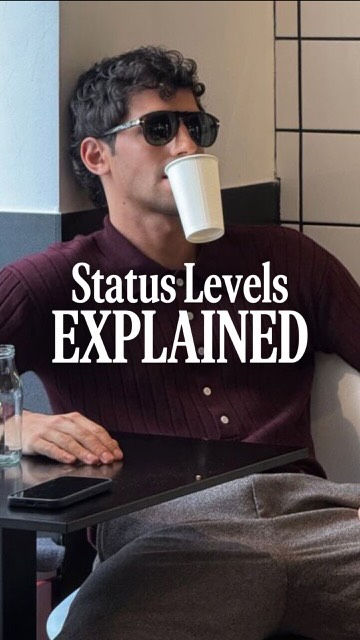
Status Levels EXPLAINED

Verbal hook · 30%

Are you rich enough to fly business class and not post about it?

Visual hook · 40%

The video opens with a shot of a luxurious first-class airplane cabin, featuring a wood-grain table, a glass of sparkling water, and a 'FIRST CLASS' boarding pass, immediately establishing a theme of wealth and exclusive travel.

[06]

Hook template

Steal this for your own video

Open with a close-up of a [status-coded object] beside a [specific proof of access], then reveal [unexpected status behavior] in a split-screen explanation.

  • — Open with a close-up of a luxury watch beside its receipt, then reveal why some owners hide the logo in a split-screen explanation.
  • — Open with a close-up of a marathon medal beside a race bib, then reveal why some runners never post their finish time in a split-screen explanation.
  • — Open with a close-up of a chef’s tasting menu beside a reservation card, then reveal why some diners avoid photographing the meal in a split-screen explanation.

[07]

Hook and payoff

The promise the opener makes, and how the video pays it back

Hook

A direct, self-reflective question that implicates the viewer in the topic and frames a common behavior as a test of status.

Payoff

A cynical but satisfying conclusion that the behavioral 'game' is inescapable, reframing the entire topic as a closed loop and leaving the viewer with a new, critical lens.

[08]

Narrative framework

The structural pattern this video runs on

Framework

The Status Paradox Unveiling

A philosophical deconstruction of a common human behavior, revealing its hidden psychological drivers and escalating through levels of sophistication to a paradoxical conclusion.

  1. 1

    The Novice Display

    Establishes a relatable, entry-level example of the behavior, detailing the overt and enthusiastic actions of a newcomer to establish a baseline.

  2. 2

    The Utility Dichotomy

    Introduces a simple, academic framework (e.g., a dichotomy like actual vs. social utility) that explains the underlying psychology of the behavior, giving the analysis intellectual weight.

  3. 3

    The Universal Proof

    Broadens the scope by applying the core theory to multiple, diverse examples, demonstrating that the principle is universal and not isolated to the initial example.

  4. 4

    The Desensitization Curve

    Contrasts the novice's behavior with that of an experienced practitioner, showing how familiarity diminishes the need for overt displays and shifts the emotional response from excitement to indifference or annoyance.

  5. 5

    The Sophistication Pivot

    Evolves the argument by revealing that the behavior doesn't disappear but transforms into a more subtle, coded, and exclusive form understood only by other experts (i.e., 'quiet luxury').

  6. 6

    The Introspective Challenge

    Directly challenges the viewer to examine their own motivations regarding the behavior, making the abstract argument personal and forcing self-assessment.

  7. 7

    The Meta-Status Paradox

    Delivers the final intellectual twist by revealing that even the most sophisticated, subtle, or absent form of the behavior is, itself, another, higher-level performance of the same core impulse.

Themes

  • Conspicuous consumption
  • Status signaling
  • Quiet luxury
  • Social psychology

Techniques

  • Picture-in-picture
  • B-roll montage
  • Visual essay

Trends

  • Cultural commentary
  • Old money aesthetic

Post caption

Are you rich enough to fly business class and not post about it? The first time: lounge, champagne, boarding pass, lie-flat seat. Full documentary. The twentieth time: annoyed the lounge is busy. Maybe status signalling doesn’t disappear as you move up. It just gets quieter, more coded, and eventually you start signalling how little you care about signalling. There is apparently no escape from this shit. #Status #Wealth #Consumerism #Psychology #Culture

Text overlays

  • title · beginning

    Status Levels EXPLAINED

  • contextual · beginning

    rich

  • contextual · beginning

    business

  • contextual · beginning

    lounge

  • contextual · beginning

    champagne

  • contextual · middle

    Rolex

  • contextual · middle

    Porsche

  • contextual · middle

    consumption

  • contextual · end

    signalling

  • contextual · end

    discretion

Transcript

Are you rich enough to fly business class and not post about it? I think there's a point with almost every status symbol where the real flex becomes not needing anybody to know. The first time you fly business class, you probably photograph everything. The lounge, the champagne, the little toiletry bag, the seat turning into a bed, the passport casually sitting next to the champagne, maybe even the obligatory shot of your legs stretched out in front of the screen with a quote, long travel day ahead. And listen, I get it. You're excited. You're doing something that feels special, but you're also signaling. Status symbols have two forms of utility. There's the actual utility of the thing, and then there's the social utility of other people knowing you have the thing. A Rolex tells the time. A Porsche gets you somewhere. Business class gets you to Australia without arriving shaped like a question rank. But all of them also communicate something. Money, success, taste, access, whatever it is you want people to infer. And I think something interesting happens to you as you become more accustomed to status, the signaling value starts to decline. Your first Rolex somehow appears in every photo, your fifth Rolex is just the watch you put on that morning. Your first five star hotel gets a full room tier, Your first business class flight gets a full length documentary. By your twentieth, you're just annoyed the lounge is too busy. There's an old idea in sociology around conspicuous consumption, buying things partly because their consumption is visible to other people. And I think signaling is often strongest when you're entering a new status group. At first, the object is evidence of the life you want people to believe you have. Eventually, if that actually is your life, you stop needing the evidence. The thing becomes normal. But here's where it gets even more ridiculous. Status signaling doesn't actually disappear, it just gets more subtle. The giant logo disappears, the clothes get quieter, you don't tag the hotel, the watch becomes something only another watch nerd would recognize. You're still signaling you've just graduated to a more exclusive language of status. And obviously, this isn't absolute. Sometimes, you post tier hotel because it's beautiful. You post the car because you love cars. You post the watch because you're a watch nerd. Not every photo of an expensive thing is some desperate cry for validation, but I do think it's worth asking yourself, would I enjoy this as much if nobody knew I had it? Because maybe there's levels to say it is worst you want the thing, then you want people to know you have the thing, then you become so accustomed to tier thing that you don't need anyone to know anymore. And then presumably you worse insufferable about not letting anyone know, judging other people all the time sneering. You've somehow turned discretion into another status symbol. There is no escape from this game. But maybe that's the final test.

Explaining the psychology of status | Viral Hooks