@nataliefratto
Instagram · Speaker address
@nataliefratto OpenAI’s not so little brother: Anthropic Here’s part 2 in unpacking the most valuable private tech companies (by secondaries demand) #anthropic #claude #openai #startup #tech

@nataliefratto
Instagram · Speaker address
@nataliefratto OpenAI’s not so little brother: Anthropic Here’s part 2 in unpacking the most valuable private tech companies (by secondaries demand) #anthropic #claude #openai #startup #tech
Performance
Video #42791 · Speaker address
[01]
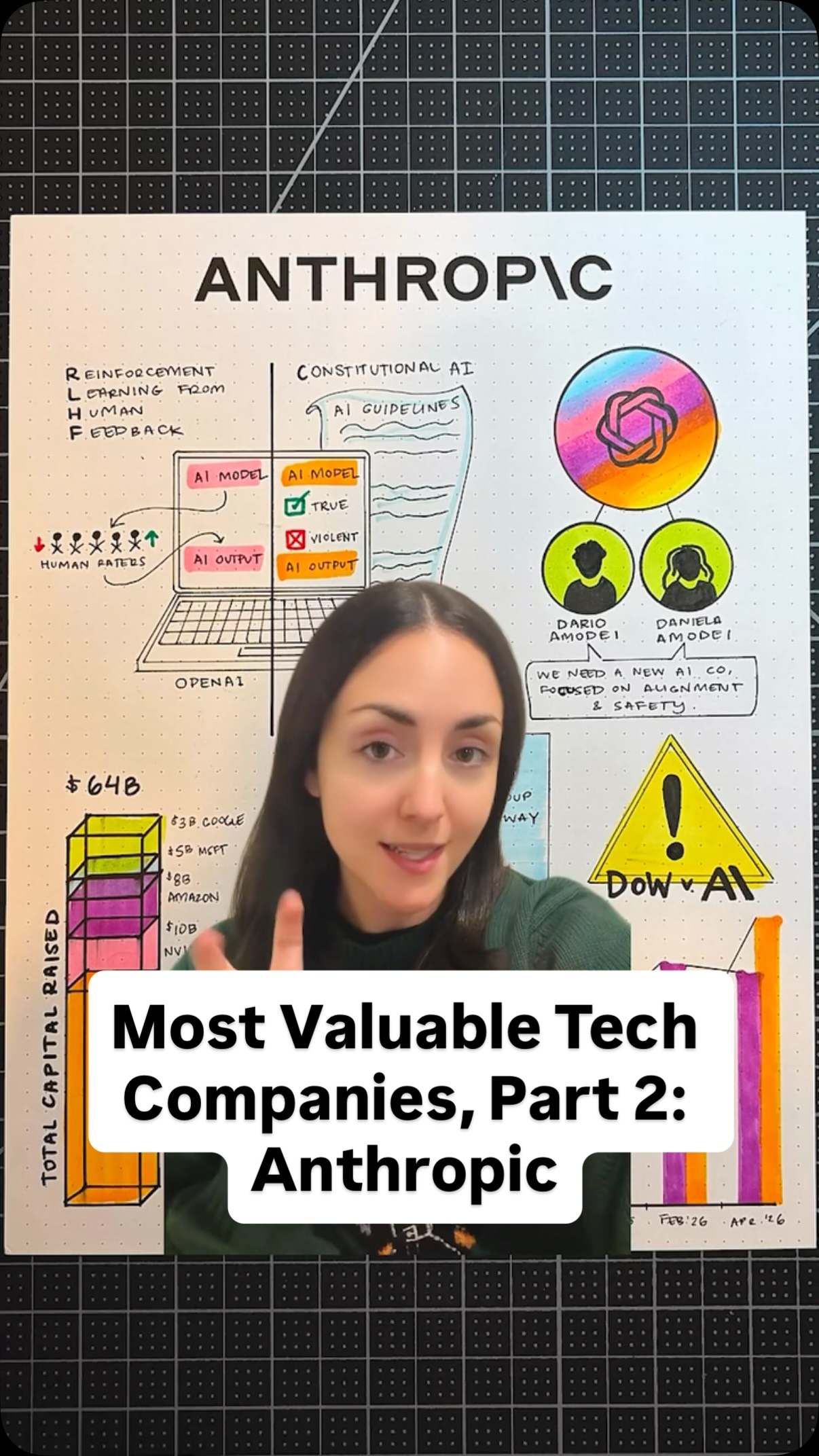
The creator explains the origin story and technical approach of the AI company Anthropic. She details how its founders, two siblings, left OpenAI to create a safer AI, and contrasts OpenAI's human-feedback model (RLHF) with Anthropic's "Constitutional AI" model, using a large hand-drawn infographic as a visual aid throughout the explanation.
[02]
[03]
 693.3K5×Talking head tech news breakdown@metav3rse · Headlines
 2.9M22×AI product launch with safety story@claudeai · Product Promo
 114.4K2.9×Hand-drawn data viz news roundup@itsmarceliina · Headlines
 136.7K4.7×Creator refutes a popular AI concept.@angus.sewell · Hot Take
 426.1K11.8×Explaining a custom robot build@fdotinc · What Is X?
 79.2KSimple breakdown of AI agents@itsmariahbrunner · Opportunity Explainer
 1.1M14.8×Creator explains new AI agent feature@rpn · Product Demo
 53.4KFounder origin story documentary teaser@joinwabi · Hype Teaser
 644.1K100.3×AI problem and council solution@jasoncooperson · Breakdown
 146.5K2.9×Explaining AI-first software development@angus.sewell · Opportunity Explainer
 174.2K55.7×AI agent POV narrative explains incident@artificial.isabel
 2.9M210×Explaining AI stages with visuals@itsemilyhiggins · Opportunity Explainer
[04]
[05]
What stops the scroll in the first 3 seconds
Verbal hook · 95%
Okay, so two siblings left OpenAI because they wanted to make a safer AI company, and just this month they passed OpenAI in revenue.
Visual hook · 5%
A woman stands in front of a large, detailed, hand-drawn infographic on a whiteboard, immediately establishing a visual and educational format for the video.
[06]
Steal this for your own video
left to build a , and they just passed them in .
[07]
The promise the opener makes, and how the video pays it back
Hook
A dramatic and counter-intuitive statement that pits a challenger against an incumbent and reveals the challenger has already won, creating immediate intrigue.
Payoff
A concluding statement that reinforces the initial hook, emphasizing the speed and scale of the challenger's success to provide a satisfying narrative resolution.
[08]
The structural pattern this video runs on
Framework
The Underdog's Gambit
To explain the success of a challenger entity by framing their story as an ideological and methodological departure from an established incumbent, culminating in a surprising victory.
The Series Frame
Briefly positions the content within a larger, authoritative series to establish credibility and context for the viewer.
The Ideological Genesis
Establishes the 'why' behind the challenger's existence by detailing the philosophical or motivational conflict that led to their split from the incumbent.
The Methodological Duel
Visually and verbally presents a side-by-side comparison of the incumbent's established method versus the challenger's innovative new approach, simplifying a complex difference into a clear binary choice.
The Consequence & Payoff
Explains the tangible, real-world advantage gained from the challenger's new method, directly linking their unique approach to a superior outcome or value proposition.
OpenAI’s not so little brother: Anthropic Here’s part 2 in unpacking the most valuable private tech companies (by secondaries demand) #anthropic #claude #openai #startup #tech
title · throughout
ANTHROPIC
informational · middle
REINFORCEMENT LEARNING FROM HUMAN FEEDBACK
informational · middle
CONSTITUTIONAL AI
informational · middle
AI GUIDELINES
contextual · middle
DARIO AMODEI
contextual · middle
DANIELA AMODEI
informational · middle
WE NEED A NEW AI CO. FOCUSED ON ALIGNMENT & SAFETY
contextual · middle
OPENAI
contextual · middle
ANTHROPIC
Okay. So two siblings left OpenAI because they wanted to make a safer AI company. And just this month, they passed OpenAI in revenue. This is part two in a series explaining the real story behind the 30 most valuable private tech companies. Anthropic started as an OpenAI breakup in 2020 when a brother, VP of research, Jario Amade, and his sister, Daniella, a VP of safety and policy, left OpenAI together. They wanted to build a new AI company more focused on alignment and safety. They also had a vision for a different technical approach to AI too. OpenAI uses a process called RLHF, where the model's answers pass through a panel of real humans who rate them to decide which is better before providing an output. Anthropic pioneered constitutional AI, where humans wrote an overarching constitution for the model to guide its behavior, and then the model checks itself against that constitution. Is this truthful? Is this violent? The resulting output is less likely to go off the rails. Enterprise legal and compliance teams often trust more. In just four years