@emmaburnze
TikTok · Yap
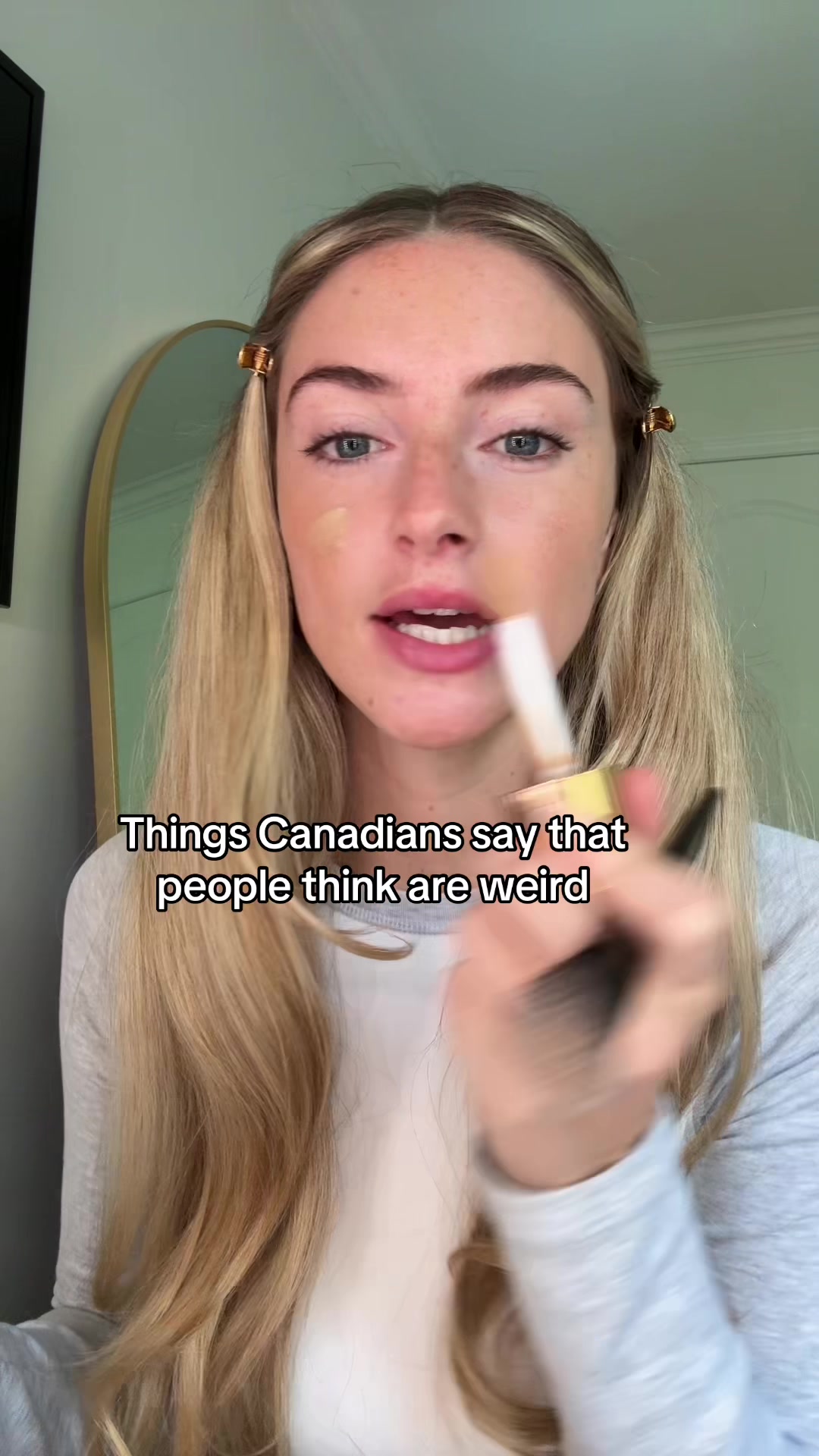
@emmaburnze How Canadians pronounce things 👀

@emmaburnze
TikTok · Yap
@emmaburnze How Canadians pronounce things 👀
Performance
Video #43123 · Yap
[01]
The creator applies makeup while explaining common Canadian pronunciations and phrases that non-Canadians find strange. She starts by detailing the 't' to 'd' sound shift with examples like 'water' and 'Toronto,' then lists other uniquely pronounced words like 'bag' and 'sorry,' and concludes by discussing the use of 'hey' for agreement.
[02]
[03]
 11M21.4×Get ready with me reintroduction@mikaylanogueira · Origin Story
 618KStorytelling while doing her makeup@chloeabeth4545 · Get Ready With Me
 128.3K4×Chatty Scandi girl makeup GRWM@abigailcanfieldd · Get Ready With Me
 3.2M5.6×Rich kid stories during makeup routine@chloeabeth4545 · Pope In The Pool Multitask
 4M36.9×Sharing opinions while doing makeup@chloeabeth4545 · Pope In The Pool Multitask
 263K2.7×Makeup tutorial tired glam serve@nyxcosmetics · Tutorial / How To
 139.9KCreator shares facts while applying makeup@jennalitner · Pope In The Pool Multitask
 515.6KFast-paced ASMR makeup application@alishamarie · ASMR Process
 2.3M22.4×Audio synced makeup transformation reveal@alishamarie · Before/After Transformation
 191.2KCreator does food-named makeup challenge@skylerreneee · Q&A Response
 575.3KDoing makeup while telling stories@chloeabeth4545 · Value Vlog
 2.8M13.2×Step-by-step makeup tutorial with products@estellelebourgeois_ · Tutorial / How To
[04]
[05]
What stops the scroll in the first 3 seconds
Title hook · 55%
Things Canadians say that people think are weird
Verbal hook · 45%
Things Canadians say that other people think are weird.
Visual hook
The creator looks directly at the camera while holding makeup brushes, immediately establishing a conversational tone and a secondary activity (makeup application) to hold visual interest.
[07]
The promise the opener makes, and how the video pays it back
Hook
A direct statement of the video's thesis, framing a specific group's common behavior as unusual or noteworthy to outsiders.
Payoff
A direct question to the audience, prompting them to share their own experiences or opinions related to the topic, thereby driving engagement in the comments.
[08]
The structural pattern this video runs on
Framework
The Cultural Shibboleth
Demonstrating unique linguistic traits of a specific in-group to an out-group, using a series of examples to prove a central thesis about the group's identity.
The Governing Principle
Establishes a broad, overarching rule or pattern of behavior unique to the group, providing a framework for the first set of examples.
The Rapid-Fire Proof
Provides a quick succession of examples that validate the previously stated principle, demonstrating its widespread application.
The Contextual Demonstration
Takes one example and places it within a real-world scenario to actively contrast the in-group's method with the out-group's method.
The In-Group Identifier
Presents a specific behavior or word as a test to distinguish members of the group from outsiders, reinforcing the theme of shared identity.
The Catalogue of Quirks
Shifts from a single rule to a quick list of other, unrelated but well-known, unique traits or terms associated with the group.
The Stereotype Confirmation
Addresses the most famous and widely-known stereotype about the group, confirming its validity in a satisfying and often humorous way.
How Canadians pronounce things 👀
title · beginning
Things Canadians say that people think are weird
informational · beginning
Water -> wader
informational · beginning
Battery -> baddery
informational · beginning
Better -> bedder
informational · middle
Toronto -> Torono
Things Canadians say that other people think are weird. Anything with a tier in the middle, we don't pronounce. We pronounce it as a d. No, water, battery, better, city, Toronto. Can you pass me that water bottle? No. Can you pass me that better bottle? I don't know why we do this. You can always tell if somebody doesn't live here because they'll say Toronto, not Toronto. Words that always catch people's attention. Bad, washroom. Sorry. I don't even know how else you would pronounce sorry. About, that's another one. Lastly, we actually do say hey or hey. Like an agreeance thing, I don't no. I, oh, wouldn't say hey necessarily, but I would say hey, no, oh, that was a good dinner, hey. Is there one that surprised you the most?