@nycdivorcelawyer
Instagram · Clip
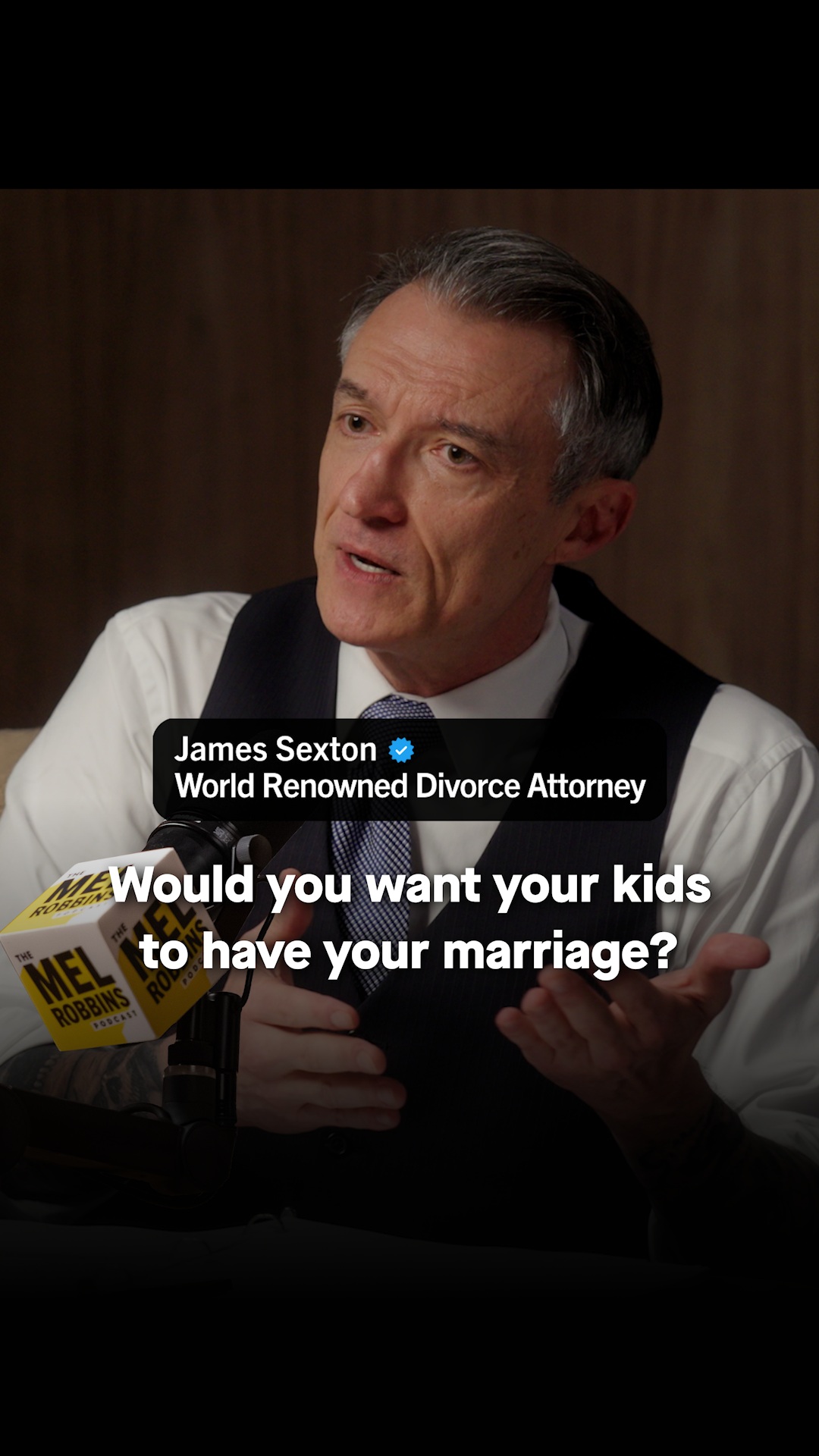
@nycdivorcelawyer Would you want your children to have your marriage? That is the question we all need to ask ourselves. #marriage #relationships

@nycdivorcelawyer
Instagram · Clip
@nycdivorcelawyer Would you want your children to have your marriage? That is the question we all need to ask ourselves. #marriage #relationships
Performance
Video #43314 · Clip
[01]
A divorce attorney poses a provocative question to viewers: "Would you want your kids to have your marriage?" He argues that staying in an unhappy marriage "for the kids" is flawed because children experience the marriage alongside their parents and learn what relationships should look like from that model. He urges parents to consider what behaviors they are teaching their children about love and respect, suggesting that a respectful divorce can be a better lesson than a high-conflict marriage.
[02]
[03]
 146.8K4.3×Podcast clip on motherhood identity@reikoslivingroom · Vulnerable Monologue
 1.6M59.2×Lawyer explains dating age gaps@nycdivorcelawyer · Anecdotal Philosophy
 785K15.8×Lawyer details messy celebrity divorce@nycdivorcelawyer
 272.5KGRWM style marriage hot take@mahammalek · Pope In The Pool Multitask
 1.5M29.1×Expert explains why you can't bribe judges@nycdivorcelawyer · Anecdotal Philosophy
 154.1K8.6×Viral story drives newsletter CTA@harnidhk · Anecdotal Philosophy
 1.3M36.7×Controversial take on single motherhood@aspirewithemmagrede · Hot Take
 807.8K5.2×Dating OnlyFans model versus past@nycdivorcelawyer
 1.5M18.5×Expert answers wild relationship questions@nycdivorcelawyer · Q&A Response
 1.9M10.5×Ex-pornstar shares personal story@wasabi.wifey · Ask an Expert
 488.5K1.7×Commentary on Ayesha Curry's marriage@nycdivorcelawyer · Hot Take
 2.8M3.7×Expert breaks down gentle parenting@callherdaddy · Breakdown
[04]
[05]
What stops the scroll in the first 3 seconds
Title hook · 50%
Would you want your kids to have your marriage?
Verbal hook · 45%
Would you want your children to have your marriage?
Visual hook · 5%
A medium close-up shot of a well-dressed man in a professional setting, making direct eye contact with the camera and using expressive hand gestures to emphasize his point.
[06]
Steal this for your own video
Would you want your to have your ?
[07]
The promise the opener makes, and how the video pays it back
Hook
A direct, emotionally-charged question that forces the audience into immediate self-reflection on a deeply held belief or personal situation.
Payoff
The speaker concludes by restating the core thesis as the ultimate, clarifying question, leaving the audience with a powerful new framework for self-evaluation and decision-making.
[08]
The structural pattern this video runs on
Framework
The Expert Reframe
An authority figure challenges a common belief by posing a provocative question, dismantling the conventional wisdom, and offering a more profound, reframed perspective as the new standard for evaluation.
The Legacy Test
The initial question is immediately made more potent by asking the audience to view their current situation through the eyes of someone they are responsible for (e.g., a child), framing their actions as a model for that person's future.
The Common Fallacy Takedown
The speaker identifies a widely accepted, noble-sounding justification for maintaining the status quo and systematically deconstructs its logic, exposing it as a flawed premise.
The Modeling Mandate
The speaker introduces the core thesis: that one's actions are not just personal choices but are actively modeling a standard of behavior for others to follow. This becomes the central argument.
The Self-Love Pivot
The argument connects the act of caring for others to the necessity of caring for oneself, reframing self-respect not as selfish, but as a prerequisite for setting a healthy example.
The Behavioral Audit
The abstract core thesis is grounded in specific, uncomfortable, and highly relatable examples of behavior, forcing the audience to apply the new framework to their own lives.
The Choice Reframe
The speaker redefines the central conflict, shifting it from a simple binary outcome (e.g., stay/leave) to a more profound choice about which 'lesson' or 'value' one wishes to teach.
The True Culprit Identification
The speaker clarifies that the problem isn't the structural situation (e.g., divorce) but the underlying negative dynamic (e.g., conflict), which is the true source of harm.
Would you want your children to have your marriage? That is the question we all need to ask ourselves. #marriage #relationships
contextual · throughout
James Sexton World Renowned Divorce Attorney
title · beginning
Would you want your kids to have your marriage?
branding · throughout
Mel Robbins
branding · middle
@melrobbins
branding · end
The Mel Robbins Podcast
call-to-action · end
Divorce
Would you want your children to have your marriage? If my daughter's marriage looked like this, would I be happy on her wedding day? If I could look at a crystal ball and see this is what my son's marriage was gonna look like ten years in, Would I want him to get married or would I say, hey, maybe you should rethink this. Staying in a marriage for the children isn't something people are actually doing a lot of the tier. You no? Because your children are in the marriage with you. And the question is not are their parents divorced. They're not gonna remember whether you stayed or not. They're gonna remember what your marriage looked like. Like, they're watching everything you're doing. You're modeling for your children what marriage should look like. You do that for your kids because you love them. Well, love yourself. Love yourself enough to look at it and to say, is this what I wanna model for my children? How my husband is treating me, is this how I want my daughter to believe a man should treat a woman? How my wife speaks to me? Is that how my son should think his wife should speak to him? Or how she should relate to him? Is this the love we want our children to see? Because the truth is, what am I modeling? And can I change it in this marriage? Is it possible to change it? You're not you're not protecting your children by not getting divorced. What you're choosing is what lesson they're gonna learn. So can they learn the lesson that two people can end a marriage and still have affection for each other and still love their children and co parent in a productive way? High conflict family dynamics, whether they end in people staying together and gutting it out for the kids or whether it's a conflict filled post divorce life where people have a contentious no parenting relationship, yeah, it's bad for kids. That doesn't have a lot to do with divorce. That has to do with how you approach divorce. That has to do with how you approach your co parenting relationship. I think that divorce is never free for children better. But the question of what relationship you're modeling for your children, I rank, is the key question. More important than is divorce good or bad for kids.