@amandaaafowler
Instagram · Yap
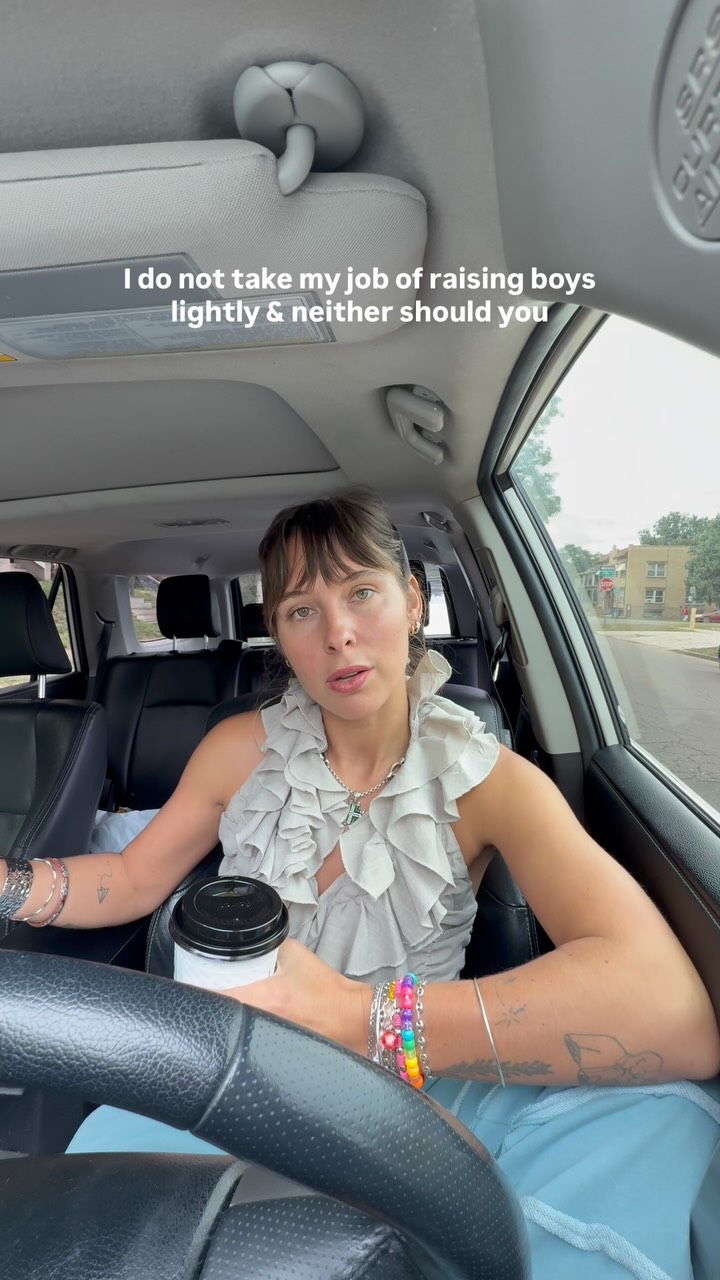
@amandaaafowler raising better boys is a collective effort, matriarchy cannot exist without alloparenting, & in my Barbie dream house – the consequence for Ken’s who are r@pists is losing their penis, or their lives!🩷

@amandaaafowler
Instagram · Yap
@amandaaafowler raising better boys is a collective effort, matriarchy cannot exist without alloparenting, & in my Barbie dream house – the consequence for Ken’s who are r@pists is losing their penis, or their lives!🩷
Performance
Video #43446 · Yap
[01]
The creator shares a series of personal anecdotes about her young sons to argue that raising boys is not easy. She recounts stories of her sons internalizing societal messages that girls are fragile and boys don't cry, and describes managing their intense emotional outbursts, concluding that raising better boys is a difficult and collective effort against outside influences.
[02]
[03]
 118.7K13.9×Girl on toilet with feminist quote.@amandaaafowler
 1.5M348.7×Mom defends her parenting style@life.withkeri · Vulnerable Monologue
 198.9K47.2×Monologue on public parenting discipline@life.withkeri · Vulnerable Monologue
 4.4M14.3×Relatable story about working motherhood@callherdaddy · Anecdotal Philosophy
 472.3K44.3×Creator deconstructs a hostile comment@oliviabarbulescu · Q&A Response
 213.2K30.4×Reacts to podcast, explains taboo@sharellegrant · Reaction
 1.5M3.8×Exposing contradictory motherhood standards@gracebeverley · Cultural Rant
 207.9K4.5×Personal monologue about social anxiety@livewellwithsophie · Vulnerable Monologue
 1.9M287.3×Anecdote justifies parenting style@life.withkeri · Anecdotal Philosophy
 146.8K4.3×Podcast clip on motherhood identity@reikoslivingroom · Vulnerable Monologue
 1.7M55.8×Relatable conversation about mom guilt@doordash · Vulnerable Monologue
 600.9K15.9×Sharing toxic workplace mean girls story@roxycouse · Vulnerable Monologue
[04]
[05]
What stops the scroll in the first 3 seconds
Title hook · 62%
I do not take my job of raising boys lightly & neither should you
Verbal hook · 38%
Boys are not easier to raise because this year, I have one son in kindergarten and one son in preschool.
Visual hook
A direct-to-camera shot of the creator in a car, creating an intimate and conversational feel.
[06]
Steal this for your own video
I don’t take lightly—and neither should .
[07]
The promise the opener makes, and how the video pays it back
Hook
A bold, contrarian statement that directly challenges a common assumption, immediately establishing the video's thesis and creating intrigue.
Payoff
A unifying call to action that concludes not with a simple solution, but with a powerful appeal for collective effort and a shared mission, transforming the personal narrative into a community-wide manifesto.
[08]
The structural pattern this video runs on
Framework
The Anecdotal Escalation Manifesto
To challenge a widely held belief by presenting a series of escalating personal anecdotes that prove the belief is false or overly simplistic, culminating in a call for collective action.
The Initial Evidence
Present a relatable, seemingly low-stakes personal story that introduces the core conflict or problem in a digestible way.
The Problem's Root Reveal
Conclude the initial story with a moment of revelation that shows the problem is deeper or more insidious than it first appeared.
The Credibility Interlude
Briefly establish the speaker's authority and good-faith efforts to solve the problem, preempting audience skepticism by demonstrating personal investment and action.
The Escalating Evidence: Part 1
Share a second, more emotionally charged anecdote that demonstrates a different and more severe facet of the core problem, raising the stakes.
The Escalating Evidence: Part 2 (Climax)
Share a third, peak-intensity anecdote that showcases the problem at its most challenging or dramatic, often involving a physical or high-stakes emotional confrontation.
The Externalization of Conflict
Shift the focus from personal struggle to a universal one by identifying an external force (societal norms, outside influences, systemic issues) as the true antagonist.
raising better boys is a collective effort, matriarchy cannot exist without alloparenting, & in my Barbie dream house – the consequence for Ken’s who are r@pists is losing their penis, or their lives!🩷
title · throughout
I do not take my job of raising boys lightly & neither should you
Boys are not easier to raise because this year, I have one son in kindergarten and one son in preschool. And the other day, when we were watching a commercial where a little girl slapped a beast into oblivion to metaphorically represent that she had beat cancer, my youngest turned to me and said, mommy, how do girls get strong? I said, what do you mean, honey? And he repeated the question, how do girls get strong? So I said, well, how do boys get strong? They eat healthy. They move their bodies. They get good sleep. It's the same for girls. I've taken my sons to the gym with me since they were babies. They've seen me lift weights in the backyard. I do flips on the trampoline, throw a fabulous spiral, and occasionally joyfully beat them in wrestling matches. I wondered what this question could possibly be rooted in, so I pried a little. And finally, he said, well, girls are fragile. He's four. Boys are not easier to raise because as a mother who has only ever allowed my son's tears to run freely down their cheeks as opposed to erasing them with the back of my hand, I overheard my four year old tell our little neighbor that boys don't cry. No when not but five minutes better, my son had a meltdown over the fact that his eggs did not have enough pepper on them, I just held him, and I let my deep breath soothe his. Boys are not easier to raise because just yesterday when my husband decided to take our youngest on a solo ice cream date and my oldest discovered that he was not invited, he had a full blown panic attack and started throwing his shoes across the living room and using my body as a punching bag. He's six, and I had to physically restrain his body from hitting and kicking me while repeating, I won't let you hurt my body. I let him cool down and then I told him to clean up his mess. Boys are not easier to raise because no matter how many times I say there are consequences to your actions rank for consent or my husband and I teach them to respect others or that boys are allowed to cry or that girls and boys are equally fragile and strong, there will always be boys at school and at the playground who are not taught the same. And while I am committed to raising boys who become men, who women feel safe around, there will always be an outside influence that I will have to work tirelessly against in raising my boys until we collectively commit to a world with better boys.