@thejaunt_
Instagram · Single Take
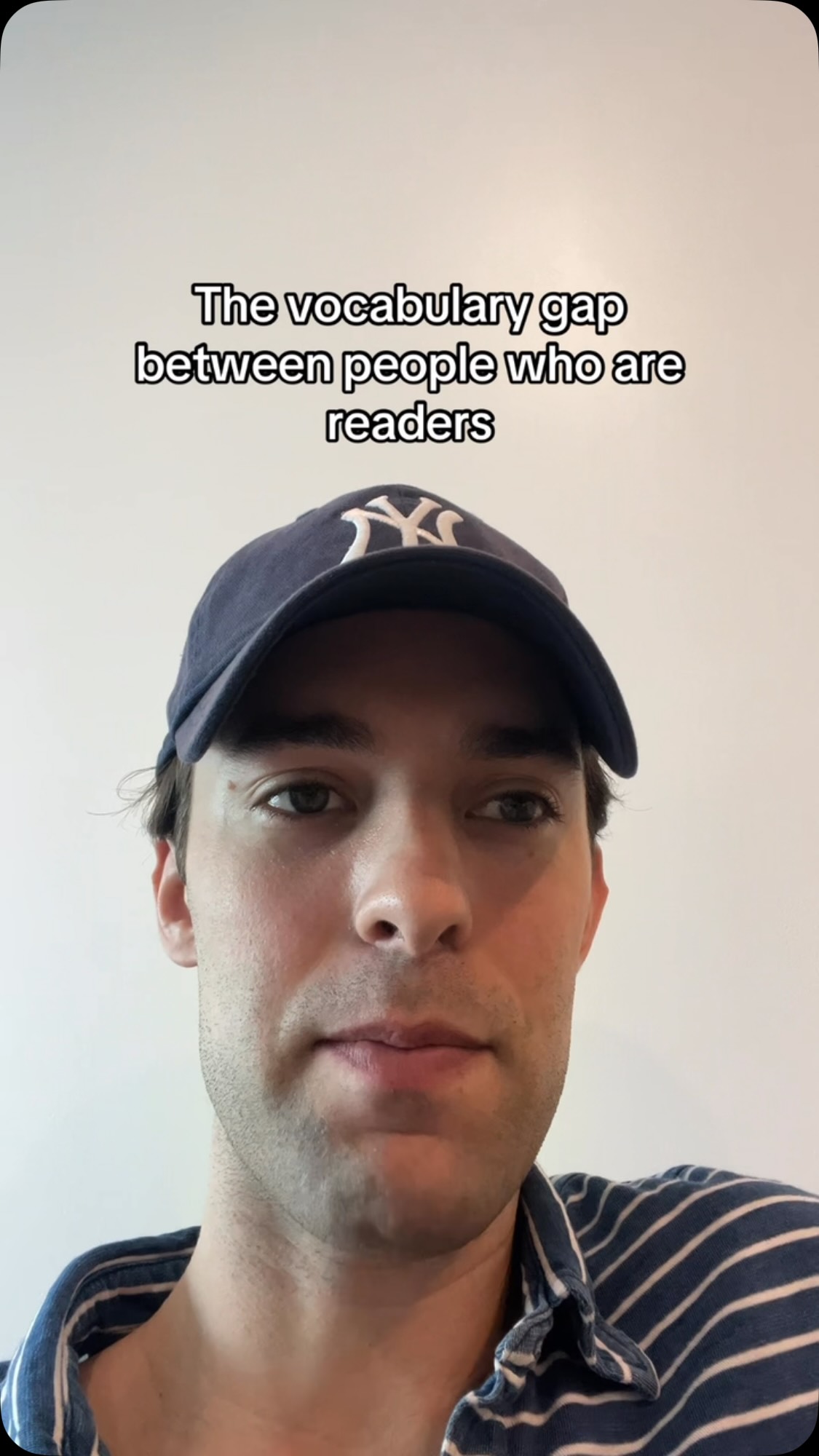
@thejaunt_ 10 years without reading

@thejaunt_
Instagram · Single Take
@thejaunt_ 10 years without reading
Performance
Video #48934 · Single Take
[01]
The creator explains his theory on the widening vocabulary gap between readers and non-readers as they age, contrasting post-college levels with the divergence by age 30. He argues that consistent reading compounds vocabulary and knowledge, forcing readers to simplify their speech with non-readers but allowing them to communicate at 'full speed' with other readers.
[02]
[03]
 1.1MVisual essay on literacy crisis.@_glassmuseum · Breakdown
 10.4M67.7×Explaining generational IQ drop causes@rony · Breakdown
 722.6K9.9×Explaining literacy crisis through philosophy@glass__museum · Breakdown
 1.4M13.6×Using averages to test intelligence.@higherupwellness · Breakdown
 1.5M78.3×Comparing dating motivations by age@thejaunt_ · Hot Take
 3.1M31.1×Explains psychology concept with study@bitterbuilds · Case Study Breakdown
 4.2M108×Creator lists niche self-improvement habits@jun_yuh · Rapid Fire Listicle
 1.3M123.1×Man explains dating perspective shift@thejaunt_ · Vulnerable Monologue
 464.4K5.8×Explains time perception with lifestyle montage@happywithmeg · Breakdown
 159.1KExplaining the significance of age 29@oluwatosin.the.oracle · Opportunity Explainer
 1.5M51.7×Monologue on becoming obsessed with salt@wyattderman · Anecdotal Philosophy
 296.8K59.3×Explains attention as a class issue@ashi.branding · Breakdown
[04]
[05]
What stops the scroll in the first 3 seconds
Title hook · 50%
The vocabulary gap between people who are readers
Verbal hook · 50%
The vocabulary gap between people who are readers and non readers starts to get more aggressive as you get older.
Visual hook
Direct-to-camera close-up shot of the speaker, creating an intimate and conversational feel.
[06]
Steal this for your own video
The gap between and gets bigger every
[07]
The promise the opener makes, and how the video pays it back
Hook
Present a strong, observational thesis that establishes a clear in-group/out-group dynamic and how the gap between them widens over time.
Payoff
Describe the cathartic and satisfying feeling the in-group experiences when they finally meet another member of their in-group, allowing them to operate at 'full speed' without limitation. This provides a powerful sense of validation and community.
[08]
The structural pattern this video runs on
Framework
The Divergence Proof
To validate a shared experience of a specific in-group by contrasting their development over time with an out-group, culminating in a cathartic feeling of recognition and release.
The Equalizing Origin
Establish a relatable baseline scenario from the past where both the in-group and out-group were on relatively equal footing, making the subsequent divergence more impactful.
The Great Divergence
Introduce a time-skip and describe how the out-group has stagnated or regressed, making the gap between them noticeable and providing the first piece of evidence for the initial thesis.
The Good Faith Disclaimer
Preemptively address potential accusations of elitism or judgment by explicitly stating that the observation is not a moral condemnation. This builds trust and keeps the audience receptive.
The Compounding Advantage
Detail the specific, compounding benefits and skills the in-group has accumulated over time, providing the logical justification for the widening gap.
The Social Friction Point
Articulate a tangible, frustrating real-world consequence of the gap, where the in-group must inhibit or 'dumb down' their abilities when interacting with the out-group.
10 years without reading
title · beginning
The vocabulary gap between people who are readers and non readers starts to get more aggressive as you get older.
informational · beginning
Like when you're 23, everyone comes out of college and they kind of have some big words fresh in their mind because they had to read.
informational · beginning
But then when you get to like 30 or 35, people who haven't read in 10 years, it kinda starts to show.
informational · middle
And I'm not even saying that in a bad way. Like, I don't think you're a bad person if you don't read or something like that.
informational · middle
There's plenty of annoying people who read regularly.
informational · middle
But if you're the type of person who has been reading for 10 years after being out of college, there's just sort of like a compounding increase in your vocabulary, and your sentence structures, and even just, like, the wealth of your knowledge.
informational · end
to the point where if you're a 30 year old reader speaking with a 30 year old who's not a reader, you, like, physically have to limit the way you would speak.
informational · end
And then when you go and you meet another person who's also a reader, it feels like you finally get to use this language that you never get to use anywhere else.
informational · end
It feels like you get to go full speed.
The vocabulary gap between people who are readers and non readers starts to get more aggressive as you get older. Like when you're 23, everyone comes out of college and they kind of have some big words fresh in their mind because they had to read. But then when you get to, like, 30 or 35, people who haven't read in ten years, it kind of starts to show. And I'm not even saying that in a bad way. Like, I don't think you're a bad person if you don't read or something like that. There's plenty of annoying people who read regularly. But if you're the type of person who has been reading for ten years after being out of college, there's just sort of like a compounding increase in your vocabulary rank your sentence structures. And even just like the the wealth of your knowledge, you start tier, like, learn a lot of things about different areas to the point where if you're a 30 year old reader speaking with a 30 year old who's not a reader, you, like, physically have to limit the way you would speak. And then when you go and you meet another person who's also a reader, it feels like you finally get to use this language that you never get to use anywhere else. It feels like you get to go full speed.