Viral Hooks
Trending short videosExplaining a dopamine infographic
M

@matt.goes_

Instagram · Greenscreen Talking Head

@matt.goes_ And you can know all of this mentally but how do you actually use this information to improve your life drastically? I'm obsessed with this question and even more obsessed with what the answers bring

View original on Instagram

The edit1 shot · 23 text
Shots Text0:56

Performance

Views
405.2K
Likes
8.1K
Comments
191
Engagement
2%
Length · 26 Oct 2026
0:56

Video #48972 · Greenscreen Talking Head

Explaining a dopamine infographicfrom @matt.goes_

[01]

Overview

The creator analyzes a 'Dopamine Chart,' explaining its premise that the speed of dopamine release differentiates addictive behaviors from successful, long-term achievements. He supports this by citing a study on Ritalin administration, then pivots to offering advice, encouraging viewers not to feel guilty about instant gratification but to cultivate awareness. He concludes by recommending viewers save the infographic as a tool for motivation.

[02]

Simple outline

  1. 1Present novel framework
  2. 2State a high-stakes binary
  3. 3Validate with external proof
  4. 4Provide an effortless solution
  5. 5Instruct to save as a tool

[03]

Related videos

[04]

Classification

Concepts
Breakdown
Elements
Side-by-Side Visual AidGreen Screen Composite

[05]

Hook analysis

What stops the scroll in the first 3 seconds

Title hook

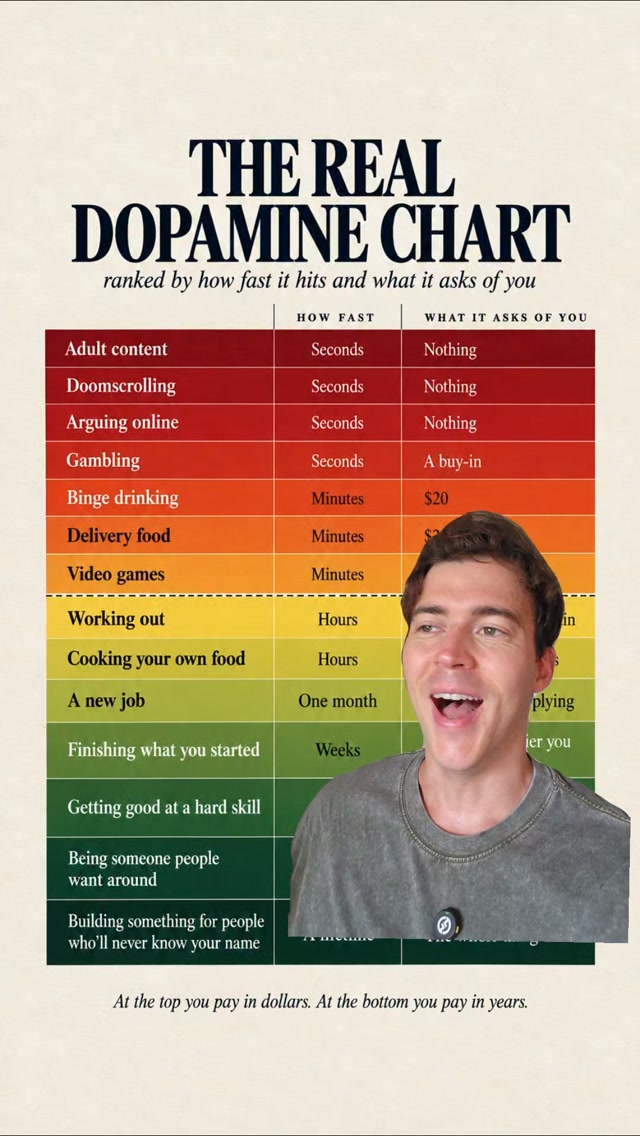
THE REAL DOPAMINE CHART

Verbal hook

I don't think I've ever seen anything explain your brain chemistry this clearly.

Visual hook

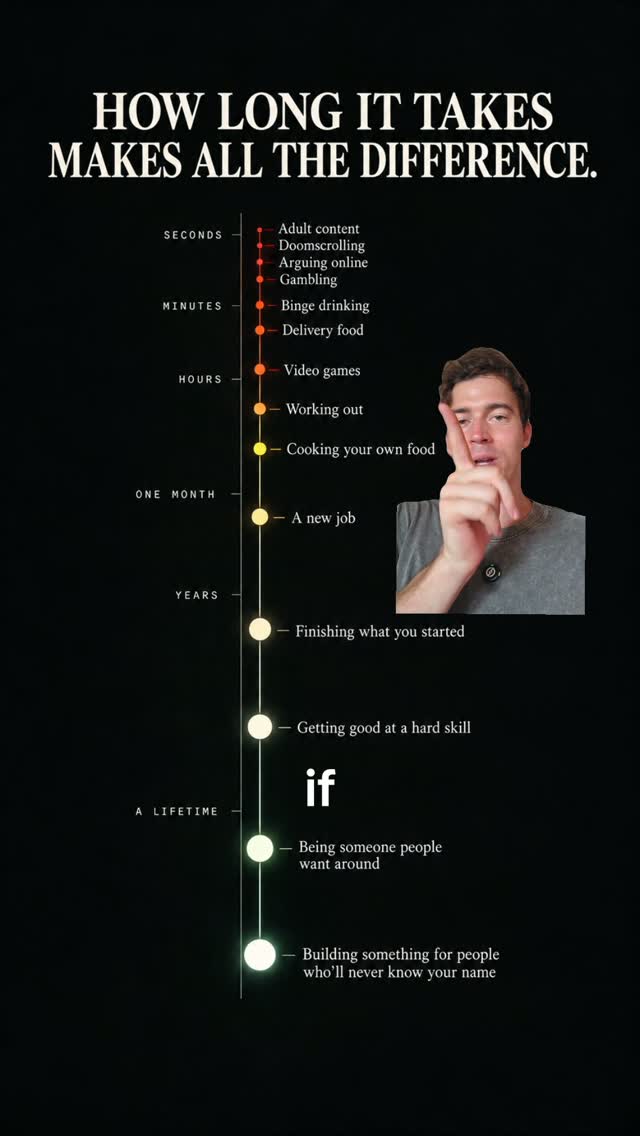
A large, colorful, and well-designed infographic titled 'THE REAL DOPAMINE CHART' serves as the immediate background, creating visual intrigue and clearly establishing the video's topic.

[07]

Hook and payoff

The promise the opener makes, and how the video pays it back

Hook

Make a superlative claim about the clarity and power of a specific piece of information or visual aid that is being presented.

Payoff

Reiterate the value of the shared information and deliver a direct call-to-action for the viewer to save the content as a practical tool for future reference, explicitly driving a key engagement metric.

[08]

Narrative framework

The structural pattern this video runs on

Framework

The Clarity & Prescription Framework

Presenting a complex topic through a simple, visual framework, validating it with an external proof point, and offering a low-friction, psychological solution that encourages saving the content as a tool.

  1. 1

    The High-Stakes Thesis

    Translate the information from the visual aid into a high-stakes, binary outcome for the viewer (e.g., success vs. failure, addict vs. successful), creating immediate personal relevance.

  2. 2

    The Authority Anchor

    Substantiate the thesis by citing a piece of external, credible evidence, such as a scientific study, experiment, or expert finding, to build trust and authority.

  3. 3

    The Causal Bridge

    Explain the underlying mechanism of *why* the thesis is true in simple, cause-and-effect terms, making the concept feel logical and understood.

  4. 4

    The Empathy Pivot & Guilt Absolution

    Directly address the viewer's potential negative self-judgment (shame, guilt) related to the topic, absolve them of it, and reframe it as a counterproductive obstacle.

  5. 5

    The Effortless Prescription

    Offer a simple, low-effort, internal action (e.g., awareness, a mindset shift) as the primary, achievable solution to the problem.

Themes

  • Delayed gratification
  • Neuroscience of habits
  • Personal development
  • Awareness and mindfulness

Techniques

  • Visual aid explanation
  • Scientific study citation
  • Direct-to-camera address

Post caption

And you can know all of this mentally but how do you actually use this information to improve your life drastically? I'm obsessed with this question and even more obsessed with what the answers bring

Text overlays

  • title · throughout

    THE REAL DOPAMINE CHART

  • contextual · throughout

    ranked by how fast it hits and what it asks of you

  • informational · throughout

    At the top you pay in dollars. At the bottom you pay in years.

  • contextual · beginning

    think

  • contextual · beginning

    explain

  • contextual · beginning

    brain

  • contextual · beginning

    chemistry

  • contextual · beginning

    speed

  • contextual · beginning

    dopamine

  • contextual · beginning

    addict

  • contextual · beginning

    successful

  • contextual · middle

    National

  • contextual · middle

    Abuse

  • contextual · middle

    experiment

  • contextual · middle

    slowly

  • contextual · middle

    high

  • contextual · middle

    craving

  • contextual · middle

    guilty

  • contextual · middle

    escape

  • contextual · end

    be

  • contextual · end

    solve

  • contextual · end

    time

  • contextual · end

    spark

Transcript

I don't think I've ever seen anything explain your brain chemistry this clearly. The reason why this chart is so good is because it shows you the speed in which you get your dopamine is gonna determine whether you're an addict or you're successful. The National Institute on Drug Abuse did an experiment where they gave people Ritalin in two forms, one through IV and one in pill form. It was the same drug, same dopamine, but pill form raised dopamine more slowly. And when it comes on slow, it doesn't give you the same high that leaves you craving it afterwards. And by the way, if you do a lot of the things up there, do not feel guilty about it because that's just gonna cause you to do it more so that you can escape. Simply be aware of it. The more aware of it that you are, the more it's just gonna solve itself on its own with time. But, yeah, I love this infographic. I had to share it. You should definitely save it and reference it in a time where you're feeling like you're losing your spark.