Viral Hooks
Trending short videosTimeline investigation of financial scandal
N

@nytmag

Instagram · Talking Head Edit

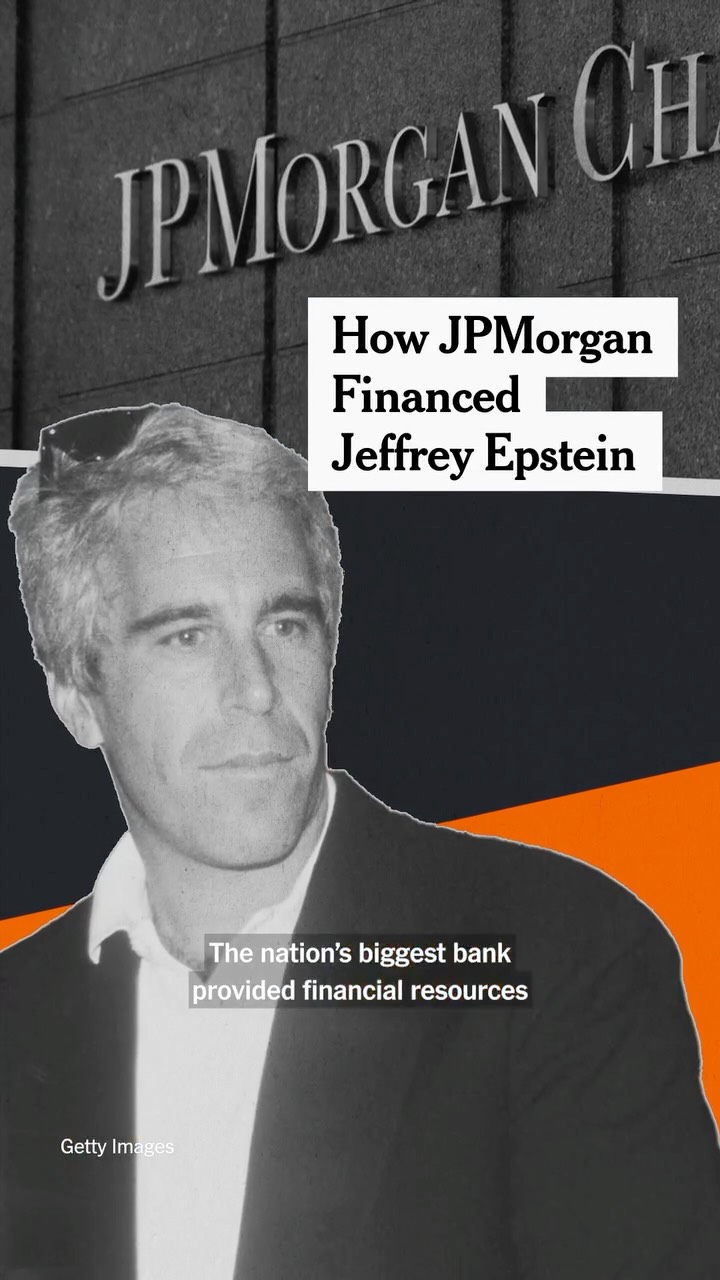
@nytmag When most people think about Jeffrey Epstein, they think of a sexual-abuse scandal. But it's also a financial scandal — one in which JPMorgan, the nation's largest bank, not only enabled Epstein's sex-trafficking operation but also enriched him while reaping profits for itself. Our business reporter Matthew Goldstein, and a team of other Times journalists, combed through 13,000 documents to explain why. Read the full investigation at the link in our bio. Video by Matthew Goldstein, Gabriel Blanco and June Kim/The New York Times

View original on Instagram

The edit1 shot · 13 text
Shots Text

Performance

Views
375.4K
Likes
0
Comments
0

Video #9374 · Talking Head Edit

Timeline investigation of financial scandalfrom @nytmag

[01]

Overview

A New York Times business reporter presents an investigative timeline detailing how JPMorgan Chase financed Jeffrey Epstein for over a decade. The reporter explains Epstein's value to the bank, his close relationship with executive Jes Staley, and how the bank ignored numerous red flags, including massive cash withdrawals and a 2008 guilty plea for soliciting a minor. The video uses documents and a chronological narrative to argue that despite internal warnings, the bank only severed ties with Epstein after Staley's departure, concluding it was a major institutional failure.

[02]

Simple outline

  1. 1State a shocking accusation
  2. 2Present chronological evidence
  3. 3Identify the key enabler
  4. 4Show the breaking point
  5. 5Deliver the final verdict

[03]

Related videos

[04]

Classification

Concepts
BreakdownCultural Rant
Elements
B-Roll CutawayText OverlayMotion Graphics
Account

[05]

Hook analysis

What stops the scroll in the first 3 seconds

Title hook · 55%

How JPMorgan Finance Jeffrey Epst

Verbal hook · 40%

The nation's biggest bank provided financial resources to Jeffrey Epstein for years, ignoring red flags about his activities all along the way.

Visual hook · 5%

The video opens with a high-contrast, bold white title text on a dark, textured background, establishing a serious, investigative tone immediately.

[07]

Hook and payoff

The promise the opener makes, and how the video pays it back

Hook

A bold, high-stakes accusation against a powerful entity, immediately establishing a central conflict and posing an implicit question of 'how/why did this happen?'

Payoff

A definitive judgment that labels the institution's actions as a specific type of failure (e.g., 'institutional,' 'moral,' 'strategic'), providing a satisfying and conclusive answer to the hook's initial question.

[08]

Narrative framework

The structural pattern this video runs on

Framework

The Investigative Timeline

To expose a systemic failure by presenting a chronological chain of evidence that reveals how a powerful institution enabled a wrongdoer, culminating in a definitive judgment.

  1. 1

    The Shocking Thesis

    State the core accusation in a single, powerful sentence that frames the entire narrative.

  2. 2

    The Credibility Anchor

    Establish the authority of the investigation by quantifying the research effort (e.g., 'we reviewed X documents'), promising a well-supported explanation.

  3. 3

    The Origin Story

    Detail the beginning of the relationship between the institution and the wrongdoer, introducing the key players and the initial perceived benefits.

  4. 4

    The Mutual Benefit

    Explain the symbiotic nature of the relationship, establishing the motive for the institution's subsequent actions and complicity.

  5. 5

    The Point of No Return

    Introduce the first major, undeniable red flag or external crisis that should have triggered action and ended the relationship.

  6. 6

    The Internal Protector

    Reveal how a key figure within the institution actively defended the wrongdoer and suppressed internal warnings, personifying the institutional failure.

  7. 7

    The Willful Blindness

    Present a moment of public or legal confirmation of the wrongdoing, and show how the institution chose to ignore it and continue the relationship.

  8. 8

    The Perverse Reward

    Demonstrate how, instead of punishment, the institution actually increased its support for the wrongdoer after the wrongdoing was confirmed.

  9. 9

    The Ignored Warning

    Highlight internal dissent that was overruled by the key protector, proving the failure was systemic and not just one person's mistake.

  10. 10

    The Protector's Downfall

    Detail the event that removed the key protector from their position of power, creating the catalyst for change.

  11. 11

    The Inevitable Severance

    Show the immediate consequence of the protector's removal: the institution finally cuts ties with the wrongdoer, proving the protector's influence.

  12. 12

    The Final Reckoning

    Describe the final, public downfall of the wrongdoer, bringing the story to its ultimate climax and triggering the final analysis.

Themes

  • Corporate Accountability
  • Financial Crime
  • Institutional Failure
  • Investigative Journalism

Techniques

  • Timeline Narrative
  • Documentary Evidence
  • Expert Commentary

Post caption

When most people think about Jeffrey Epstein, they think of a sexual-abuse scandal. But it's also a financial scandal — one in which JPMorgan, the nation's largest bank, not only enabled Epstein's sex-trafficking operation but also enriched him while reaping profits for itself. Our business reporter Matthew Goldstein, and a team of other Times journalists, combed through 13,000 documents to explain why. Read the full investigation at the link in our bio. Video by Matthew Goldstein, Gabriel Blanco and June Kim/The New York Times

Text overlays

  • title · beginning

    How JPMorgan Finance Jeffrey Epst

  • contextual · beginning

    Matthew Goldstein NEW YORK TIMES BUSINESS REPORTER

  • informational · beginning

    Late 1990s Epstein becomes JPM client

  • contextual · beginning

    Jes Staley Former JPMorgan Executive

  • informational · beginning

    1999 Epstein and Staley first meet

  • informational · middle

    2003 Epstein becomes one of the biggest investor clients Withdraws $175,000 in cash

  • informational · middle

    2004 Epstein facilitates deal with hedgefund Epstein pockets $15 million fee

  • informational · middle

    2005 Palm Beach investigation Epstein withdrew over $1.7 million in cash

  • informational · middle

    2008 Epstein pleads guilty Epstein stays as client

  • informational · middle

    2011 This is not an honorable person in any way. He should not be a client.

  • informational · end

    2013 Staley leaves JPM Epstein dropped as client

  • informational · end

    2019 Epstein arrested on trafficking charges

  • branding · end

    The New York Times

Transcript

The nation's biggest bank provided financial resources to Jeffrey Epstein for years, ignoring red flags about his activities all along the way. We reviewed about 13,000 legal documents and other filings to find out why this relationship went on for so long. When he came to the bank around 1998, he was a financial advisor to billionaires, Best Staley, who was a top banker at JPMorgan for many years, basically became a very close friend of Jeffrey Epstein. In total, there are roughly a 130 some odd accounts tied to Epstein. His accounts were worth a lot of money for the rank, but also there were these very large best withdrawals, one as large as a $175,000 When you have a client taking out this kind of money, someone who shouldn't say, wait a minute. Woah. What's going on here? But this isn't just like a private client with lots of money. This is also someone who can do things for the bank if need be. There was this deal put together to buy a hedge fund called Highbridge. And Epstein sort of plays like a middleman in this tier. And he got a $15,000,000 fee and it sort of cemented his value. 2005 becomes a pivotal year. Down in Florida, the parents of a 14 year old girl filed a police complaint saying Epstein sexually abused their daughter. At this point in time already, he withdrew about $1,700,000 from the bank. Staley vouches for Epstein mainly by saying, good, it's outrageous to think that he'd be with teenage girls. By 2008, Epstein pleads guilty to a single charge of soliciting prostitution for a teenage girl. So the bank obviously has a quandary here. No one wants to bucks daily, so he ends up staying. Epstein is pleading guilty. He's still essentially running his sex trafficking operation. Wire transfers are still going through the bank. There's still cash withdrawals. The bank is still noticing them. By the 2010, Epstein is close to getting out of jail. Staley, at this point, is starting to be seen as the potential heir apparent to Jamie Dimon, the CEO. They extend an additional 50,000,000 some odd in trading credits for Epstein. By 2011, the general counsel of the bank wanted to exit him. Epstein remains as a client. If you go to JPMorgan, they'll tell you it's only because of Staley. But also, if they felt strongly enough it was a reputational risk, they could have escalated it. In 2012, there's a clear falling out between Staley and Dimon, and eventually, he leaves the bank. It's pretty clear that Epstein is seeing his days are gonna be numbered there. He's arrested in July 2019 when stories start to spill out into the media that internally some at the bank were always unhappy about Epstein, yet he stayed on as a client. But nothing really happens. Jamie Dimon, the CEO, says he he doesn't recall he even knew of Epstein until 2019 when he was arrested. At the end of the day, what we found is that this was an institutional fail at JPMorgan.