@angelo.toure
TikTok · Skit
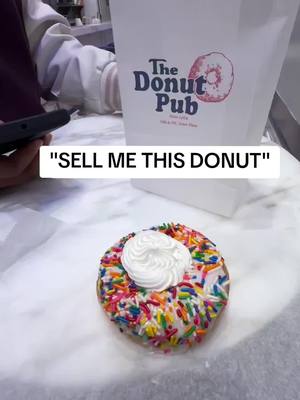
@angelo.toure How to sell a $20 donut 🍩… Here’s how sales psychology works in real life. Would you have bought the donut? ⬇️ Thanks @thedonutpub 🙌 #salestips #howtosell #salespsychology #objectionhandling #sales

@angelo.toure
TikTok · Skit
@angelo.toure How to sell a $20 donut 🍩… Here’s how sales psychology works in real life. Would you have bought the donut? ⬇️ Thanks @thedonutpub 🙌 #salestips #howtosell #salespsychology #objectionhandling #sales
Performance
Video #10544 · Skit
[01]
The creator enacts a sales roleplay scenario where he accepts a challenge to sell a $20 donut. He demonstrates specific sales techniques—such as probing questions, reframing value with a Disney analogy, and creating urgency—while on-screen text labels each psychological tactic for the viewer.
[02]
[03]
 82K5.7×Sales technique role-play demonstration@angelo.toure · Tutorial / How To
 12.4M71×Psychological sales technique skit@thejordisegues · Skit
 11.6M9.1×Funny skit about slow sales@amber_bees · Relatable Skit
 214.5K1×Sales call skit with a twist@wolfofcustom · Relatable Skit
 231.7KComedic skit of a frustrating cold call@wolfofcustom · Relatable Skit
 1.5MCharacter skit about business friend@leogonzall · Relatable Skit
 2.7M786.7×POV barista denies customer purchase@drinkpoppi · Relatable Skit
 160.2K212.8×Sales advice text over video@itsashleyboston · Playbook
 7.4M31.4×Satirical CEO pitches delivery service@lifeisaloha · Satirical Product Pitch
 166K41.4×Skit of annoying customer types@babylonbrews · Relatable Skit
 1.3M413.6×Comedic skit of barista frustrations@babylonbrews · Relatable Skit
 1MComedic finance lesson using whiteboard@itsbobbyfinn · Skit
[04]
[05]
What stops the scroll in the first 3 seconds
Title hook · 50%
SELL ME THIS DONUT
Verbal hook · 45%
Sell me this donut.
Visual hook · 5%
Close-up shot of a decorated donut on a marble table with a person holding a phone, immediately establishing the object of the sales challenge.
[06]
Steal this for your own video
SELL ME THIS
[07]
The promise the opener makes, and how the video pays it back
Hook
The Wolf Challenge: The video opens with a classic, recognizable prompt ('Sell me this...') applied to a common object, instantly setting a skill-based challenge.
Payoff
The Sweetener Close: The deal is sealed by adding a time-sensitive bonus (urgency) to tip the scales and secure the 'yes'.
[08]
The structural pattern this video runs on
Framework
The Persuasion Dojo
Demonstrating complex psychological sales tactics through a high-stakes roleplay involving a mundane object with an inflated price.
The Needs Audit
Instead of pitching features, the seller immediately asks questions to uncover the buyer's underlying emotional motivation (the 'why').
The Sticker Shock
An absurdly high price point is introduced to deliberately trigger a rejection, creating a conflict that must be resolved.
The Objection Isolation
The seller clarifies the rejection to determine if it's a resource issue (no money) or a value issue (not worth it), setting up the counter-argument.
The Emotional Anchor
The seller uses a high-status analogy (e.g., Disney) to shift the conversation from the physical product to an emotional experience.
The Happiness Equation
The price is re-contextualized as a small investment in personal well-being rather than a cost for a commodity.
How to sell a $20 donut 🍩… Here’s how sales psychology works in real life. Would you have bought the donut? ⬇️ Thanks @thedonutpub 🙌 #salestips #howtosell #salespsychology #objectionhandling #sales
title · beginning
SELL ME THIS DONUT
informational · middle
Push Back to Probe
informational · middle
Blitz with No-Based Questions
informational · middle
Sell the EMOTION
informational · middle
= are you broke or are you hesitant?
informational · middle
ethical mind invasion
informational · middle
= this donut is as valuable as Disney
informational · middle
No Based Question pt infinity
informational · end
create extreme urgency
contextual · end
fair eNOugh??
Sell me this donut. Why are we doing this? Because best sell me the donut. Okay. Why do you even want a donut? It's been a long day. I want a little treat. Would this make your day worse? No. Good make it better. Would it be a bad idea to get something that would make your day better and make you happy? No. But how much is it? It's $20. That's too expensive. You're saying it's too expensive because you don't have $20 or you wanna make sure it's worth $20? I wanna make sure it's worth $20. K. Do you mind if I share something with you? Sure. You know how when you go to Disney, it's not about it best being a park, it's about making a memory? Mhmm. Investing into something like this isn't about it being a sweet treat. It's about being happy. Is your happiness worth tier? I mean, I guess so. Okay. Well, if you had $20 and that's all you needed to make yourself happy, would investing $20 into your happiness be a bad idea? No. Okay. Here's a doughnut. And if you get it right now, I'm throwing this coffee. Fair enough? Really? Fair enough? That's fair. Alright. Done. Don't ask me to do this.