@hansloreidesign
TikTok · Talking Head Edit
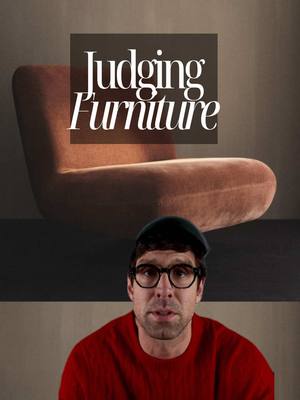
@hansloreidesign Should you judge furniture based in how comfortable it is? Plz share your thoughts

@hansloreidesign
TikTok · Talking Head Edit
@hansloreidesign Should you judge furniture based in how comfortable it is? Plz share your thoughts
Performance
Video #16324 · Talking Head Edit
[01]
The creator poses the question of whether furniture should be judged by comfort. He argues that since most furniture is looked at far more than it's sat in (with exceptions like sofas and beds), its primary value is aesthetic, functioning as "room sculpture." He uses patio furniture as a key example to support his thesis and concludes by asking the audience for their own criteria for judging furniture.
[02]
[03]
 170.2K8.5×Comparing safe vs. bold design@hansloreidesign · Good vs Bad
 741.2K5×Critiquing boring decor with weird alternatives@lilswalty · Rapid Fire Listicle
 267K131.4×Explaining a historical design trend@annakahoelkstudio · Breakdown
 2.1M34.9×Interior designer rates IKEA products@mrphoenixgrey · Anti-Recommendation List
 5.6M99×Man critiques modern clean aesthetic@lohause · Brand Manifesto
 869.9K19.4×Relatable new apartment shopping priorities.@nmillz · Rapid Fire Listicle
 284.7K1.6×Design tip for cozy living rooms@hansloreidesign · Explainer
 2M8.7×List of weird home decor@lilswalty · Rapid Fire Listicle
 263.3K16.1×Interior design tip with examples@hansloreidesign · Breakdown
 1M4.2×List of weird home design alternatives@lilswalty · Rapid Fire Listicle
 201.3K13×Contrasting boring vs bold design.@hansloreidesign · Rapid Fire Listicle
 536.9K5.4×Designer questions standard design feature@lilswalty · Hot Take
[04]
[05]
What stops the scroll in the first 3 seconds
Title hook · 35%
How should you judge furniture?
Verbal hook · 50%
Should you judge furniture based on how comfortable it is?
Visual hook · 15%
A speaker is framed next to a classic designer chair (Wassily Chair) against a wall with strong diagonal shadow patterns, creating a visually composed and interesting opening shot.
[06]
Steal this for your own video
Should you really judge by ?
[07]
The promise the opener makes, and how the video pays it back
Hook
A direct, relatable question that challenges a universally held belief, immediately creating intrigue and prompting the viewer to seek the answer.
Payoff
A direct, open-ended question posed to the audience that prompts them to share their own perspective on the topic, explicitly driving comments and engagement.
[08]
The structural pattern this video runs on
Framework
The Contrarian Reframe
To persuade the audience to adopt a new, counterintuitive perspective on a common topic by systematically dismantling a popular belief and replacing it with a new, more 'logical' framework.
The Contrarian Claim
State the core thesis of the video, which directly contradicts a popular opinion, often supported by a surprising statistic or observation (e.g., '90% of the time...').
The Credibility Concession
Acknowledge and set aside the obvious exceptions or counterarguments to the main thesis. This builds trust and shows the creator has considered opposing views, making the core argument seem more robust.
The Conceptual Reframe
Redefine the subject's primary purpose or identity, shifting the audience's evaluation criteria from the conventional (e.g., utility) to the unconventional (e.g., aesthetics, 'room sculpture').
The Illustrative Extreme
Introduce a specific, often extreme, example where the new, reframed logic is undeniably true, making the general argument more plausible by association.
The Conclusive Mandate
Deliver the final, actionable takeaway or new rule for the audience to follow, presented as the logical conclusion of the preceding argument.
Should you judge furniture based in how comfortable it is? Plz share your thoughts
title · beginning
How should you judge furniture?
informational · beginning
BUT 90% OF THE TIME YOU ARE NOT SITTING IN IT.
contextual · middle
I WOULD ARGUE IT'S MORE OF A ROOM SCULPTURE.
informational · end
99% OF THE TIME YOU'RE JUST LOOKING AT IT.
call-to-action · end
How do you judge furniture?
Should you judge furniture based on how comfortable it is? I keep thinking about this, and I just wanted to share my thoughts. Furniture is usually judged based on comfort, but 90% of the time, you are not sitting in it. Obvious exceptions would be a sofa, a bed, and an office chair, but outside of that, in any given twenty four hour period, it's probably not much. So when you're not sitting in a chair, is it a chair? I would argue it's more of a room sculpture. It's decor. It's adding architecture rank color and dimension to a space to please the eye. It's a set piece. This becomes very obvious when we move to patio furniture. So unless you live in Southern California, you are just not sitting in that very often. Days, weeks, perhaps months no by without any use. So its purpose, if we measure by minutes with butts and seats, is really to provide decor to your patio. Almost all the weight in that decision, I think, should just be made towards finding something that looks the best because it almost never gets sat in. 99% of the time, you're just looking at it. How do you judge furniture? We'd love to hear your thoughts.