@lilswalty
Instagram · Speaker address
@lilswalty Are you team toe kick or no kick? #interiordesigner #denverinteriordesign #interiordesigntips #interiordesignideas #toekick

@lilswalty
Instagram · Speaker address
@lilswalty Are you team toe kick or no kick? #interiordesigner #denverinteriordesign #interiordesigntips #interiordesignideas #toekick
Performance
Video #40400 · Speaker address
[01]
An interior designer questions the necessity and aesthetic value of toe kicks on kitchen cabinetry. She explains their practical purpose, argues they are ugly and detract from the trend of furniture-like cabinetry, refutes the common fear of stubbing one's toe using personal examples, and concludes by asking the audience for their opinions on the design feature.
[02]
[03]
 461.2K5.6×Designer questions a kitchen trend@lilswalty · Hot Take
 444.1K1.7×Rapid fire list of design pet peeves@lilswalty · Rapid Fire Listicle
 741.2K5×Critiquing boring decor with weird alternatives@lilswalty · Rapid Fire Listicle
 768.3K8.5×Creator argues against design trend@lilswalty · Hot Take
 1M4.2×List of weird home design alternatives@lilswalty · Rapid Fire Listicle
 2M20.3×Expert contrasts good vs bad@lilswalty · Good vs Bad
 201.3K13×Contrasting boring vs bold design.@hansloreidesign · Rapid Fire Listicle
 1.4M25.4×Explains a simple design hack@hansloreidesign · Breakdown
 2.1M34.9×Interior designer rates IKEA products@mrphoenixgrey · Anti-Recommendation List
 2.6M1.7×Comment rebuttal with floor reveal@jennaphipps · Hot Take
 170.2K8.5×Comparing safe vs. bold design@hansloreidesign · Good vs Bad
 5.5M642.4×Argues furniture is art not function@hansloreidesign · Hot Take
[04]
[05]
What stops the scroll in the first 3 seconds
Title hook · 50%
Are toe kicks dying?
Verbal hook · 45%
Are toe kicks dying?
Visual hook · 5%
A static, well-lit shot of a traditional, cream-colored kitchen, establishing the video's aesthetic and subject matter.
[07]
The promise the opener makes, and how the video pays it back
Hook
A direct, provocative question that challenges a common, unquestioned standard, immediately framing the topic as a debate.
Payoff
A direct call to the audience for their opinions, often framed with a slightly humorous, conspiratorial question (e.g., 'Have we all been brainwashed?'), which transforms the monologue into a community-wide discussion and maximizes engagement.
[08]
The structural pattern this video runs on
Framework
The Status Quo Interrogation
To challenge a widely accepted norm by first validating its practical purpose, then systematically dismantling its underlying logic through relatable analogies, and finally reframing the issue with a new, more compelling aesthetic or philosophical perspective before opening the floor for debate.
The Steelman & Rebuttal
First, fairly represent the strongest argument for the status quo to build credibility and show understanding. Then, immediately pivot to a personal, often aesthetic, counter-argument, establishing the core conflict of the video (e.g., practicality vs. aesthetics).
The Objection Gauntlet
Proactively voice the audience's most obvious objection to the new idea. Then, systematically invalidate that objection using a series of relatable, common-sense analogies that expose the objection as an unfounded or exaggerated fear.
The Grand Unifying Theory
Reveal the larger trend or philosophical shift that is the true motivation for questioning the norm. This elevates the argument from a simple preference to an insightful observation about a broader change.
The Psychological Trigger
Explain the subconscious effect or mental association that makes the status quo feel dated or incorrect within the new context, providing a concrete reason for the aesthetic judgment.
The Personal Stake
Ground the abstract argument by applying it to a personal decision or future plan, demonstrating genuine conviction and making the concept feel more tangible.
Are you team toe kick or no kick? #interiordesigner #denverinteriordesign #interiordesigntips #interiordesignideas #toekick
title · beginning
Are toe kicks dying?
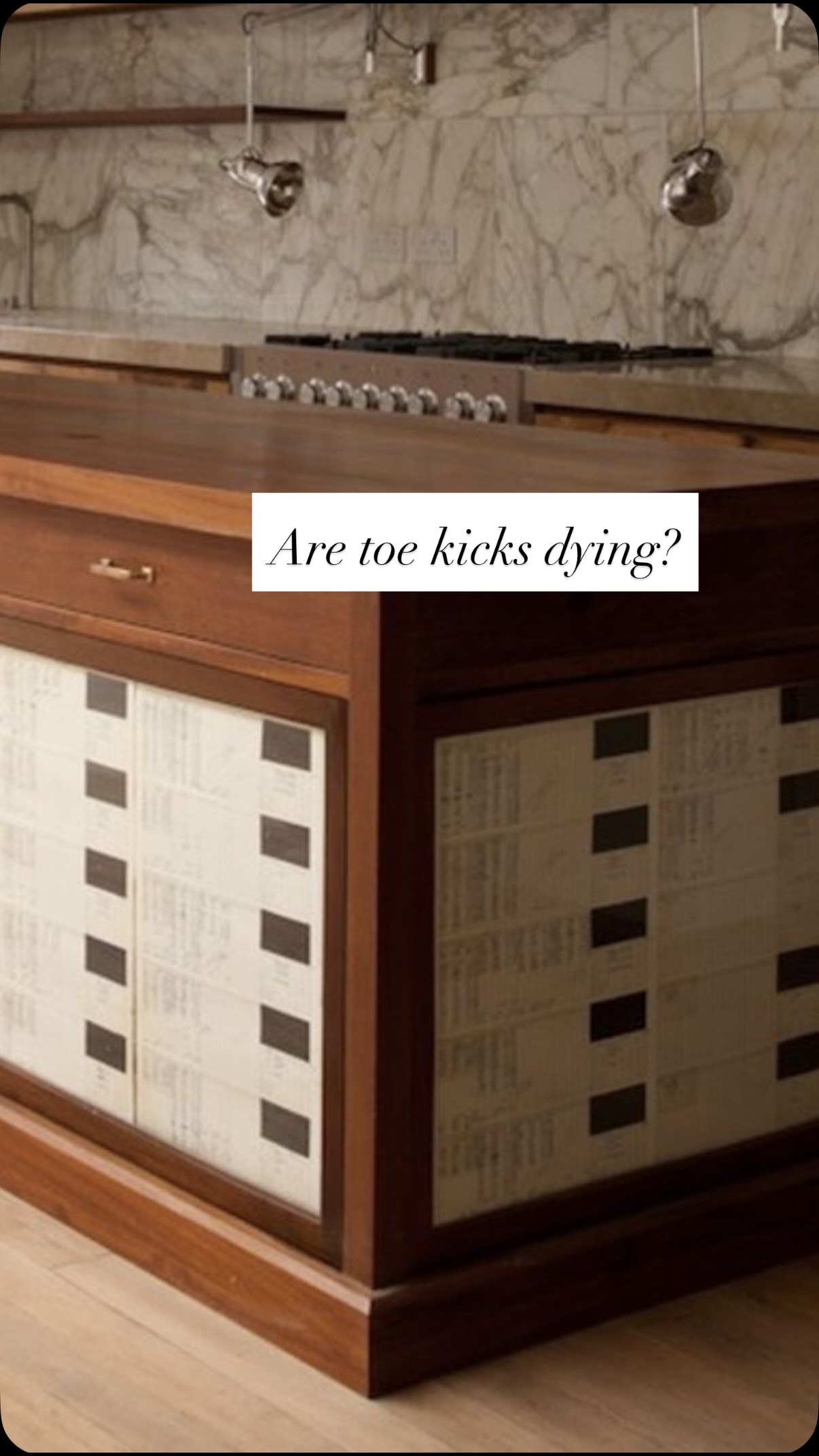
Toe kicks dying? Because this weekend thinks that I'm questioning as a designer, I'm questioning toe kicks. I understand why we have them. That little recess at the bottom lets you stand closer to your counter without your toes hitting the cabinet. Very practical. But aesthetically, I think they're really ugly. There is something in my brain that immediately good, okay. But if I take the cabinet all the way to the floor, obviously, I'm gonna stub my toe. But am I really? I have never stubbed my toe on a washing machine. I'm not regularly walking full speed into a bookshelf. I have set my toe on my bed frame, but it was pitch black in the middle of the night, so I feel like that doesn't count. But the reason I'm starting to question it is because we're making cabinetry look more and more like furniture, especially islands. I want an island to look like one giant beautiful piece of furniture. But when we carve that little recess out at the better, my brain immediately goes cabinet. So now as I think about my new future kitchen, I'm thinking maybe no toe kicks. Have we all just been brainwashed by big cabinetry? I genuinely do not know. What are your thoughts?