@theminimalists
Instagram · Clip
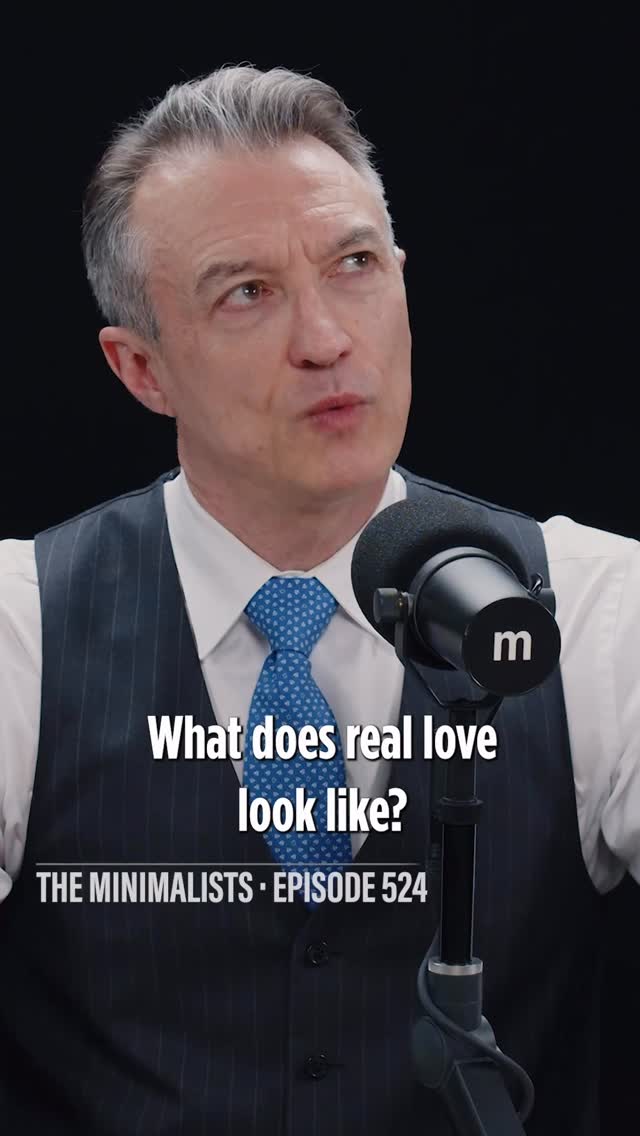
@theminimalists What does real love look like to you?

@theminimalists
Instagram · Clip
@theminimalists What does real love look like to you?
Performance
Video #16903 · Clip
[01]
The speaker poses the question 'What does real love look like?' and answers it by recounting a conversation with a friend. He uses an analogy comparing his friend's willingness to sell a $5,000 watch for $10,000 versus his unwillingness to sell his beloved cat for any amount of money to illustrate that real love is priceless and non-transactional.
[02]
[03]
 525.1K21.7×Monologue contrasting true vs selfish love@jrp.co · Anecdotal Philosophy
 1.2M35.6×Philosophical quote breakdown on love@thejaunt_ · Anecdotal Philosophy
 1.2M88.7×Speaker defines love through actions@jrp.co · Vulnerable Monologue
 63.3KCar monologue on friendship philosophy@higherupwellness · Vulnerable Monologue
 1.9M28.9×Creator's year-end love lessons listicle@prestonrack · Breakdown
 1.6M17.4×Podcast clip about relationship validation@nycdivorcelawyer · Anecdotal Philosophy
 854.3KRant about why nothing is worth the price@fmsmith319 · Cultural Rant
 893.9K9.5×Explaining value of unprompted affection@nycdivorcelawyer · Anecdotal Philosophy
 1.7M24.5×Man explains why marriage should end in death@jackhneel · Vulnerable Monologue
 320.2K7.5×Expert explains why love is essential@aspirewithemmagrede · Breakdown5.2M379.7×Monologue on choosing a partner@jrp.co · Vulnerable Monologue
 7.6M564.1×Passionate monologue on dating reality@jrp.co · Vulnerable Monologue
[04]
[05]
What stops the scroll in the first 3 seconds
Title hook · 50%
What does real love look like?
Verbal hook · 45%
What does real love look like?
Visual hook · 5%
A professionally lit medium close-up of a speaker in a studio setting, addressing the camera directly with a high-quality microphone in the foreground.
[07]
The promise the opener makes, and how the video pays it back
Hook
A direct, philosophical question that taps into a universal human experience, immediately engaging the viewer's curiosity.
Payoff
The narrative cuts off, leaving the audience to complete the logical sequence. The payoff is the viewer's own 'aha' moment, where they conclude that 'real love' is defined by its non-transactional, priceless nature, making the message feel like a personal realization rather than a delivered statement.
[08]
The structural pattern this video runs on
Framework
The Priceless Analogy
To define an abstract concept by creating a narrative that contrasts a valuable but ultimately transactional object with a truly priceless one, guiding the audience to the conclusion that the abstract concept's value is infinite.
The Grounding Anecdote
Frames the abstract topic within a personal, relatable story (a conversation with a friend) to make the exploration feel authentic and less like a lecture.
The Tangible Proxy
Introduces a concrete, high-value object (a watch) that will serve as a measurable baseline for the concept of 'value'.
The Sentimental Value Probe
Tests the object against its market value. The initial refusal to sell establishes that its worth transcends mere monetary value, adding a layer of sentiment.
The Transactional Threshold
Escalates the offer for the object until a price is met, establishing a critical point: despite sentiment, the object has a finite, transactional limit. It can be bought.
The Invaluable Pivot (Cliffhanger)
Begins to apply the same transactional logic to the second subject (the pet, which represents love), creating a stark contrast and forcing the audience to anticipate the inevitable conclusion that some things are truly priceless.
What does real love look like to you?
title · beginning
What does real love look like?
branding · throughout
THE MINIMALISTS • EPISODE 524
What does real love look like? And I was talking to a friend the other day because this question came up. Like, I have weird conversations with my friends. And I imagine you guys do too. And, he said something about, like, well, what do you think real love looks like? And he has a cat. He has a really lovely cat named Delilah. And I know he loves Delilah. Like, most people who have pets love their pets. I have two dogs. I love them, like, in a just insane way. And I said to him, well and he has a watch. He's a nice watch. So, like, I think someone bought it for him. It's a lovely watch. And I said to him, well, here's here's how I define love. How much is your did you pay for your watch? And he says, oh, it's like a $5,000 watch. And I said, okay. If I said I'll give you $5,000 for that watch, would you give me your watch? And he said, no, because it's, you know, it was like I've had it, and I have a sentimental attachment to it. I said, okay. If I said I'll give you $10,000 for your watch, would you give it to me? I said, yeah, absolutely. Dollars 10,000? Like, I'll I'll give you this watch. I said, okay, great. How much if I said