Viral Hooks
Trending short videosExplains science behind metal cube
C

@craighillcompany

Instagram · Talking Head Edit

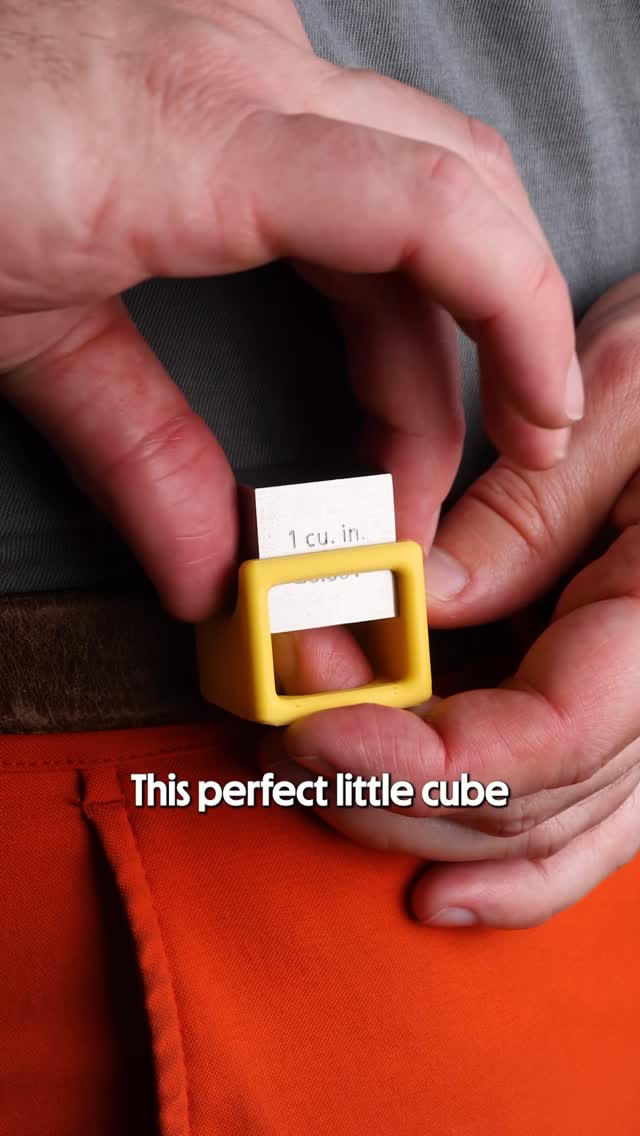
@craighillcompany Extremely good at doing nothing. In our effort to make the most precise and stable pocket-sized scale figure on Earth, we decided to use Invar. Invar is a Noble Prize-winning alloy known for having an exceptionally low coefficient of thermal expansion. When exposed to great changes in temperature, the material hardly expands or contracts. Machined into a cube with tolerances 1/4 the thickness of a sheet of paper, the Invar Cubic Inch is the most dimensionally stable and indisputably precise object we have ever held. It's our scale figure of choice when we're photographing samples, references, and final products. We made it years ago to satisfy our impractical, but uncontrollable, desire for precision in-studio. Now, we are bringing it back in a limited run for everyone to enjoy. Invar Cubic Inch for scale. (Thank you @this_kebun for modeling and printing Hunter's cubic inch holster. This does not come included with the product, but I'm sure Kevin would share the files if you wanted them.)

View original on Instagram

The edit1 shot · 2 text
Shots Text2:26

Performance

Views
4.2M
Likes
105.1K
Comments
982
Engagement
2.5%
Length · 10 Jul 2025
2:26

Video #19408 · Talking Head Edit

Explains science behind metal cubefrom @craighillcompany

[01]

Overview

The creator introduces a precision Invar cube, using a bridge's expansion joint to explain the concept of thermal expansion. He contrasts the stable Invar alloy with common coins that expand with heat, demonstrating why the cube is the perfect scale reference for photography, before showcasing the product and a 3D-printed holster.

[02]

Simple outline

  1. 1State paradoxical hook
  2. 2Explain principle via macro analogy
  3. 3Reveal flaw in common alternative
  4. 4Introduce scientifically perfect solution
  5. 5Demonstrate practical application

[03]

Related videos

[04]

Classification

Concepts
BreakdownProduct Showcase
Elements
B-Roll CutawayMacro Photography

[05]

Hook analysis

What stops the scroll in the first 3 seconds

Title hook · 45%

This perfect little cube

Verbal hook · 50%

This perfect little cube is machined out of a special alloy that makes it extremely good at doing nothing because doing nothing is exactly what we wanted it to do.

Visual hook · 5%

Close-up shot of a creator holding a precise, metallic cube against a yellow 3D-printed holster, creating immediate curiosity about the object.

[07]

Hook and payoff

The promise the opener makes, and how the video pays it back

Hook

The Paradoxical Claim: Introduces the object with a counter-intuitive feature (e.g., 'good at doing nothing') to create immediate curiosity.

Payoff

The Eccentric Commitment: Ends with a display of extreme dedication (e.g., a custom holster), cementing the creator's authority and passion.

[08]

Narrative framework

The structural pattern this video runs on

Framework

The Scientific Justification Arc

Validating a niche obsession by connecting a simple object to a complex, universal scientific principle.

  1. 1

    The Macro Analogy

    Explains the underlying scientific or mechanical problem using a massive, undeniable real-world example (e.g., a bridge) to establish stakes.

  2. 2

    The Micro Translation

    Scales the problem down to everyday objects, revealing a hidden flaw in common tools (e.g., coins) that the audience takes for granted.

  3. 3

    The Hero Material Reveal

    Introduces the subject not just as a product, but as a material science solution that defies the previously established flaw.

  4. 4

    The Quantitative Proof

    Validates the solution with specific data points or comparative metrics (e.g., '10-15x less expansion') to move from opinion to fact.

  5. 5

    The Ritual Demonstration

    Shows the object being used in its specific, high-utility context, proving its value beyond just being a novelty.

Themes

  • Precision
  • Science in everyday objects
  • Material properties
  • Photography tools

Techniques

  • Analogy (Bridge)
  • Comparison (Coin vs Cube)
  • Macro shots
  • Location context

Trends

  • Educational deep dives
  • Niche product showcases

Post caption

Extremely good at doing nothing. In our effort to make the most precise and stable pocket-sized scale figure on Earth, we decided to use Invar. Invar is a Noble Prize-winning alloy known for having an exceptionally low coefficient of thermal expansion. When exposed to great changes in temperature, the material hardly expands or contracts. Machined into a cube with tolerances 1/4 the thickness of a sheet of paper, the Invar Cubic Inch is the most dimensionally stable and indisputably precise object we have ever held. It's our scale figure of choice when we're photographing samples, references, and final products. We made it years ago to satisfy our impractical, but uncontrollable, desire for precision in-studio. Now, we are bringing it back in a limited run for everyone to enjoy. Invar Cubic Inch for scale. (Thank you @this_kebun for modeling and printing Hunter's cubic inch holster. This does not come included with the product, but I'm sure Kevin would share the files if you wanted them.)

Text overlays

  • title · beginning

    This perfect little cube

  • informational · middle

    1 cu. in. +/- 0.001"

Transcript

This perfect little cube is machined out of a special alloy that makes it extremely good at doing nothing because doing nothing is exactly what we wanted it to do. So if you look down at my feet, you'll see that something, not nothing, is happening. This gap of the bridge is called expansion joint. This bridge is made of steel and concrete, which are materials that will grow and shrink depending on the temperature. And this gap allows for that movement of those materials to happen without the bridge tearing itself apart or buckling into itself. But there are some instances, in some cases, where you don't want the material to grow or shrink at all. Scale figures are used by scientists and architects and painters to help you understand how large an object is. Because I'm standing on this bridge, you get some relative sense for the scale and overall size of this bridge. Better for smaller objects, like the ones that we design and collect, we need a smaller and more precise scale figure. The most obvious and commonly used item is a coin, but this coin has the exact same problem as better bridge up there bad thermal expansion. If you were to increase the temperature of this quarter by about a 100 degrees, you would actually grow the size of it by about point 2%. That means when I take a photo of an object with a better next to it, and I don't know what the temperature in the room was, how large is that quarter? Yes, we know 100% that we are insane people, but if we were good go through the effort of making our own reference objects, we wanted that object to be as consistent and perfect as it possibly could be. There was only one choice for what material to use, which is the most dimensionally stable alloy known to man, which is inbar, has an extremely low coefficient of thermal expansion. Over the same temperature change, Invar will experience 10 to 15 times less expansion or contraction as copper, for example. It'll be as close to a perfect scale figure as we could ever need or want. In perpetuity, whenever I am documenting image. Rank, yes, we did three d print a holster for it because you never know when you're gonna need to take your perfect scale figure out into the world with you. Good do I have an appreciation and affection for an inch.

Explains science behind metal cube | Viral Hooks