@shwinnabegobrand
Instagram · Greenscreen Talking Head
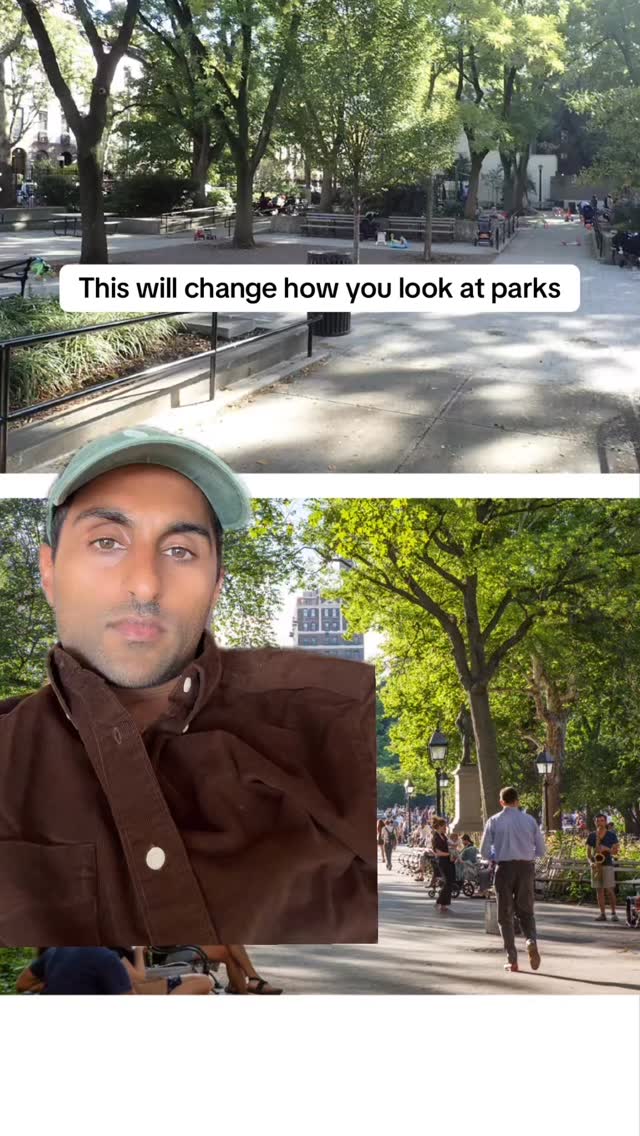
@shwinnabegobrand Mansplaining parks

@shwinnabegobrand
Instagram · Greenscreen Talking Head
@shwinnabegobrand Mansplaining parks
Performance
Video #2131 · Greenscreen Talking Head
[01]
The creator recounts a dinner conversation about parks, then uses this anecdote to launch into an explanation of Jane Jacobs' two key principles for successful urban parks. He uses Washington Square Park as a case study, illustrating the importance of diverse borders and multiple internal uses with maps and image screenshots to support his points.
[02]
[03]
 179K9.8×Text-narrated vlog about art philosophy@isaacfrench_ · Anecdotal Philosophy
 999K64.3×Walking tour of sustainable neighborhood@isaacfrench_ · Location Showcase
 1.4M83.8×Greenscreen history of useless lawns@zephzoid · Advocacy Explainer
 73.8K1.7×Explaining a neighborhood's controversial name@lovecertt · Origin Story
 103.3KDesigner lists water feature ideas@hansloreidesign · Buying List
 90.9K1.3×Asking San Diegans about parking@sandiegotalks · Question Montage
 2.4M3.9×Using AI to uncover city secrets@wacomo · Strange but True
 103.6KShowcasing 11 personal home details@hansloreidesign · Rapid Fire Listicle
 3.7M235.1×Walking tour of magical neighborhood@isaacfrench_ · Location Showcase
 1.5MComedic skit about city design@aka__vinnie · Skit
 271.9K885.6×Architect critiques modern city buildings@mwmoedinger1 · Breakdown
 1.9M114.9×Creator shows backyard office commute@isaacfrench_ · Lifestyle Showcase
[04]
[05]
What stops the scroll in the first 3 seconds
Title hook · 55%
This will change how you look at parks
Verbal hook · 40%
No I'm out to dinner the other night, and this topic of parks and urban spaces comes up.
Visual hook · 5%
A split-screen composition showing a wide shot of a park path on top and the creator's face layered over a different, busier park scene on the bottom.
[06]
Steal this for your own video
I was at when came up — and it completely changed how I see .
[07]
The promise the opener makes, and how the video pays it back
Hook
A bold, text-on-screen claim that promises to fundamentally change the viewer's perspective on a familiar subject.
Payoff
A final, concise summary of the framework that empowers the viewer with a new, expert-backed lens for judgment, followed by a personality-driven, ironic outro.
[08]
The structural pattern this video runs on
Framework
The Expert Deconstruction
Explaining the hidden 'rules' or criteria that separate 'good' from 'bad' in a common category, using an external authority to validate the framework and visual evidence to prove each point.
The Relatable Anecdote
Frames the topic within a common, everyday social interaction (e.g., a dinner conversation) to establish relatability and introduce the core problem.
The Knowledge Drop
Asserts that there is a hidden, non-obvious system or set of rules governing the topic, positioning the creator as an insider with valuable information.
The Authority Citation
References a credible external source (a book, study, expert) to legitimize the creator's framework and elevate it from personal opinion to informed analysis.
The Rule Deconstruction Loop
Systematically presents and proves each rule in the framework using a repeating micro-pattern. This is done for two distinct rules in the video.
The Negative Counterpoint
Briefly describes the opposite of the 'good' example to reinforce the value and importance of the presented criteria.
The Conclusive Summary
Restates the core rules in a concise final takeaway, solidifying the lesson for the viewer.
Mansplaining parks
title · beginning
This will change how you look at parks
No I'm out to dinner the other night, and this topic of parks and urban spaces comes up. And we're kind of talking about why this, like, one park sucks. And I was like, hey, there's actually rules to what makes good parks versus bad parks. And I told them and they're like, wow, that's really interesting. And as someone is who loves a good park, I will tell you too. Now the tenants of what makes a good versus bad park can be understood from this phenomenal good. And there's two main things that allow for a good park. Worst is good borders. And one of the things that Jane says is that the borders of a park, what surrounds it better the worst. Because when you have a diversity of activity, you have residential buildings, you have dorm rooms, You've got delis and restaurants. A handful of office buildings. That diversity of activity draws in a variety of different people at all points and times of the day. Which means as a result, you just have tons of different people and ages walking through this park all day. So a good park is almost a byproduct of what surrounds the rank, number one. Number two, a good park cannot be single yes, meaning tier has to be a number of different reasons why people are drawn to this park. Washington Square Rank, for example, they've got a playground, so they bring parents and children. They've got a nice fountain that you can kinda sit and hang out, bunch of places to sit, lawns that you can lay on, bunch of little vendors you can buy stuff from. You can even get your ass whipped in best. Where some other parks, they might just have a playground, a single use activity that only draws in one type of person. So borders and a diversity of activity, any diversity of use cases make for a good park. And if you like this, you probably won't find any other content on my page about this.