@glass__museum
TikTok · Speaker address
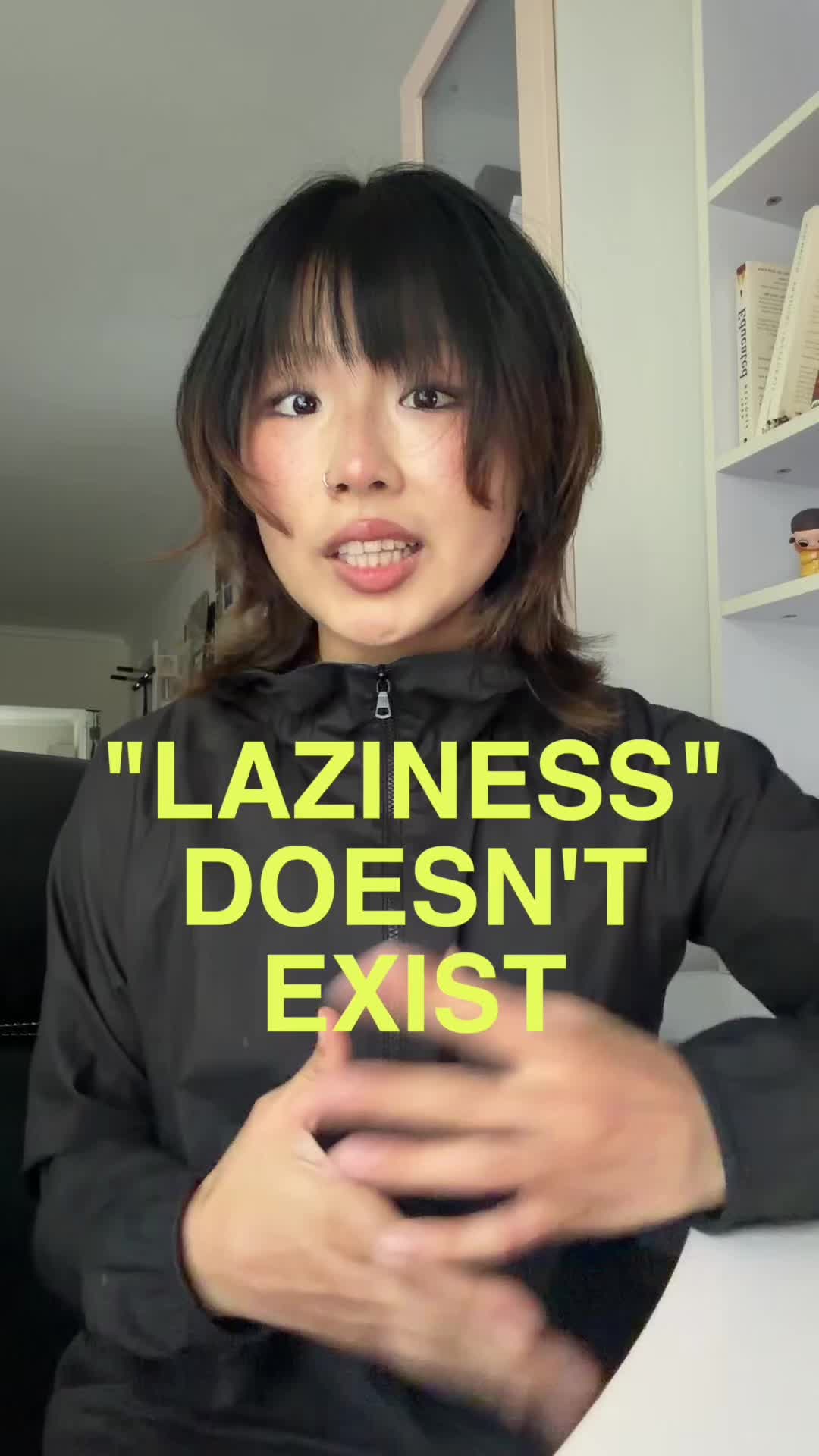
@glass__museum On productivity, the Protestant work ethic, meritocracy, and auto-exploitation #productivity #philosophy #politics #neoliberalism #hustleculture

@glass__museum
TikTok · Speaker address
@glass__museum On productivity, the Protestant work ethic, meritocracy, and auto-exploitation #productivity #philosophy #politics #neoliberalism #hustleculture
Performance
Video #33092 · Speaker address
[01]
The creator delivers a video essay arguing that 'laziness' is a social construct. She begins by defining the 'Laziness Lie,' then traces its origins to the Protestant work ethic and its role in justifying slavery in Colonial America. She connects this history to modern neoliberal ideas like meritocracy and 'auto-exploitation,' using book excerpts, historical context, and philosophical concepts to argue that tying human worth to productivity is harmful and distracts from systemic issues.
[02]
[03]
 217.8K3.3×Creator critiques leftist ideological arguments@womp_tomp · Cultural Rant
 493.7K60.2×Monologue comparing work to slavery@holistic.grenade · Hot Take
 158.5K2.4×Explaining ADHD rise with philosophy@glass__museum · Breakdown
 354.9K6.3×Explaining a controversial societal theory@womp_tomp · Hot Take
 722.6K9.9×Explaining literacy crisis through philosophy@glass__museum · Breakdown
 84K1.4×Philosophical argument against pursuing happiness@glass__museum · Breakdown
 71.1K3.9×Creator critiques optimization culture's effects@pleasedontmakemefocus · Breakdown
 189.9KExplaining the modern work crisis@yourbrain_onmoney · Breakdown
 313.2K95.6×Explaining friction as a status symbol@ashi.branding
 139.4K4.4×Splitscreen political argument breakdown@womp_tomp · Reaction
 672.8K9.3×Sociology theory explained with B-roll@maisonrickie · Breakdown
 247.5K7.4×Split-screen satirical political commentary@womp_tomp · Satirical Advice
[04]
[05]
What stops the scroll in the first 3 seconds
Title hook · 55%
"LAZINESS" DOESN'T EXIST
Verbal hook · 40%
Laziness doesn't exist.
Visual hook · 5%
A medium close-up of the speaker addressing the camera directly with expressive hand gestures, creating an immediate sense of a direct, personal lecture.
[06]
Steal this for your own video
"" DOESN'T EXIST
[07]
The promise the opener makes, and how the video pays it back
Hook
A bold, contrarian statement that challenges a deeply ingrained societal norm or belief, creating immediate intrigue and a desire to see the claim proven.
Payoff
A philosophical reframing that offers an alternative, healthier worldview. It concludes with a call to action, not for a specific task, but for a fundamental shift in perspective, empowering the viewer to reject the harmful belief.
[08]
The structural pattern this video runs on
Framework
The Deconstructive Thesis
To deconstruct a commonly held belief by tracing its historical origins, revealing its harmful modern applications, and offering a new, empowering perspective.
The Societal Scapegoat
Frame the problem by showing how the conventional belief is used as a simplistic and harmful explanation for complex societal issues, establishing the stakes of the argument.
The Expert Witness
Introduce an authoritative source (a book, study, or expert) to lend credibility to the contrarian thesis and formally define the 'lie' being deconstructed.
The Historical Origin Story
Trace the belief back to a specific, often surprising, historical root, reframing it not as a universal truth but as a cultural construct with a clear beginning.
The Moral Indictment
Connect the historical belief to a major, morally unambiguous injustice, thereby framing the belief itself as a tool of oppression and adding emotional and ethical weight to the argument.
The Modern Mutation
Demonstrate how the original historical idea has evolved and 'reinvented itself' to fit the contemporary socio-economic landscape, making the argument directly relevant to the viewer's life.
The Internalized Oppression
Explain how individuals have internalized this belief, leading to self-policing, guilt, and psychological harm, turning a systemic issue into a personal struggle the viewer can relate to.
On productivity, the Protestant work ethic, meritocracy, and auto-exploitation #productivity #philosophy #politics #neoliberalism #hustleculture
title · beginning
"LAZINESS" DOESN'T EXIST
contextual · middle
(Price, 18)
contextual · middle
(Price, 26)
title · middle
evil doesn't die it reinvents itself
title · middle
BOOTSTRAPS
contextual · end
(Psychopolitics, 2)
contextual · end
(Psychopolitics, 7)
Laziness doesn't exist. For some reason, being lazy is one of the worst things people rank be according to society. Whether it's academic failure, addiction, homelessness, any and all social ill in a neoliberal society is explained by laziness. But the way we talk about laziness is less of a description of human behavior than it is a label we use to judge real's moral character and ultimately inform our notions of human worth. In his book Laziness Does Not Exist, author and psychologist Devon Price writes about the laziness lie. That is, the idea that productivity determines a person's worth, that our needs and limitations are obstacles to be overcome, and that there is always more work that we should be doing. But in order to understand how we got to this point, we need to first examine the origins of our modern obsessional productivity, which lies, like the majority of Better traditions, in religion, particularly the infamous Protestant work ethic. Basically, when the Puritans first arrived to The United States in the seventeenth century, they brought with them the idea that if a person was a hard worker, it was a sign from God that they were chosen for salvation. And if they weren't, then it was a sign that they had already been damned. So of course, this meant that people who struggled weren't seen as deserving help or understanding since their inability to succeed was seen as proof that they lacked God's favor. I wonder what else is going on in The States at this time that would coincidentally politically benefit from the convenience of this divine message from Good? Slavery. It's it's slavery. Colonial America was built on the labor of enslaved people. And while this made the colonies hella rich, the enslaved people obviously had nothing to gain from it. So what better motivation to get these people to work harder than to tell them that suffering was morally righteous and that they would be rewarded in heaven for being docile, agreeable, and most importantly, diligent. And it's also totally not a coincidence that enslavers feared leisure in the event that idle time would give them means to revolt. Throughout history, accusations of laziness have continuously redirected attention away from structural inequality and towards supposed deficiencies in marginalized populations. But evil doesn't disappear, it simply reinvents itself. And so we see the same idea present in our contemporary neoliberal system's idea of meritocracy. Modern culture is saturated with stories of successful self made white guys that reinforce the idea that actually we can't pull ourselves up by our own bootstraps as long as the bootstraps are made of generational wealth. But this belief in meritocracy is not only misplaced, it's harmful. If you believe that people are homeless because they're lazy, then we don't need to address housing shortages or wealth disparity. If we believe that addiction is a result of a lack of discipline, then we don't need policy reform or mental health support. And this doesn't just affect how we view others. If you've ever felt pressured to put protein in something that Good never intended to be proteinist, if you've ever felt shame for wasting your time, then you've experienced what philosopher, Biyom Chol Rank, calls auto exploitation. He writes that under neoliberalism, we willingly exploit ourselves without our master and thus become an absolute slave. Worse work nine to five and then we spend our five to nines trying to figure out how to optimize our leisure to yield maximum output. We take hobbies that bring us joy and then ruin them by trying to monetize or scale them and most insidiously, this auto exploitation makes it so that tier exploited are not inclined to revolution so much as depression. Indeed, this neoliberal self undermines the possibility of collective resistance as we direct our frustration inwards towards shame rather than outwards towards structural injustice. At the end of the day, rest is an essential part of being alive. Alive. It's in a yang, bro. Seasons change. Night falls. Leisure is integral to the human experience. People wonder why the birth rates are declining. Meanwhile, when the fuck are people finding the time to fuck if people are working all the tier? Like, motherfuckers really gotta calculate if that pussy got a good ROI. And ultimately, it's not enough to simply advocate for working less. Less. Instead, we need to question the assumption that human worth is tied to productivity in the first place. Your ability to exist shouldn't be contingent upon your ability to produce shareholder value.