Viral Hooks
Trending short videosExplaining beauty standards as class signals
A

@ashi.branding

Instagram · Talking Head Edit

@ashi.branding Our face has become a bigger class marker than any other beauty choice. Today, the aspirational face is one that looks “untouched” while requiring more invasive work than before. Celebrities are repositioning these procedures as feminism tools for empowerment and progress. This isn’t new, taboo procedures have always relied on powerful women normalizing them and making them desirable. The problem is that today that loop is starting earlier: injectables for teenagers grew 75% in 4 years, which makes sense for a generation raised on AI and editing tools showing them what the “perfect” face should look like. So what kind of face do you think is a status symbol? #beauty #botox #culture #marketing #genz

View original on Instagram

The edit1 shot · 8 text
Shots Text1:15

Performance

Views
167K
Likes
4.7K
Comments
87
Engagement
2.9%
Outlier
38.5×
Length · 15 Jul 2026
1:15

Video #36836 · Talking Head Edit

Explaining beauty standards as class signalsfrom @ashi.branding

[01]

Overview

The creator analyzes how faces have become class signals, referencing a New Yorker article to explain the evolution of aspirational beauty standards. She contrasts the overt 'Instagram Face' of the 2010s with the current 'untouched' look, providing historical context from the 1920s and 2010s to show a pattern of powerful women normalizing procedures through empowerment language. The creator connects this to the 'quiet luxury' concept, where the elite shift from visible to invisible (and more expensive) work once a trend is democratized, and concludes by noting this cycle is accelerating with teenagers.

[02]

Simple outline

  1. 1State provocative thesis
  2. 2Contrast past vs. present
  3. 3Provide historical proof
  4. 4Reveal the underlying pattern
  5. 5End with an open question

[03]

Related videos

[04]

Classification

Concepts
BreakdownEvolution ShowcaseHeadlines
Elements
B-Roll CutawayImage OverlayScreenshot as Evidence

[05]

Hook analysis

What stops the scroll in the first 3 seconds

Title hook · 55%

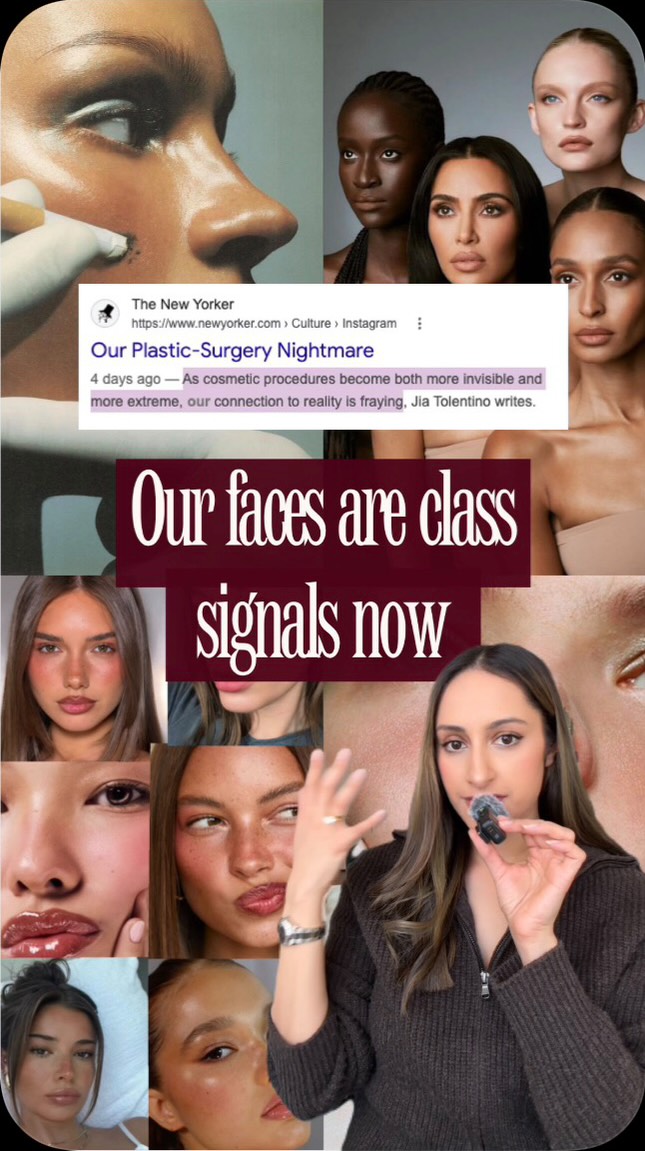
Our faces are class signals now

Verbal hook · 40%

Our faces have officially become class signals.

Visual hook · 5%

A dense visual collage featuring a close-up of a cosmetic procedure, a screenshot of a New Yorker article titled 'Our Plastic-Surgery Nightmare', and a group photo of diverse models and celebrities.

[06]

Hook template

Steal this for your own video

[Everyday thing] are [provocative class/status reframe] now.

  • — Your groceries are a class signal now.
  • — Your gym routine is a status signal now.
  • — Your living room is a wealth signal now.

[07]

Hook and payoff

The promise the opener makes, and how the video pays it back

Hook

A bold, declarative thesis statement that reframes a common observation as a significant societal signal.

Payoff

An open-ended, forward-looking question that challenges the audience to speculate on the next phase of the cycle, directly prompting comments and engagement.

[08]

Narrative framework

The structural pattern this video runs on

Framework

The Cultural Pattern Reveal

To deconstruct a contemporary cultural trend by establishing a provocative thesis, proving it with a 'then vs. now' comparison, validating it with historical precedents, and revealing the underlying cyclical pattern to create an 'aha' moment for the viewer.

  1. 1

    The Then/Now Contrast

    Establishes the core argument by contrasting a well-understood past version of a trend with its more complex and subtle present-day iteration. This grounds the thesis in a relatable example.

  2. 2

    The Ideological Framing

    Identifies and critiques the contemporary language or justification used to promote the trend, often highlighting a disconnect between the marketing (e.g., 'empowerment') and the reality.

  3. 3

    The Historical Echo

    Validates the central argument by presenting historical examples that follow the same pattern. This proves the trend is not new but a recurring cycle, lending the analysis depth and authority.

  4. 4

    The Cycle Codified

    Explicitly articulates the repeating formula or pattern that governs the trend's lifecycle (e.g., elite adoption -> normalization -> mass adoption).

  5. 5

    The Elite Pivot

    Explains the final stage of the cycle, where the trend becomes mainstream, forcing the elite to pivot to a new, more inaccessible or 'invisible' signal to maintain distinction.

  6. 6

    The Urgent Escalation

    Raises the stakes by revealing how the current iteration of the cycle is accelerating or impacting a more vulnerable demographic, making the issue feel immediate and concerning.

Themes

  • Social class
  • Commodification of the body
  • Feminism
  • Consumer culture
  • Quiet luxury

Techniques

  • Historical analysis
  • Cultural commentary
  • Visual evidence
  • Trend deconstruction

Trends

  • Video essay
  • Cultural analysis
  • Quiet luxury

Post caption

Our face has become a bigger class marker than any other beauty choice. Today, the aspirational face is one that looks “untouched” while requiring more invasive work than before. Celebrities are repositioning these procedures as feminism tools for empowerment and progress. This isn’t new, taboo procedures have always relied on powerful women normalizing them and making them desirable. The problem is that today that loop is starting earlier: injectables for teenagers grew 75% in 4 years, which makes sense for a generation raised on AI and editing tools showing them what the “perfect” face should look like. So what kind of face do you think is a status symbol? #beauty #botox #culture #marketing #genz

Text overlays

  • title · beginning

    Our faces are class signals now

  • contextual · beginning

    Our faces have officially become class signals.

  • contextual · beginning

    the most aspirational faces looked like this and it was called Instagram Face:

  • contextual · middle

    Today, the most aspirational face is one that looks 'untouched' while still requiring more invasive work than before.

  • informational · middle

    In the 1920s, Suzanne Noel explicitly framed the facelift as a feminist tool *for Women to tackle ageism,

  • contextual · end

    the elite move on from the visible codes to the invisible codes of wealth.

  • informational · end

    Injectables for teenagers grew 75% in four years.

  • contextual · end

    So the question is what part of the female body gets commoditised next?

Transcript

Our faces have officially become class signals. I saw this viral New Yorker article talking about how the aspirational face has evolved over the last decade. Ten years ago, the most aspirational faces looked like this, and it was called Instagram rank. Visible Botox and fillers to give a highly contoured appearance. Today, the most aspirational face is one that looks untouched while still requiring more invasive work than before. Celebrities like Kylie and Kris Jenner are repositioning these procedures as tools for female empowerment, and this isn't new. Injectables have always relied on powerful women normalizing them. In the nineteen twenties, Suzanne Noel explicitly framed the face lift as a feminist tool to tackle ageism, work longer, and maintain their financial independence. Tier twenty ten's rappers popularized BBLs reframed as investments and under the illusion of body positivity, and each aesthetic follows the same pattern. Powerful women normalize it through the language of empowerment. It becomes aspirational, gets democratized, and when it does, the elite move on from the visible codes to the invisible codes of wealth. Because while noticeable work requires money, inconspicuous work requires money and access. Today, the loop is starting earlier. Injectables for teenagers grew 75% in four years. So the question is what part of the female body gets commoditized next?