@mirandadoesbrands Fresh food is becoming the new aesthetic of aspiration as a result of grocery prices becoming so high, but the rise of the fresh food aesthetic reminded me of the junk food aesthetic that was popularised in the 2010s.
The aesthetic of aspiration is always shaped by how the economy is performing. In the 2010s, junk food felt ironic because the economy was doing well. In the 2020s, groceries have got so expensive that the ability to eat fresh produce and make wholesome home cooked meals is genuinely a status symbol, and brands are using the grocery aesthetic as a way to align themselves with a desirable lifestyle.
Explaining food as a status symbolfrom @mirandadoesbrands
[01]
Overview
The creator presents a thesis that fresh food has become the new status symbol due to high grocery prices, contrasting this with the 2010s trend of celebrities and fashion brands glorifying junk food. She supports her argument by showing examples from fashion (Moschino, Loewe), celebrity photoshoots (Hailey Bieber), and economic data (rising prices, theft), concluding that aspirational aesthetics are a direct reflection of the economy's performance.
Fresh food is now so expensive, it's become a status symbol.
Visual hook · 15%
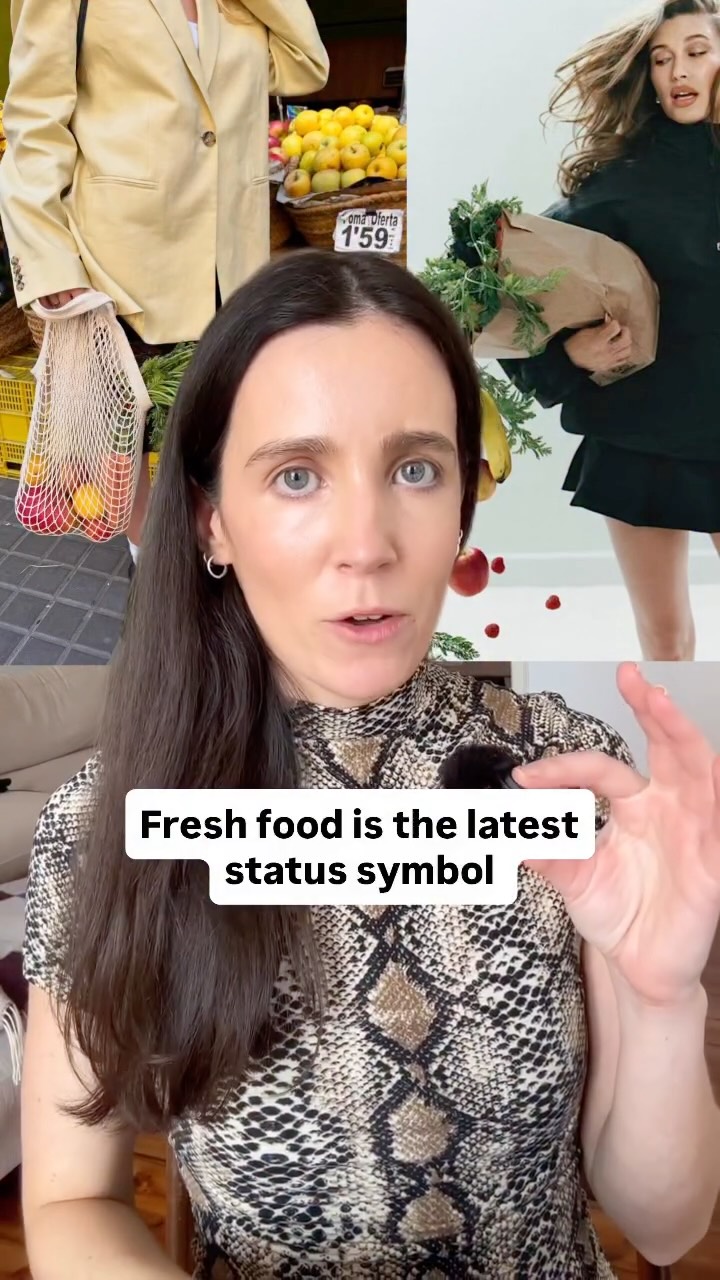
A split-screen composition showing two stylish women (one being Hailey Bieber) holding bags of fresh groceries, with the speaker positioned in the center, immediately establishing the video's theme of fashion meeting food.
[06]
Hook template
Steal this for your own video
Fresh [everyday item] is now so expensive, it's become a [unexpected status symbol].
— Fresh groceries are now so expensive, they've become a luxury flex.
— A gym membership is now so exclusive, it's become a class signal.
— Tap water is now so marketed, it's become a lifestyle brand.
[07]
Hook and payoff
The promise the opener makes, and how the video pays it back
Hook
A bold, counter-intuitive declaration about a current trend, immediately supported by a shocking or high-value example to establish credibility and intrigue.
Payoff
The Unifying Theory: Broadens the scope from the specific examples to a universal, memorable rule that explains the relationship between the catalyst and the cultural trends. It concludes by symmetrically restating the 'then' vs. 'now' comparison through this new lens, providing a concise and intellectually satisfying takeaway.
[08]
Narrative framework
The structural pattern this video runs on
Framework
The Then-vs-Now Economic Lens
This framework establishes a surprising contemporary cultural trend, contrasts it with a memorable past trend, and then reveals the underlying socio-economic shift that explains the change, culminating in a universal rule.
1
The Current Exhibit
Provides multiple, visually distinct pieces of contemporary evidence (e.g., celebrity actions, luxury products) that prove the hook's claim is a real, observable phenomenon.
2
The Nostalgic Counterpoint
Pivots the narrative by asking a 'remember when...?' style question, introducing a familiar but opposing trend from the past. This creates a clear A-vs-B comparison.
3
The Past Rationale
Substantiates the counterpoint with visual evidence from the previous era and explains the psychological or cultural logic that made it popular at the time.
4
The Causal Pivot
Explicitly states the 'why' behind the shift from the past trend to the present one, identifying a specific, tangible catalyst (often economic or social) with a 'But now...' transition.
5
The Data Corroboration
Presents hard evidence (news headlines, data charts, statistics) to prove the catalyst is real and significant, anchoring the cultural theory in factual reality.
Themes
Consumerism
Economic indicators
Cultural trends
Aspiration
Luxury
Techniques
Juxtaposition
Trend analysis
Visual evidence
Trends
Aesthetic analysis
Economic commentary
Post caption
Fresh food is becoming the new aesthetic of aspiration as a result of grocery prices becoming so high, but the rise of the fresh food aesthetic reminded me of the junk food aesthetic that was popularised in the 2010s.
The aesthetic of aspiration is always shaped by how the economy is performing. In the 2010s, junk food felt ironic because the economy was doing well. In the 2020s, groceries have got so expensive that the ability to eat fresh produce and make wholesome home cooked meals is genuinely a status symbol, and brands are using the grocery aesthetic as a way to align themselves with a desirable lifestyle.
Text overlays
title · beginning
Fresh food is the latest status symbol
Transcript
Fresh food is now so expensive, it's become a status symbol. Moschino is selling a bag that looks like a pack of apples for over $2,000 And Hailey Bieber just did this photoshoot posing with fresh produce. But do you remember when all the it girls used to pose with big greasy pizzas and burgers? In 2014, Moschino even did a collaboration with McDonald's. At the time, junk food was a way for the elite to seem relatable, while at the same time flaunt that they could eat it without any consequence. But now with the cost of groceries being so high, in The US, tariffs mean that a standard food shop has now doubled. And things are so bad in The UK that supermarkets are losing billions to theft. When food has to be kept behind a security glass, fresh groceries become the latest aesthetic for brands to use to align themselves with luxury. And the aesthetics of aspiration are always a reflection of how the economy is performing. Junk food was playful and ironic when business was booming. Fresh groceries become aspirational when things are not so great.