Viral Hooks
Trending short videosCultural trend analysis with examples
T

@tatumbrandt

Instagram · Talking Head Edit

@tatumbrandt Let’s talk about the complicated world of aging and longevity 👇 For decades, beauty and wellness sold us “anti-aging.” Now the playbook has flipped: in a world where maximalist aesthetic work can be seen as low-status, aging well is the new luxury. We’re talking about a market worth $58 billion today and projected to hit $181 billion by 2034 Now the ironic thing here is that in celebrating old age the longevity industry is still celebrating aspects of youth in order to profit off an older generation, but so it goes in a capitalist economy folks. I digress. Longevity has become the cultural currency of 2025 (is that buzzwordy enough for you?) You have likely already noticed this in the world of fashion Where luxury houses like Loewe and Burberry casting women in their 80s as campaign stars, not as token gestures but as signals of heritage, resilience, enduring status. NOW in the world of wellness tech - Ōura markets its ring with the slogan “Give us the finger” casting real people over the age of 50 as the faces of modern health. We’ve gone from an era where health means “don’t get sick”, to meaning “upgrade yourself” in the era of longevity. In many ways, it’s the antithesis of the cosmetic wellness boom that defined the last several decades. There’s an excellent substack that speaks to this by Studio Koto - it’s “OFF.Brand” and the title is “Branding Longevity: the next health frontier” - def worth the read. But my point here is that we’re shifting from youth aesthetics as the status symbol (because this can be bought more easily today) to TIME. And having time, it seems, has never been more expensive. #wellnessbrand #brandstrategy #longevity #wellnesstech #marketingstrategy

View original on Instagram

The edit1 shot · 6 text
Shots Text

Performance

Views
250.4K
Likes
8.6K
Comments
232
Engagement
3.5%
Outlier
1.9×

Video #5440 · Talking Head Edit

Cultural trend analysis with examplesfrom @tatumbrandt

[01]

Overview

The creator analyzes the cultural shift where aging has become an aspirational status symbol. She explains how the 'longevity industry' has flipped the 'anti-aging' narrative, provides market data on its growth, and uses examples from luxury fashion (Loewe, Burberry) and wellness tech (Oura) to illustrate how brands are now marketing longevity as the ultimate luxury. She concludes that time, not youth, is the new, most expensive status symbol.

[02]

Simple outline

  1. 1Identify a cultural shift
  2. 2Reveal the economic engine
  3. 3Provide high-status proof
  4. 4Declare the new currency

[03]

Related videos

[04]

Classification

Concepts
Breakdown
Elements
Picture-in-PictureB-Roll CutawayText OverlayImage Overlay

[05]

Hook analysis

What stops the scroll in the first 3 seconds

Title hook · 35%

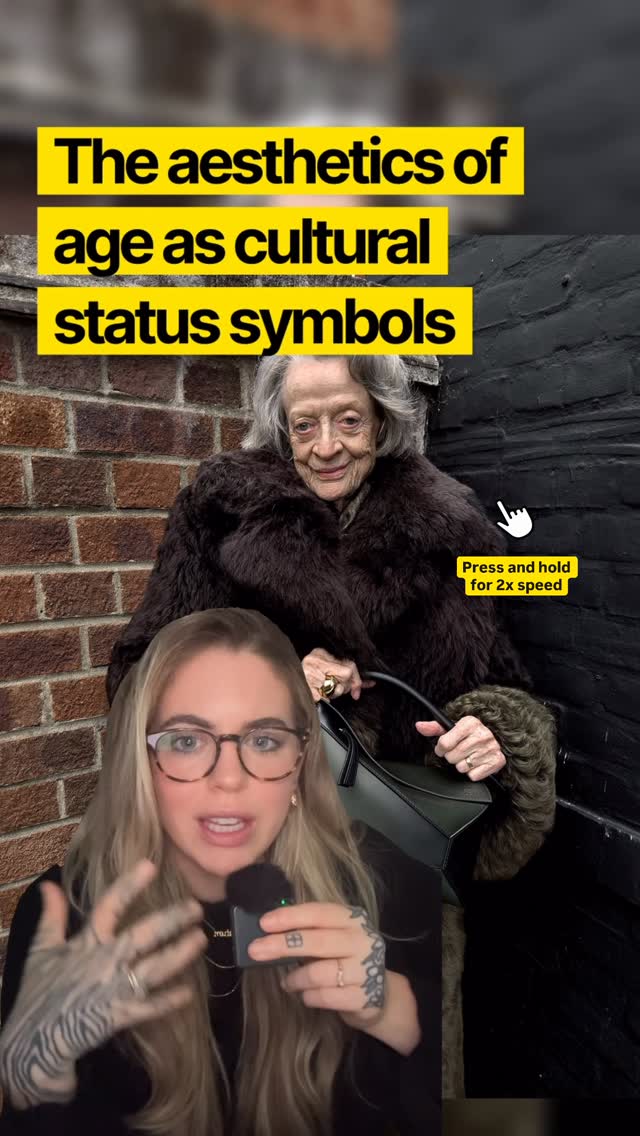
The aesthetics of age as cultural status symbols

Verbal hook · 50%

Okay. Have you noticed how aging is suddenly aspirational?

Visual hook · 15%

The video opens with the creator in a picture-in-picture overlay on top of a high-fashion, black and white photograph of an elegant, older woman, creating immediate visual contrast and intrigue.

[07]

Hook and payoff

The promise the opener makes, and how the video pays it back

Hook

A direct, counter-intuitive question that challenges a widely held belief about a cultural norm, immediately creating curiosity.

Payoff

A concise, powerful, and memorable final statement that reframes the new 'currency' as the most expensive and exclusive asset, leaving the viewer with a profound takeaway.

[08]

Narrative framework

The structural pattern this video runs on

Framework

The Cultural Currency Blueprint

To deconstruct a visible cultural trend by revealing the hidden economic forces and high-status players driving it, ultimately redefining a core societal value as a new form of luxury.

  1. 1

    The Counter-Intuitive Observation

    State a surprising new trend that contradicts the status quo, making the viewer question their assumptions.

  2. 2

    The Hidden Hand Reveal

    Name the specific industry or economic force responsible for manufacturing this trend, positioning the explanation as an insider's take.

  3. 3

    The Paradigm Shift

    Frame the trend as a fundamental flip from an old, outdated model to a new, aspirational one.

  4. 4

    The Scale of the Game

    Quantify the trend with large-scale financial data (market size, growth projections) to establish its undeniable importance and scale.

  5. 5

    The Ecosystem Evidence

    Broaden the scope by showing how this trend is manifesting across multiple, diverse sectors, proving its pervasiveness.

  6. 6

    The New Currency Declaration

    Articulate the core thesis by defining a new, intangible concept (like time, knowledge, access) as the ultimate status symbol.

  7. 7

    The High-Culture Proof Point

    Validate the trend by showcasing its adoption by established, high-status legacy brands (e.g., luxury fashion, heritage institutions).

  8. 8

    The Modern Tech Proof Point

    Reinforce the trend's relevance by showing its adoption by contemporary, forward-thinking brands (e.g., tech, wellness).

  9. 9

    The Grand Unifying Theory

    Synthesize all the evidence into a single, clear statement that explains the fundamental shift in what is now valued.

Themes

  • cultural shifts
  • consumer behavior
  • luxury marketing
  • status symbols

Techniques

  • Picture-in-picture
  • B-roll integration
  • Data visualization

Trends

  • Longevity Economy
  • Pro-aging marketing

Post caption

Let’s talk about the complicated world of aging and longevity 👇 For decades, beauty and wellness sold us “anti-aging.” Now the playbook has flipped: in a world where maximalist aesthetic work can be seen as low-status, aging well is the new luxury. We’re talking about a market worth $58 billion today and projected to hit $181 billion by 2034 Now the ironic thing here is that in celebrating old age the longevity industry is still celebrating aspects of youth in order to profit off an older generation, but so it goes in a capitalist economy folks. I digress. Longevity has become the cultural currency of 2025 (is that buzzwordy enough for you?) You have likely already noticed this in the world of fashion Where luxury houses like Loewe and Burberry casting women in their 80s as campaign stars, not as token gestures but as signals of heritage, resilience, enduring status. NOW in the world of wellness tech - Ōura markets its ring with the slogan “Give us the finger” casting real people over the age of 50 as the faces of modern health. We’ve gone from an era where health means “don’t get sick”, to meaning “upgrade yourself” in the era of longevity. In many ways, it’s the antithesis of the cosmetic wellness boom that defined the last several decades. There’s an excellent substack that speaks to this by Studio Koto - it’s “OFF.Brand” and the title is “Branding Longevity: the next health frontier” - def worth the read. But my point here is that we’re shifting from youth aesthetics as the status symbol (because this can be bought more easily today) to TIME. And having time, it seems, has never been more expensive. #wellnessbrand #brandstrategy #longevity #wellnesstech #marketingstrategy
Text overlays

  • title · beginning

    The aesthetics of age as cultural status symbols

  • contextual · middle

    longevity

  • contextual · middle

    aging well is the new luxury

  • informational · middle

    valued at USD 58.3 billion in 2024 and is projected to reach USD 181.4 billion by 2034

  • contextual · middle

    Longevity has become the cultural currency of 2025

  • contextual · end

    time, it seems, has never been more expensive.

Transcript

Okay. Have you noticed how aging is suddenly aspirational? It is not an accident. That is the longevity industry at work. For decades, beauty and wellness sold us anti aging, and now the playbook has flipped. In a world where maximalist aesthetic work can be seen as low status, aging well is the new luxury. We are talking about a market worth $58,000,000,000 today and projected to hit 181,000,000,000 by 2034. From biotech to biohacking, from wearables to wellness tourism, every corner of the industry is packaging years of life as like the ultimate flex and status symbol. Longevity has become the cultural currency of 2025 because what good is wealth if you don't have the years to spend it? Now rank know the longevity economy is massive. Consumers over 50 control a huge percentage of wealth, which means trillions of dollars are chasing health span, travel, and lifestyle, and the cultural aesthetics have caught up. You have likely already no this in the world of fashion, where luxury houses like Loewe and Burberry have been casting women in their eighties as the face of campaigns. And not as token gestures, but as symbols of heritage, resilience, and enduring status. Now in the world of wellness tech, one of Aura's latest campaigns is give us the finger, where they're casting real people over the age of 50 as the faces of modern health. We've gone from an era where health means don't get sick to meaning upgrade yourself in the era of longevity. In many ways, it's the antithesis of the cosmetic wellness boom that defined the last several decades. There's an excellent article about exactly this by the brand studio KODO that I'll link below. But my point here is we have shifted from youth as the status symbol to tier, and having time, it seems, has never been more expensive.