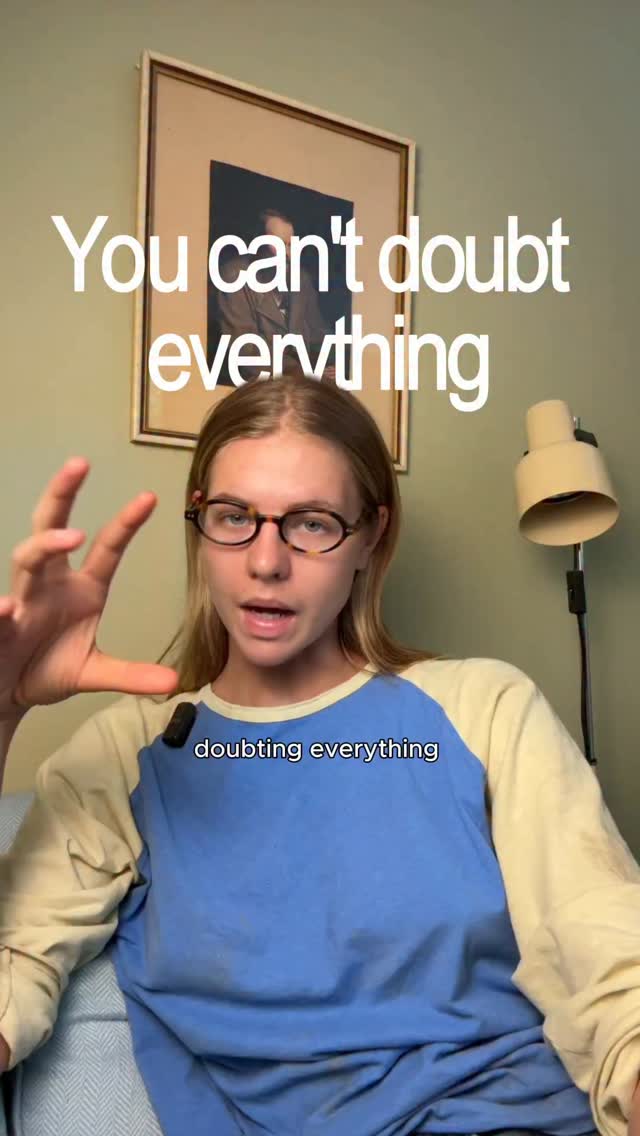
@var.aunevik You cannot doubt everything, at least not at once, and at least not according to Wittgenstein.
Before you can question anything, something has to hold still.
Every doubt you have turns on things you are not doubting.
Like when you fact-check an article, you might be doubting the acticle itself, but you’re also trusting a hundred other things at the same time. Your eyes, the language, your own judgement, even your memory of how reading works.
Which is why doubting everything is impossisble. If you try to doubt everything you won’t be able to doubt anything at all. There won’t be a body left to doubt with.
It seems that life is then, mostly about being okay with accepting a lot of things.
Explaining philosophy with an analogyfrom @var.aunevik
[01]
Overview
The creator explains the philosophical concept that it's impossible to doubt everything at once. She uses a thought experiment about checking if you have two hands to illustrate the problem of infinite regress, then introduces Wittgenstein's idea of 'hinges'—foundational beliefs that must remain stable for doubt to be possible—using the analogy of a door hinge. She concludes by applying this to everyday actions like fact-checking, arguing that life requires accepting many things on trust.
— You can't fact-check everything — here's why philosophers agreed
— You can't optimize every decision — here's why behavioral scientists agreed
— You can't test every ingredient — here's why top chefs agreed
[07]
Hook and payoff
The promise the opener makes, and how the video pays it back
Hook
A bold, declarative statement that contradicts a common belief or intuition, immediately creating intellectual curiosity and a desire for explanation.
Payoff
The initial thesis is restated, now validated by the preceding argument, and then expanded into a broader, more profound philosophical statement about life or human nature, leaving the viewer with a new perspective.
[08]
Narrative framework
The structural pattern this video runs on
Framework
The Paradox & Metaphor
To deconstruct a common assumption by presenting a logical paradox, then resolving it with a simple, powerful metaphor that leads to a profound conclusion.
1
The Grounding Scenario
An easily understood thought experiment or hypothetical situation is presented to make the abstract hook concrete and relatable to the viewer's own experience.
2
The Escalating Paradox
The initial scenario is deconstructed to reveal a circular logic or an unsolvable problem, creating intellectual tension and demonstrating the weakness of the initial assumption.
3
The Authoritative Pivot
An expert, concept, or external framework is introduced as the key to solving the paradox, shifting the narrative from problem to solution and lending credibility to the argument.
4
The Core Metaphor
The expert's solution is distilled into a single, powerful, and easily visualized metaphor that serves as the central explanatory device for the entire concept.
5
The Practical Application
The metaphor is applied to a common, modern-day situation to prove its relevance and utility, connecting the abstract theory to the viewer's lived experience.
Themes
Epistemology
Certainty
Perception
Trust
Techniques
Thought experiment
Analogy
Direct address
Trends
Philosophy explainer
Educational content
Post caption
You cannot doubt everything, at least not at once, and at least not according to Wittgenstein.
Before you can question anything, something has to hold still.
Every doubt you have turns on things you are not doubting.
Like when you fact-check an article, you might be doubting the acticle itself, but you’re also trusting a hundred other things at the same time. Your eyes, the language, your own judgement, even your memory of how reading works.
Which is why doubting everything is impossisble. If you try to doubt everything you won’t be able to doubt anything at all. There won’t be a body left to doubt with.
It seems that life is then, mostly about being okay with accepting a lot of things.
Text overlays
title · beginning
You can't doubt everything
contextual · beginning
doubting everything
contextual · beginning
is not possible
contextual · beginning
if a blind man
contextual · beginning
have you got two hands?
contextual · beginning
look down
contextual · beginning
or would you
contextual · beginning
you already know?
contextual · middle
weren't really sure
contextual · middle
so you
contextual · middle
but wait
contextual · middle
aren't you trusting
contextual · middle
your eyes
contextual · middle
if you can't be sure about your own hands
contextual · middle
your eyes could be wrong too
contextual · middle
you have to test your eyes first
contextual · middle
what is tested by what?
contextual · middle
Wittgenstein used
contextual · middle
these fixed points hinges
contextual · middle
every doubt you have turns on things
contextual · middle
the door
contextual · middle
have to stay put
contextual · end
when you fact check
contextual · end
doubting the article
contextual · end
trusting a 100 other things
contextual · end
the language
contextual · end
your own judgment
contextual · end
and your memory
contextual · end
which is why doubting everything is impossible
Transcript
Everything is not possible. If a blind man asked you, 'Have you got two hands?' would you look down to check? Or would you just answer because you already know? Imagine you actually did check, but you weren't really sure. So you good down. But wait, aren't you trusting your eyes? If you can't be sure about your own hands, your eyes could be wrong too. And so you have to test your eyes first. But how do you test your eyes? By looking at your hands? Now you're ending up going in circles. Who decides what is tested by what? Wittgenstein used this example to make a point about doubt. Before you can question anything, something has to hold still. And he called these fixed points hinges. Every doubt you have turns on things that you are in fact no doubting. If you want tier door to turn, the hinges have to stay put. And you rely on these hinges all the tier. Like literally all the time. When you fact check a headline, you might be doubting the article, but you're also trusting a 100 other things at the same tier. Your eyes, the language, your own judgment and your memory about how reading worse, Which is why doubting everything is impossible. If you try to doubt everything, you never get as far as doubting anything. There wouldn't even be a body left to doubt with. Life is in fact mostly about being okay with accepting a lot of things.