@itsmarceliina
Instagram · Speaker address
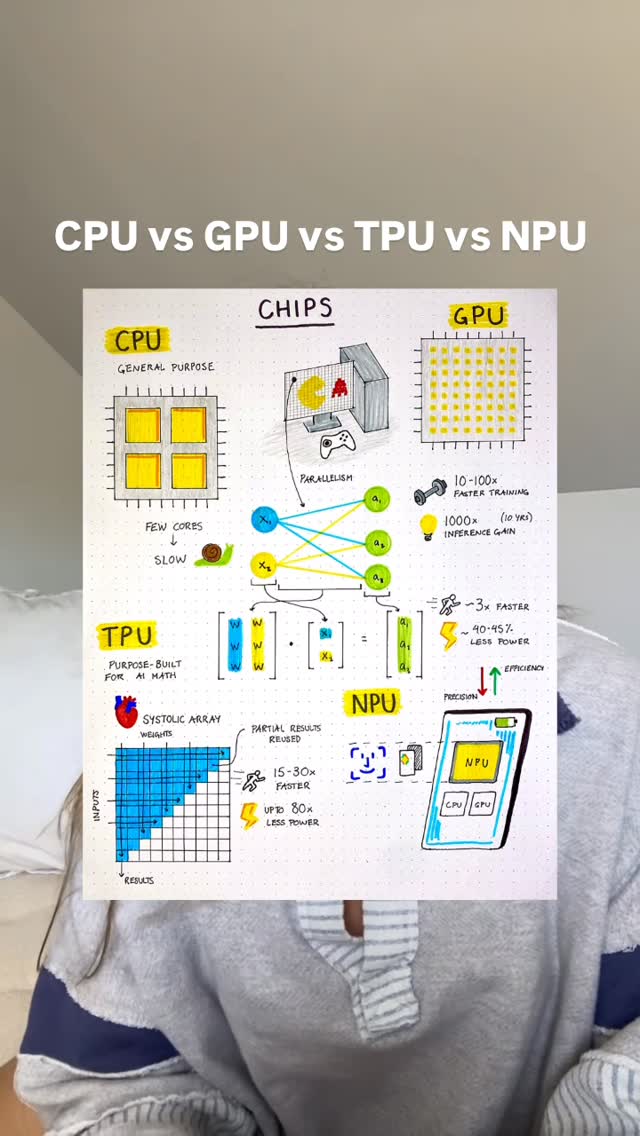
@itsmarceliina the chip aisle keeps expanding- specialized flavors for specialized tasks

@itsmarceliina
Instagram · Speaker address
@itsmarceliina the chip aisle keeps expanding- specialized flavors for specialized tasks
Performance
Video #37343 · Speaker address
[01]
The creator explains the fundamental differences between computer chips like CPUs, GPUs, TPUs, and NPUs. She begins by establishing that most people don't understand these differences, then uses a detailed, hand-drawn diagram to illustrate that the core of modern AI is massive matrix multiplication, and each chip is a specialized tool for that math, proceeding to break down the architecture and purpose of CPUs and GPUs.
[02]
[03]
 1.2MSplit-screen tech news breakdown@rpn · Breakdown
 686.5K63.4×Telling the origin story of AI@itsemilyhiggins · Origin Story
 146.5K2.9×Explaining AI-first software development@angus.sewell · Opportunity Explainer
 503.4KCreator refutes expert via split-screen@ashabuilds · Split Screen Explainer
 2.9M210×Explaining AI stages with visuals@itsemilyhiggins · Opportunity Explainer
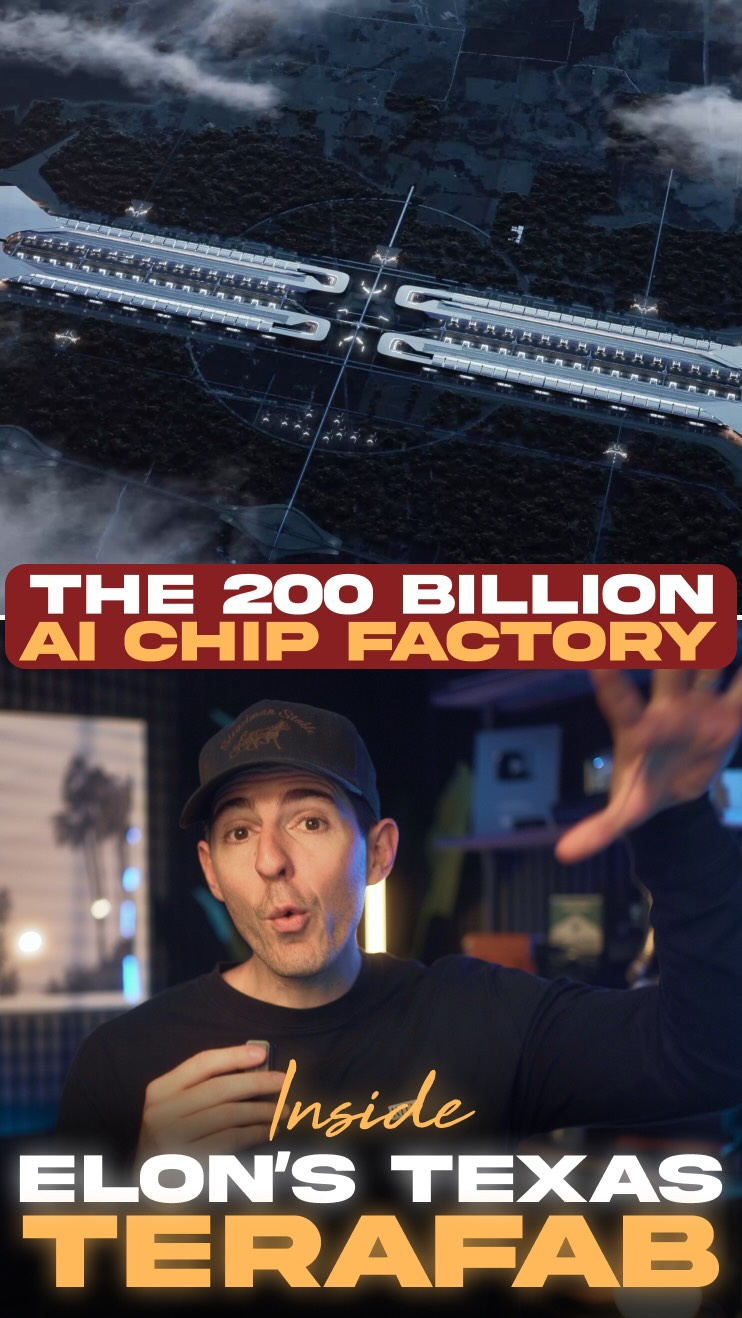 1.9M173.8×Explainer on Musk's massive factory@kallaway · Breakdown
 79.2KSimple breakdown of AI agents@itsmariahbrunner · Opportunity Explainer
 448.7K8.8×Explains building a company AI brain@angus.sewell · Breakdown
 234.5K5.9×Showing the process of creation@softgirlnocode · Journey Documentation
 136.7K4.7×Creator refutes a popular AI concept.@angus.sewell · Hot Take
 1.9M3711.6×Claude vs ChatGPT simplified breakdown@bigpictureclub · Breakdown
 85.4KAI video editing process breakdown@solocontent.studio · Tutorial / How To
[04]
[05]
What stops the scroll in the first 3 seconds
Title hook · 35%
CPU vs GPU vs TPU vs NPU
Verbal hook · 40%
The chips powering AI like GPUs, TPUs, NPUs are some of the most sought after pieces of hardware in the world right now. But most people can't explain the difference between any of them.
Visual hook · 25%
The creator holds up a large, colorful, hand-drawn diagram that visually summarizes the entire topic, serving as a pattern interrupt and a promise of a clear explanation.
[07]
The promise the opener makes, and how the video pays it back
Hook
The Knowledge Gap Hook: Identifies a topic of high relevance and value, then highlights a common lack of understanding about it, promising to provide the missing clarity.
Payoff
The viewer achieves a feeling of mastery and insider knowledge, having successfully built a mental model that demystifies a complex topic. The promise made in the hook is fulfilled.
[08]
The structural pattern this video runs on
Framework
The Scaffolding Explainer
Systematically explaining a category of complex, related items by first establishing a single unifying principle and then using a familiar baseline item as a reference point for comparison.
The Unifying Principle
Establishes a single, foundational concept that underpins all the items to be discussed, simplifying the entire topic into one core idea that makes the viewer feel capable of understanding.
The Familiar Baseline
Introduces the most well-known item in the category. It defines its general purpose, visualizes its structure, and identifies its key limitation in the context of the Unifying Principle, creating a benchmark for comparison.
The Specialized Solution
Introduces the next item as a direct solution to the baseline's limitation. It explains its different origin or purpose and contrasts its structure to show precisely why it's better suited for the specific task.
the chip aisle keeps expanding- specialized flavors for specialized tasks
title · beginning
CPU vs GPU vs TPU vs NPU
The chips powering AI like GPUs, TPUs, NPUs are some of the most sought after pieces of hardware in the world right no. But most people can't explain the difference between any of them. Let's fix that. What you see here is what every instance of modern AI runs almost entirely on, massive matrix multiplication repeated over and over inside neural networks. Every different chip acronym is just a different specialization of that same math under a different constraint. The chip most people are familiar with is the CPU, the classic general purpose chip. It has a small number of powerful cores built to handle anything, running apps, loading web pages, executing code, responding to a click. It can technically do the matrix math behind AI, but deep learning needs that same operation applied across millions of values simultaneously. And a handful of cores just can't keep up. That's why, for AI, we ended up borrowing a chip from a completely different worse, graphics. GPUs were originally built to render video games via thousands of tiny cores applying the same operation to millions of pixels at once. That structure maps almost perfectly onto neural network math, which needs the same massive parallelism. No GPUs