@deathtostock let's learn from our mistakes and not aestheticize this moment please ×
editorials featuring two-dimensional objects, hand cut designs, brands referencing scrapbooks and thread. everyone files it under the 'analog revival', the same way we branded the last one 'hipness purgatory' in the late 00s.
what we're actually bringing back is much older than the internet though.
we built a paper-theatre world for our next shoot, coming soon to the dts platform.
'analog revival' is
Analyzing the 'analog aesthetic' trendfrom @deathtostock
[01]
Overview
The creator presents a cultural analysis arguing against labeling a current design trend as a simple 'analog aesthetic.' She provides a montage of visual examples from fashion, graphic design, marketing, and interiors to define the trend, then refutes the idea that it's just a reaction to AI. The creator draws a direct historical parallel to the 'Hipness Purgatory' aesthetic of the early 2000s, explaining that both movements grew out of communal DIY spaces as a backlash against technology.
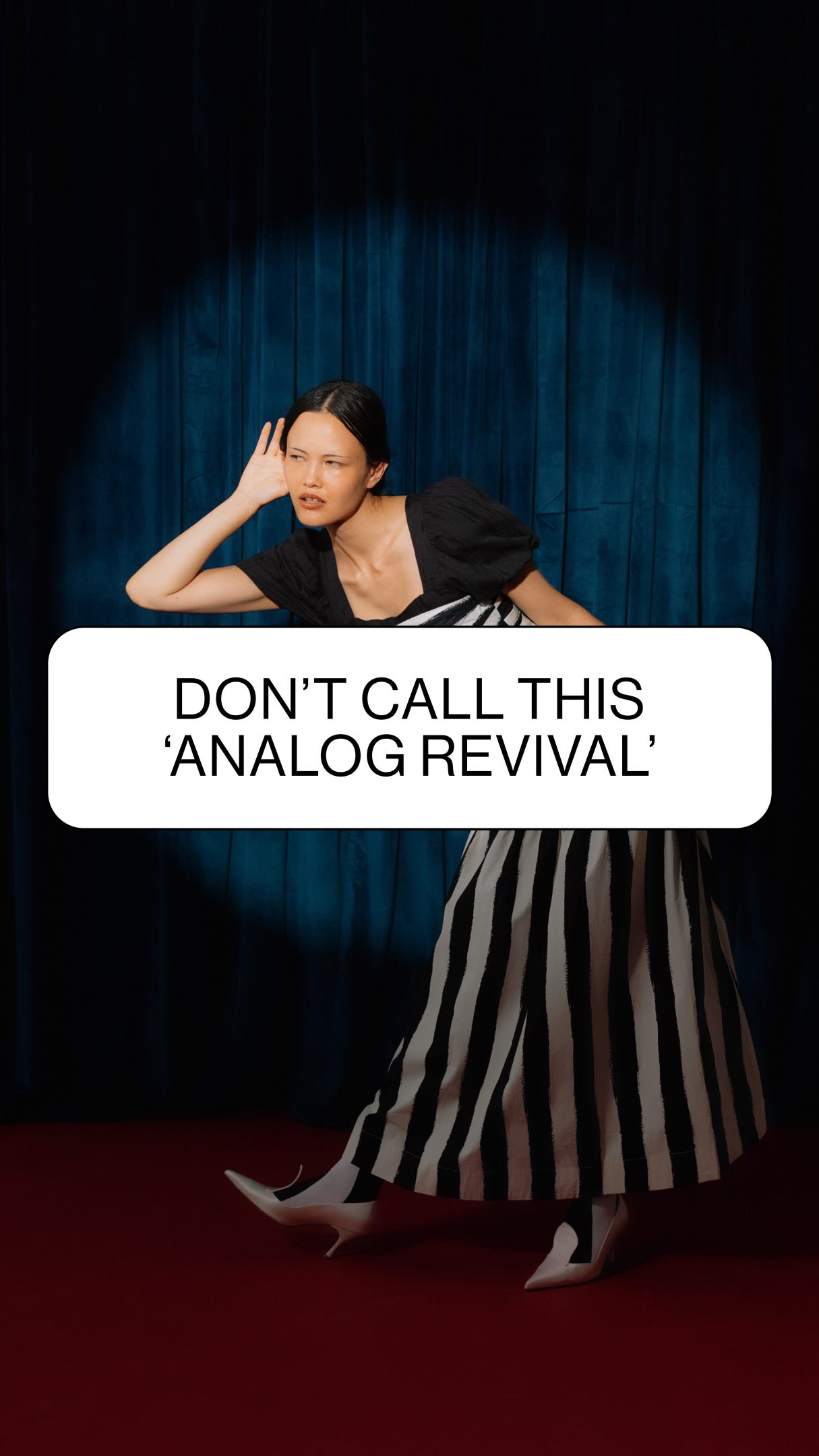
A person styled as a paper doll with hand-drawn, two-dimensional clothing is shown behind the speaker, immediately establishing the unique, crafty aesthetic being discussed.
[06]
Hook template
Steal this for your own video
Stop calling this a [commonly used label].
— Stop calling this a 'girl dinner.'
— Stop calling this a 'minimalist lifestyle.'
— Stop calling this a 'bull market.'
[07]
Hook and payoff
The promise the opener makes, and how the video pays it back
Hook
A direct, contrarian command that challenges a widely accepted term or idea, immediately creating a knowledge gap and promising a more nuanced explanation.
Payoff
The viewer receives a sophisticated, historically-grounded understanding of a current trend, feeling intellectually rewarded for having learned the 'real story' behind a phenomenon they already recognized.
[08]
Narrative framework
The structural pattern this video runs on
Framework
The Historical Reframe
To debunk a popular, surface-level explanation for a current trend by revealing its deeper, historical precedent and true cultural origins.
1
The Ubiquity Proof
A rapid-fire montage of diverse examples across multiple domains (e.g., fashion, design, marketing) to establish the pervasiveness of the trend being discussed, validating the viewer's awareness of it.
2
The Tactile Inventory
A breakdown of the specific, tangible materials and techniques that define the trend, adding a layer of technical detail and credibility to the analysis.
3
The Common Misconception
Explicitly stating and dismissing the popular but superficial explanation for the trend, positioning it as an incomplete or incorrect diagnosis.
4
The Historical Pivot
Revealing that the true origins are much older than the common explanation suggests, and introducing the idea of a historical precedent or a repeating cycle.
5
The Precedent Reveal
Naming the specific historical parallel with a unique, memorable term, transforming an abstract idea into a concrete, named phenomenon.
6
The Precedent's Anatomy
Deconstructing the key characteristics of the historical precedent to show its direct similarity to the current trend.
7
The Root Cause Revelation
Delivering the final thesis by connecting both the historical precedent and the current trend to a shared, underlying cultural or social movement, providing a deeper and more satisfying explanation.
Themes
Cultural cycles
Reaction against technology
DIY culture
Historical context of art movements
Techniques
Visual essay
Trend analysis
Historical comparison
Trends
Analog Revival
Anti-AI sentiment
Post caption
let's learn from our mistakes and not aestheticize this moment please ×
editorials featuring two-dimensional objects, hand cut designs, brands referencing scrapbooks and thread. everyone files it under the 'analog revival', the same way we branded the last one 'hipness purgatory' in the late 00s.
what we're actually bringing back is much older than the internet though.
we built a paper-theatre world for our next shoot, coming soon to the dts platform.
'analog revival' is
Text overlays
title · beginning
Stop calling this an "analog aesthetic."
informational · beginning
This is way more than just a reaction against AI.
contextual · beginning
As seen in editorials
informational · beginning
and fashion have gone two-dimensional,
informational · beginning
in graphic design featuring hand-cut shapes and stamp symbols,
informational · middle
in brand marketing referencing scrapbooks, stitching, collage,
informational · middle
and in interiors decorated with hand-painted ornamentation.
This keeps getting filed under the wider "analog revival" and anti-AI movement.
informational · middle
But what's actually behind it is way older than that.
informational · end
Yes, I'm talking about "Hipness Purgatory."
informational · end
grew out of real communal DIY spaces in the late 2000s and early 2010s.
branding · beginning
kickiyangz
branding · beginning
chloe julin_designs
branding · beginning
furfurgarments
Transcript
Stop calling this an analog aesthetic. This is way more than just a reaction against AI. Let me explain. As in the editorials where everyday objects and fashion have gone two dimensional, in graphic design featuring hand cut shapes and stamp symbols. In brand marketing referencing scrapbooks, stitching, collage. And in interiors decorated with hand painted ornamentation. Accessible materials like paper mache, linocut stamps, thread, watercolor paint, and increasingly tier look of them are popping up across media. This keeps getting filed under the wider analog revival and anti AI movement. But what's actually behind it is way older than that. In fact, we worse in a very similar space just twenty years ago, and we mistakenly overfocus on the aesthetic. Yes. I'm talking about hipness purgatory. Known for its loose drawings, no paper textures, references no. A time of backlash against tech and
Analyzing the 'analog aesthetic' trend | Viral Hooks