@kolbykirschner
Instagram · Speaker address
@kolbykirschner Machiavellianism pt. 1 Think like Machiavelli, but not fully ;)

@kolbykirschner
Instagram · Speaker address
@kolbykirschner Machiavellianism pt. 1 Think like Machiavelli, but not fully ;)
Performance
Video #39887 · Speaker address
[01]
The creator explains the common misconceptions of Machiavellianism, distinguishing between its useful strategic elements (like understanding incentives and thinking ahead) and its harmful aspects (like deception and exploitation). He provides clear dichotomies to help viewers adopt the beneficial traits while avoiding the unethical ones, ultimately reframing the philosophy as a tool for self-defense against manipulation.
[02]
[03]
 172.7K36×Explaining a psychological personality trait@kolbykirschner · Breakdown
 1.8M409.6×Explaining the Machiavellian mindset.@kolbykirschner · Breakdown
 439.9K2.7×Play dumb then crush manipulators@grantmitt · Playbook
 1.7M41.4×Monologue on dealing with manipulators@jrp.co · Vulnerable Monologue
 268.6K31.8×Direct monologue about spotting frauds@sensei.nick · Hot Take
 341K8×Explaining why human nature matters@kolbykirschner · Opportunity Explainer
 1.2M9.8×Monologue on overthinking's pitfalls@benhbader · Hot Take
 166.9K5×Creator critiques another's philosophical take@womp_tomp · Reaction
 591.4K16×Philosophical argument with historical examples@kolbykirschner · Breakdown
 974.4K8.4×Explaining a controversial conspiracy theory@womp_tomp · Hot Take
 137.3K1.5×Explaining philosophy with visual aids@womp_tomp · Breakdown
 552.4K246.2×Explaining a complex thinking model@kolbykirschner · Breakdown
[04]
[05]
What stops the scroll in the first 3 seconds
Title hook · 45%
How to think like Machiavelli (the traits you actually want)
Verbal hook · 50%
There's a dangerous mistake people make when they learn about Machiavellianism.
Visual hook · 5%
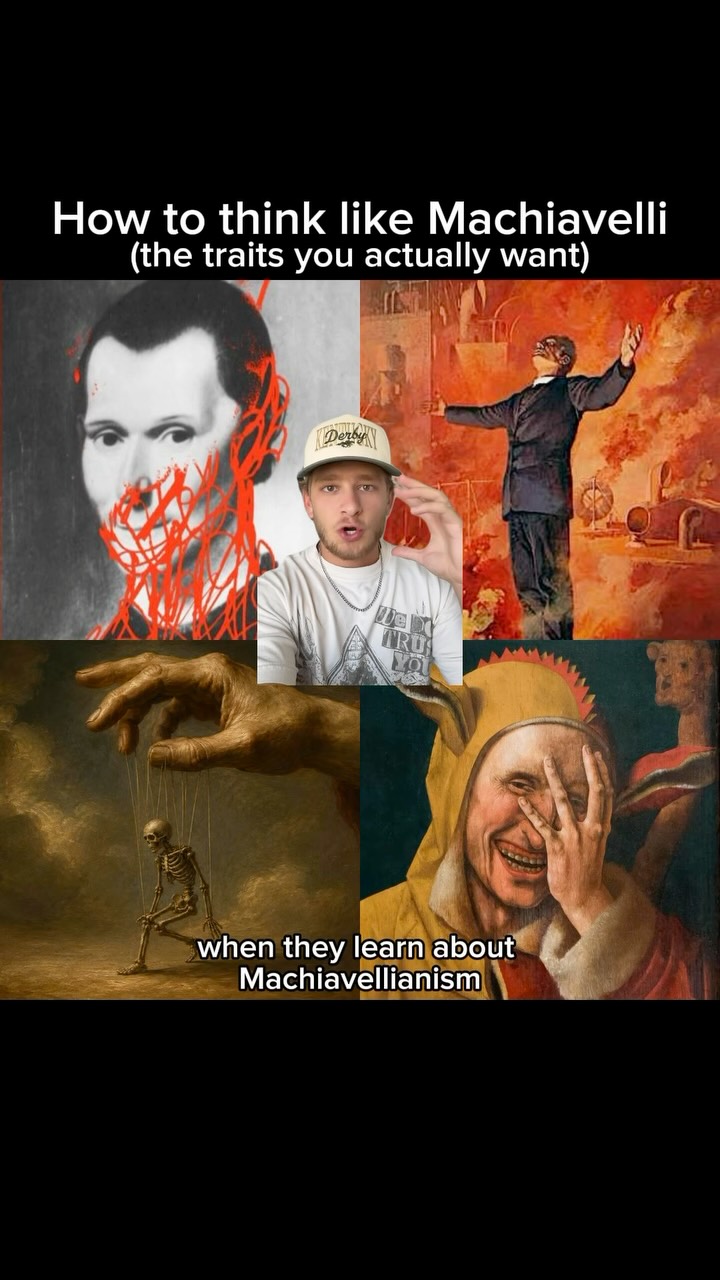
A four-panel collage of surreal and classical-style paintings, including a portrait with red veins, a blindfolded man, a skeleton puppet, and a laughing jester, with the creator in a small circle in the center.
[07]
The promise the opener makes, and how the video pays it back
Hook
The Common Misconception Hook: Start by highlighting a 'dangerous mistake' or common misunderstanding people have about a well-known but complex topic, creating immediate intrigue and positioning the creator as an expert.
Payoff
The Empowering Reframe: Conclude by revealing that the most valuable lesson from the concept isn't its popular (often negative) application, but a more profound, often defensive or protective, purpose that empowers the viewer and provides a satisfying intellectual twist.
[08]
The structural pattern this video runs on
Framework
The Nuanced Reframe
Deconstructing a popular but misunderstood concept to separate its useful components from its toxic ones, ultimately reframing its purpose for the viewer's benefit and empowerment.
The Promise of Nuance
Assert that the popular black-and-white view is flawed and promise to reveal a more sophisticated, powerful understanding by 'drawing a line' between the good and bad parts.
The Strategic Asset Breakdown
Define the positive, actionable traits or components of the concept. Frame them as tools for effectiveness and strategic thinking by providing specific, practical examples.
The Benefit Reinforcement
Explicitly state the real-world advantages of adopting these positive components, connecting the abstract idea to tangible personal gains for the viewer.
The Ethical Boundary Line
Clearly and decisively state the point at which the concept crosses from useful to problematic or toxic. This serves as the central pivot of the entire argument.
The Dichotomy Gauntlet
Use a series of rapid, direct 'This, Not That' comparisons to solidify the boundary between the useful application and the toxic one, making the complex distinction simple and memorable.
The Selective Adoption Mandate
Deliver a clear call to action, instructing the audience to embrace the positive elements while consciously rejecting the negative ones, summarizing the core lesson.
Machiavellianism pt. 1 Think like Machiavelli, but not fully ;)
title · beginning
How to think like Machiavelli (the traits you actually want)
informational · middle
What does this person actually want? What aren't they telling me? What incentive is driving their behavior?
There's a dangerous mistake people make when they learn about Machiavellianism. They either reject it completely or they start believing that manipulation is some kind of superpower. Both of them miss the lesson because there are parts of Machiavellian thinking that can make you far more effective in life and put you ahead if you know where to draw the line. A Machiavellian thinks three steps ahead. They ask questions like, what does this person actually want? What aren't they telling me? What incentive is driving their behavior? Those are incredibly useful questions that make you better at negotiating, reading people, spotting hidden incentives, and even avoiding being manipulated yourself. But the problem begins when understanding people becomes exploiting them. Knowing someone's motivations is awareness. Using their motivations against them through deception is manipulation. Thinking three moves ahead is strategy. Treating every relationship as a transaction is Machiavellianism. So take the awareness. Take the ability to think ahead. Take the understanding of incentives and human nature, but leave the deception, the exploitation, and the belief that people are just merely pieces on a chessboard. Because perhaps the most useful lesson from Machiavelli isn't how to manipulate people. It's how to understand people who might try to manipulate you. If you want more on how to learn the best human nature, you're in the right place.