@kolbykirschner
Instagram · Greenscreen Talking Head

@kolbykirschner File 003: The Machiavellian Mind

@kolbykirschner
Instagram · Greenscreen Talking Head
@kolbykirschner File 003: The Machiavellian Mind
Performance
Video #44999 · Greenscreen Talking Head
[01]
The creator defines the Machiavellian mind as a personality type focused on strategic manipulation and personal gain. He explains their behaviors (flattery, hiding information), their internal justification (results over intentions), and contrasts this with the healthy use of social skills like negotiation and strategic planning, emphasizing that the key difference lies in the intention behind the actions (to communicate vs. to control).
[02]
[03]
 172.7K36×Explaining a psychological personality trait@kolbykirschner · Breakdown
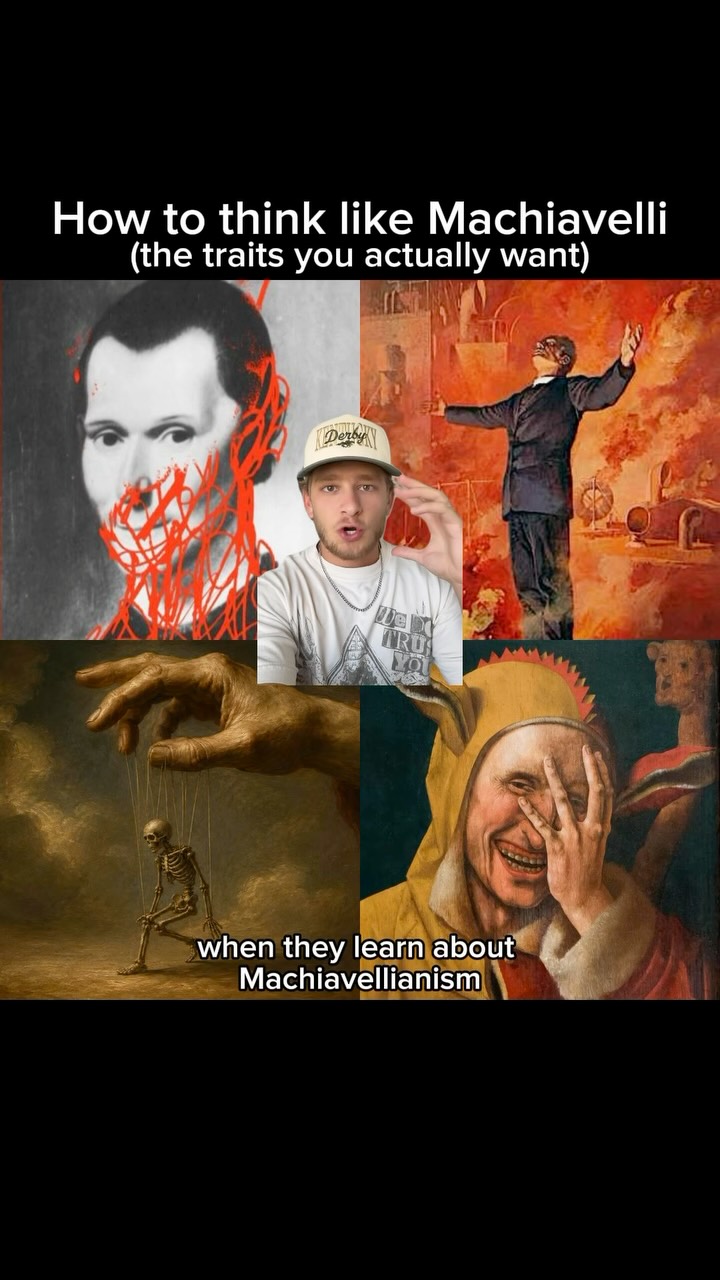 160.7K64.9×Breaking down a philosophy's good traits@kolbykirschner · Breakdown
 439.9K2.7×Play dumb then crush manipulators@grantmitt · Playbook
 441.9KExplains a rare personality archetype@diewithoutregretss · Opportunity Explainer
 95.5K12.7×Explaining metacognition with analogies@sensei.nick · Breakdown
 120.9K9.6×Explaining a relatable personality type@justinbernardino · Vulnerable Monologue
 397.3K17.3×Listing relatable corporate frustrations@roxycouse
 231.5K6.7×Greenscreen listicle with app promo@wendylikestostudy · Rapid Fire Listicle
 1.7M41.4×Monologue on dealing with manipulators@jrp.co · Vulnerable Monologue
 3.9M154.6×Explaining a complex psychological concept@jun_yuh · Opportunity Explainer
 311.3K124.7×Explaining a rare creative intelligence@kolbykirschner · Breakdown
 760.3K288×Explaining a rare personality type@kolbykirschner · Opportunity Explainer
[04]
[05]
What stops the scroll in the first 3 seconds
Title hook · 40%
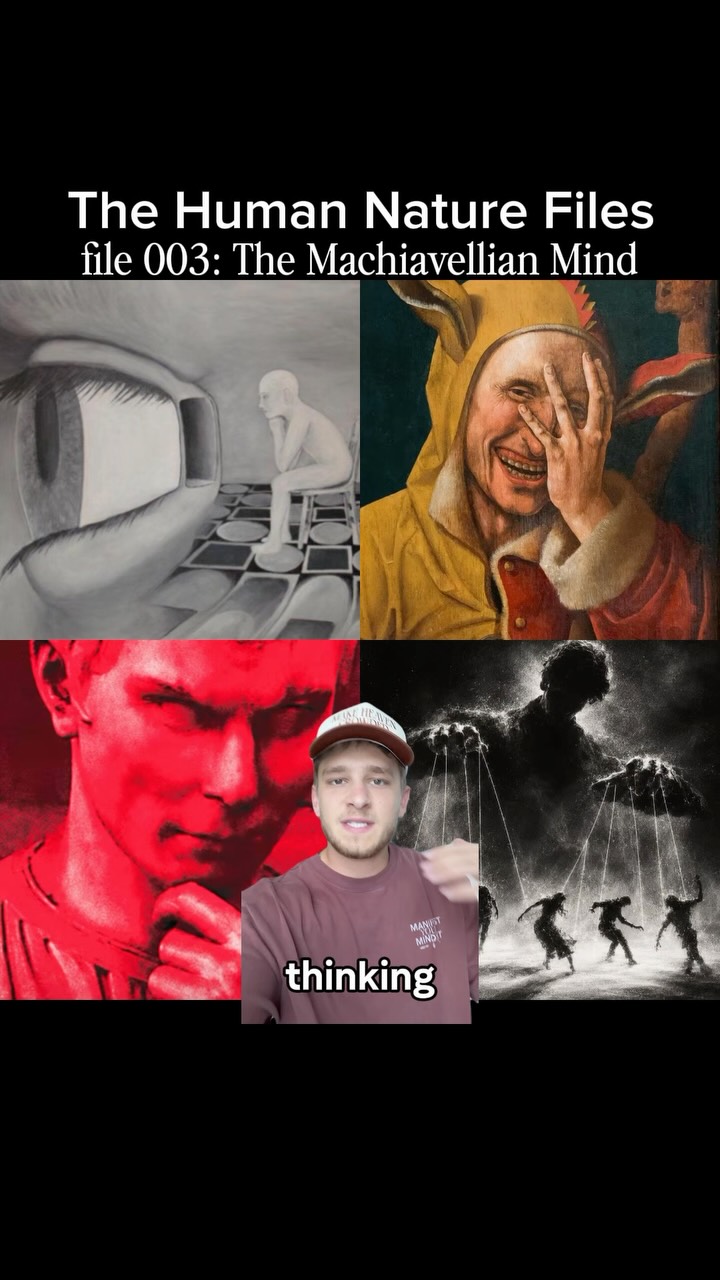
The Human Nature Files file 003: The Machiavellian Mind
Verbal hook · 35%
Imagine someone who is always thinking three steps ahead.
Visual hook · 25%
A four-panel collage of distinct and surreal art pieces, including a laughing jester, a person inside an eye, a puppeteer controlling people, and a man's face in stark red lighting, creating immediate intrigue and setting a dark, analytical tone.
[06]
Steal this for your own video
The Files: File 00 — The Mind
[07]
The promise the opener makes, and how the video pays it back
Hook
Presents a relatable, intriguing archetype or scenario to immediately capture attention and establish the video's subject.
Payoff
Delivers a concise, powerful, and often poetic redefinition of the concept that serves as a memorable final takeaway, summarizing the entire argument.
[08]
The structural pattern this video runs on
Framework
The Concept Deconstruction
To take a complex psychological or social concept, define it through relatable examples, reveal a counter-intuitive internal logic, introduce a critical nuance that challenges a black-and-white view, and conclude with a powerful, memorable redefinition.
The Authority Frame
Establishes the context and credibility of the narrator or series, positioning the content as an authoritative analysis (e.g., 'Welcome to the Human Nature Files').
The Tactical Breakdown
Provides concrete, observable examples of the concept in action to make it tangible for the viewer (e.g., 'They may flatter someone... hide information...').
The Moral Paradox
Introduces a counter-intuitive twist by revealing the subject's internal justification or self-perception, adding a layer of complexity that hooks the viewer (e.g., 'They don't necessarily see themselves as a bad person').
The Trait Synthesis
Concisely summarizes the key characteristics or components associated with the concept, providing a clear mental model for the audience.
The Critical Nuance
Pivots the narrative by introducing a crucial distinction that prevents oversimplification, often contrasting the concept with a more common or acceptable version of the behavior (e.g., 'being strategic doesn't necessarily mean you're Machiavellian').
The Intentional Divide
Frames the core of the concept as a binary choice based on underlying intent, clarifying the moral or functional difference (e.g., 'understand to communicate better' vs. 'understand to control better').
File 003: The Machiavellian Mind
title · beginning
The Human Nature Files file 003: The Machiavellian Mind
title · beginning
FILE 003: The Machiavellian Mind
title · end
Machiavelli
Imagine someone who is always thinking three steps ahead. They know exactly what they want better instead of asking for it directly, they carefully influence the people around them to get it. Welcome to the human nature files where we study the strange patterns behind why people think, feel and behave the way they do. This is file three, the Machiavellian mind. They may flatter someone when it benefits them. Hide information when it gives them an advantage or say exactly what someone wants to hear. But here's what's interesting. They don't necessarily see themselves as a bad person. Tier mind, they simply believe that tier results matter more than the intentions. This type of person is associated with strategic manipulation, emotional detachment, and a strong focus on personal goals. A highly Machiavellian person is constantly calculating. Who can help me? What do they want? What should I reveal? They're not just interacting with the person in front of them. They're thinking about the outcome that they can create through them. But here's where it can get a little weird and complex because being strategic doesn't necessarily mean that you're Machiavellian. Planning ahead is useful. Understanding what motivates people is useful. Knowing how to negotiate, worse, and read a room are actually valuable social skills to have. But the difference is how you use that understanding. You can understand someone to communicate with them better or you can understand them to control them better. The same understanding of human nature can create a completely different behavior depending on the intention behind it. That right there may be the most important distinction. Machiavellianism isn't simply about being better, but it's what happens when people stop being people and they become chess pieces on a board.