Viral Hooks
Trending short videosContrarian take on padel investment
T

@thealexbranford

Instagram · Yap

@thealexbranford Padel doesn’t need to die for you to lose your money. It just needs three more courts down the road. Your ten-year lease suddenly looks very fucking long. A booming sport can still be a terrible investment. The risk in investing in padel courts is assuming today’s fully booked calendar will survive tomorrow’s competition. More courts means more choice. Your customers can move to somewhere cheaper or closer. Your rent and loan repayments stay with you. Here’s the maths: 📉 Booked hours fall 25%. 📉 You cut prices 20%. 💸 Revenue falls 40%. That’s before you’ve paid staff, maintenance, insurance or the landlord. Before opening a padel club, stress-test occupancy, pricing and local competition. Court revenue means very little until you understand the costs underneath it. Would you still invest if another club opened ten minutes away? Follow for more on business models, investment returns and the numbers behind the hype. #Padel #PadelBusiness #BusinessInvestment #BusinessFinance #Entrepreneurship

View original on Instagram

The edit1 shot · 3 text
Shots Text1:22

Performance

Views
171.9K
Likes
1.4K
Comments
121
Engagement
0.9%
Outlier
75.1×
Length · 8 Sept 2026
1:22

Video #41752 · Yap

Contrarian take on padel investmentfrom @thealexbranford

[01]

Overview

The creator, a fractional CFO, explains the financial risks of investing in the booming padel court industry. He starts by showing the attractive initial revenue projections based on current high demand, then systematically deconstructs this investment case by introducing the inevitable factor of market competition. He uses specific calculations to demonstrate how increased supply leads to lower occupancy and price cuts, causing a dramatic drop in revenue while fixed costs remain, ultimately turning a seemingly profitable venture into a money-losing one.

[02]

Simple outline

  1. 1State contrarian thesis
  2. 2Show appealing surface-level logic
  3. 3Reveal the fatal flaw
  4. 4Prove flaw with devastating math
  5. 5Deliver actionable warning

[03]

Related videos

[04]

Classification

Format
Concepts
Opportunity ExplainerBreakdownHot Take
Elements
Green Screen CompositeText OverlayJump CutTitle Text Hook

[05]

Hook analysis

What stops the scroll in the first 3 seconds

Title hook · 45%

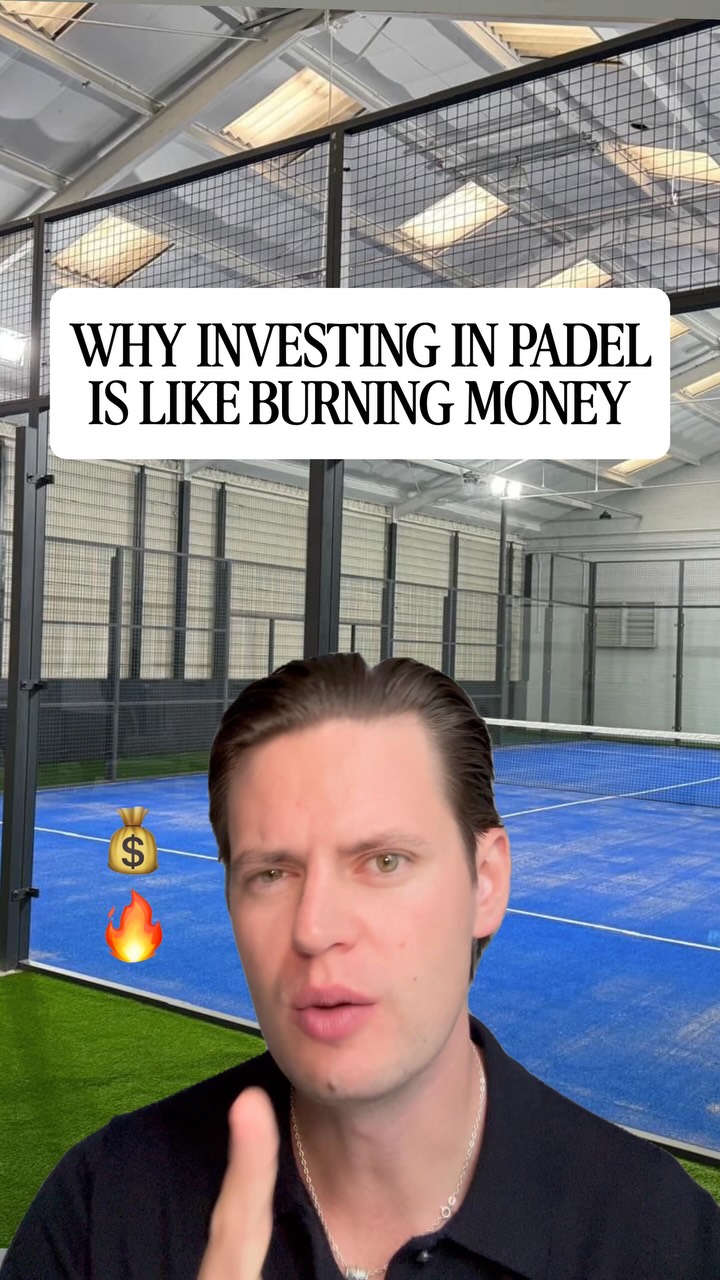
WHY INVESTING IN PADEL IS LIKE BURNING MONEY

Verbal hook · 50%

There's a massive boom in padel, but nobody understands why it's going to lose you every pound that you invest.

Visual hook · 5%

A man is superimposed via green screen in front of a clean, empty indoor padel court, establishing immediate context and authority on the topic.

[06]

Hook template

Steal this for your own video

WHY INVESTING IN [trending opportunity] IS LIKE [vivid money-loss metaphor]

  • — WHY INVESTING IN PICKLEBALL COURTS IS LIKE BURNING CASH
  • — WHY INVESTING IN GHOST KITCHENS IS LIKE FLUSHING MONEY DOWN THE DRAIN
  • — WHY INVESTING IN CRYPTO MINING RIGS IS LIKE SETTING YOUR SAVINGS ON FIRE

[07]

Hook and payoff

The promise the opener makes, and how the video pays it back

Hook

A bold, counter-intuitive statement that challenges a popular belief or trend, creating an immediate knowledge gap and promising to reveal a hidden truth.

Payoff

A direct, actionable warning combined with a set of critical questions that empowers the viewer to properly stress-test the opportunity and avoid the exposed trap.

[08]

Narrative framework

The structural pattern this video runs on

Framework

The Hidden Flaw Deconstruction

To expose the unseen risk in a seemingly obvious or popular opportunity by revealing a fatal assumption and proving its negative consequences with simple, powerful math.

  1. 1

    The Surface-Level Allure

    Establishes the common, attractive perception of the opportunity by presenting simple, appealing data that validates the viewer's initial positive assumption.

  2. 2

    The Hidden Flaw Reveal

    Pivots the narrative by identifying the single, critical, and overlooked assumption in the common logic. This is the 'but here's the catch' moment.

  3. 3

    The Competitive Reality

    Explains the logical consequence of the opportunity's attractiveness: it will inevitably draw in competition, which directly undermines the initial assumption.

  4. 4

    The Mathematical Hammer

    Uses simple, stark mathematics to demonstrate the severe, compounding negative impact of the new reality (e.g., lower volume and lower prices) on the initial attractive numbers.

  5. 5

    The Fixed-Cost Anchor

    Adds a layer of financial pressure by highlighting fixed constraints (like rent or loan repayments) that do not decrease even when revenue collapses.

  6. 6

    The Distilled Principle

    Boils down the entire complex argument into a simple, memorable supply-and-demand rule that the viewer can easily grasp and apply elsewhere.

Themes

  • Investment risk
  • Supply and demand
  • Business strategy
  • Market analysis

Techniques

  • Financial modeling
  • Contrarian analysis
  • Direct address

Post caption

Padel doesn’t need to die for you to lose your money. It just needs three more courts down the road. Your ten-year lease suddenly looks very fucking long. A booming sport can still be a terrible investment. The risk in investing in padel courts is assuming today’s fully booked calendar will survive tomorrow’s competition. More courts means more choice. Your customers can move to somewhere cheaper or closer. Your rent and loan repayments stay with you. Here’s the maths: 📉 Booked hours fall 25%. 📉 You cut prices 20%. 💸 Revenue falls 40%. That’s before you’ve paid staff, maintenance, insurance or the landlord. Before opening a padel club, stress-test occupancy, pricing and local competition. Court revenue means very little until you understand the costs underneath it. Would you still invest if another club opened ten minutes away? Follow for more on business models, investment returns and the numbers behind the hype. #Padel #PadelBusiness #BusinessInvestment #BusinessFinance #Entrepreneurship

Text overlays

  • title · beginning

    WHY INVESTING IN PADEL IS LIKE BURNING MONEY

  • informational · middle

    6 hours £40 per hour 365 days £87,600 per annum

  • informational · middle

    4.5 hours £32 per hour £52,560 per annum

Transcript

A massive boom in Paddle, but nobody understands why it's going to lose you every pound that you invest. Tier thing that makes your first call look like a money printer could be exactly the thing that destroys your return. I'm Alex. I've watched tier $300,000,000 worth of deals, and now I'm a fractional CFO helping scaling businesses understand where they actually make money. And here's why investing in Paddle can be a shit investment. You book a court, nothing available. £40 an hour, four people a plane. You rank, I should open one of these. So you build a spreadsheet, six hours booked a day, good an hour, nearly $90 a year per call? Looks lovely, but this is the cap. You've assumed that today's shortage will still exist after everyone else has built their calls. Those attractive returns, other investors can see them good. And your customer might love your club. Do they love it enough to drive past a cheap one ten minutes close to home? Now you've got two problems, fewer bookings and pressure to cut your prices, and this is where the math gets nasty. Booked hours fall by 25% and you cut prices by 20%, your revenue falls by 40%, but your rent doesn't. And if you borrow to build it, those repayments don't disappear either. Paddle doesn't even have to become less popular for this to happen. Your town just needs courts to open faster than demand grows. So please love Good before you invest in Paddle courts, ask what stops the next court taking my customers, and do the numbers still work if it does? If your entire investment case is everyone wants to play paddle, you haven't finished your investment case, mate. Follow for more on what makes a growing business a good investment.

Contrarian take on padel investment | Viral Hooks