Post caption
COMMENT “SMARTER” FOR MY DEEP DIVE
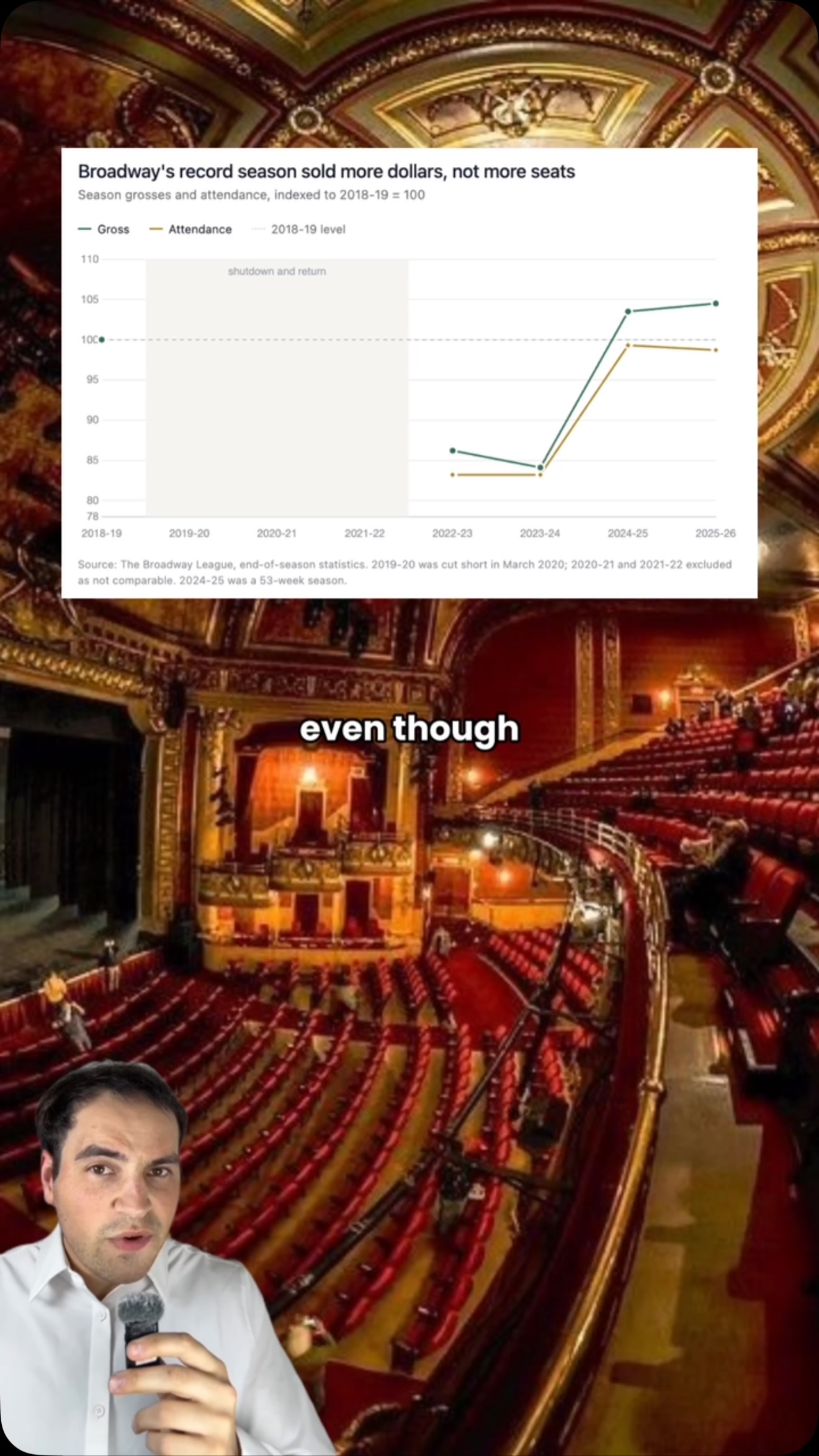
Do Broadway musicals make money? Almost never, and the numbers are worse than the industry admits. Broadway just posted the highest-grossing season in its history at $1.91 billion, and inside that record, 46 new musicals have opened since 2020 on roughly $800 million from investors. 3 have turned a profit. A major musical now costs $15 million to $25 million to open and burns $650,000 to $800,000 a week before the theater takes rent plus 6 to 7 percent of the gross, which means most shows are underwater every morning before the first ticket sells. Broadway show profits have been a 1-in-5 proposition since the 1960s, and nothing, not two recessions, not a pandemic, not the $921 ticket, has moved that number.
So why does anyone still write the check? Because the person putting $50,000 into a musical isn’t buying what a person buying $50,000 of stock is buying. They’re buying opening night, their name in the Playbill, the Tony party, and the right to say they produced a Broadway show. The financial return is a lottery ticket stapled to a luxury experience, and that prestige lowers the return investors need to justify the risk. Call it the prestige subsidy. It’s why Broadway can keep raising money at failure rates that would kill any other industry, and why the real money now comes from what happens after the marquee comes down: tours, school licensing, and films.
#economics #musicals #muscialtheater #broadway
Transcript
There's no business like show business, which is lucky because Broadway is terrible at being a business. Even though it just had its best year in recorded history, with 1,910,000,000 in ticket sales, and 14,600,000 people through the doors, and more than 90% of every available seat filled. Which sounds like an incredible business. There's just one problem, and that's that Broadway musicals are almost impossible to make money on. Since the pandemic, 46 new musicals have opened on Broadway raising over 800,000,000 from investors. Three have turned a profit. That means you can sell almost every seat in the building, break the all time industry revenue record, and still have a business where roughly four out of five new musicals lose their investors money. So what the is going on here? To understand it, you have to understand how Broadway musicals get made. Before anybody sings a note, a producer raises something called the capitalization, which is basically all the money required to build a show and get it to opening night. For a major musical, that can easily mean 15,000,000, 20,000,000, and sometimes more. But once opening night happens, the spending is far from over. A big musical can burn somewhere between $650,000 and 800,000 every single week just to stay open even before accounting for the theater overhead good and another six to 7% of the gross. Of worse, the goal is to eventually generate enough profit above those weekly expenses and pay back the original capitalization in a process called recoupment. A study of Broadway musicals opening between two thousand and eight and twenty seventeen found that only about 21 no 26% actually recoup their investment. And you would think investors would eventually notice this. Because normally when an investment has an 80% chance of losing money, something happens to that market. But Broadway has a really strange feature. Correction never seems to arrive. And the reason is that the person investing 25 or 50 ks in a Broadway musical is not necessarily buying the same thing as someone buying 50 ks worth of stock. Because we usually think about investments in terms of risk and expected better. Bad Broadway investors get utility from the investment before it ever pays them back. I'm calling it the prestige subsidy. The prestige itself effectively lowers the return an investor needs to justify writing the check, which means Broadway can keep retracting capital at failure rates that would probably kill a normal startup category. Take Sunset tier Broadway production cost around $13,500,000 to capitalize, but a version of the essentially same production in London's West End reportedly cost closer to $3,000,000 Rank that's because once you get to Broadway, you're dealing with a very specific set of theaters, labor agreements, best, and operating costs that are extremely difficult for any individual producer to change. So producers have to focus on changing something else instead: what Broadway is for. Look at a show like Wicked. The original Broadway production was capitalized for around $14,000,000 More than two decades better, the first Wicked movie grossed roughly $758,000,000 worldwide and the second added hundreds of millions more. Now obviously those films grosses don't flow directly back to the original Broadway investors, but they reveal something important about the money in show business and how it moves. A Broadway musical can be financially made as a Broadway musical, but incredibly valuable as IP. As every adaptation good keep generating money for years after the original production closes. Which means Broadway is increasingly more like an expensive research and development lab. You spend millions proving that a tier, score, and brand can work in in front of an audience and then the intellectual property travels somewhere with much better economics. Broadway is a strange market and if you're interested in this, comment smarter rank I'll send you my deep dive on this.