@bitterbuilds
Instagram · Speaker address
@bitterbuilds This one was quite fun

@bitterbuilds
Instagram · Speaker address
@bitterbuilds This one was quite fun
Performance
Video #41977 · Speaker address
[01]
The creator takes on a challenge to speak for one minute on a randomly generated topic. After the topic 'The fundamental attribution error' is selected, he conducts 15 minutes of research (shown in a montage) and then delivers a one-minute, timed presentation explaining the psychological concept, using an example and connecting it to empathy and self-kindness.
[02]
[03]
 6.3M59.1×Creator explains random topic in one minute@bitterbuilds · Timed Challenge
 8MResearches and explains random topic@bitterbuilds · Challenge
 626.3K85×Greenscreen psychology communication skills explainer@kolbykirschner · Breakdown
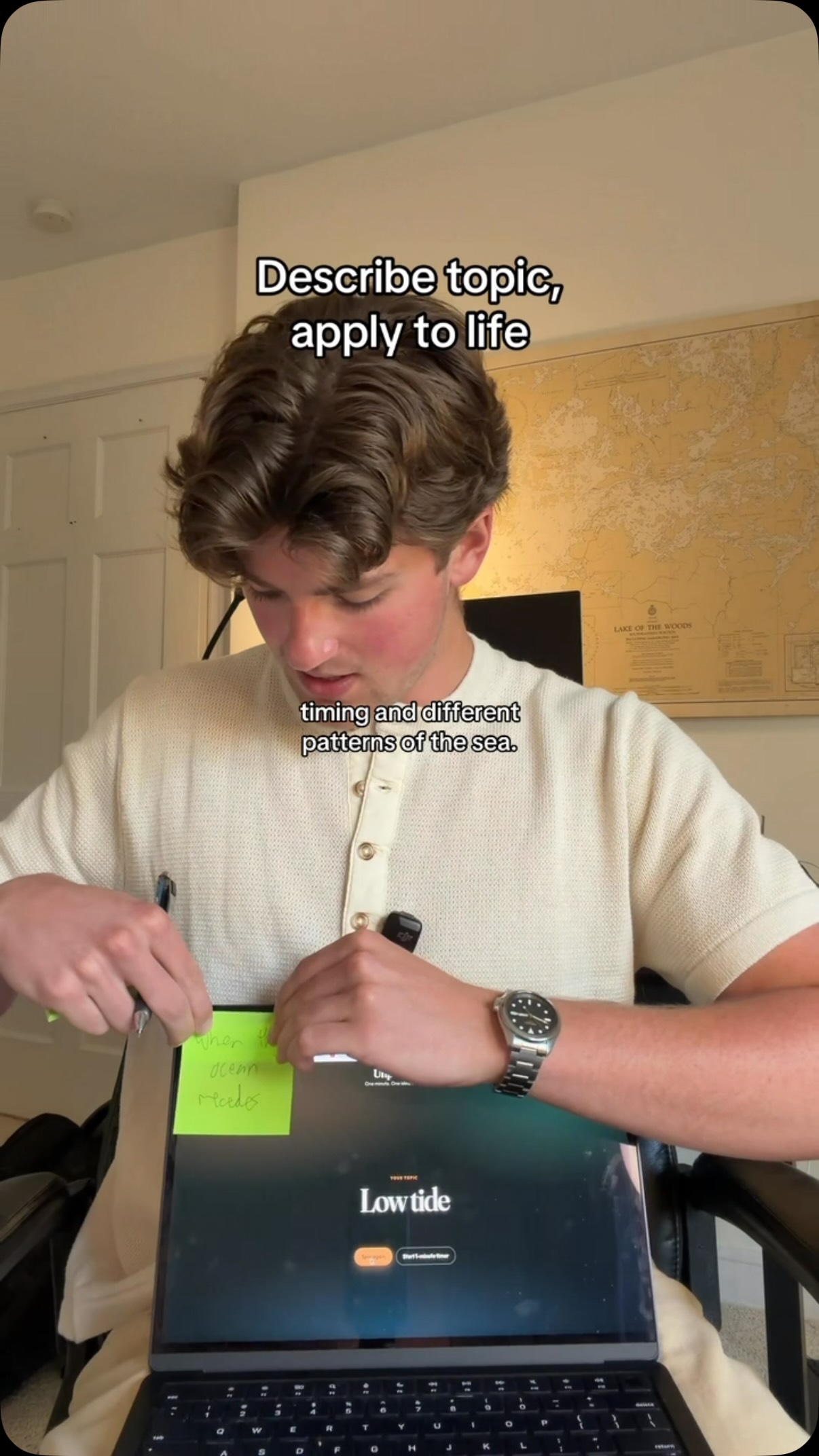 1.5M12.7×Random topic speaking challenge@bitterbuilds · Analogical Definition
 169.2K4.2×Raw motivational talk from car@gregcolbeck · Motivational Mantra
 128.4KHigh-energy creative mindset breakdown@johnbucog · Breakdown
 1.3M1.5×Creator shares ideas and philosophy on self-reliance vs consumerism@bradley.thor · Anecdotal Philosophy
 426.9K14.6×Direct talk on self-awe@bellasolanot · Vulnerable Monologue
 484.3KMonologue on emotional intelligence curse@jb_copeland · Vulnerable Monologue
 1.6M113.6×Rapid fire therapy lessons list@devin.the.one · Rapid Fire Listicle
 1.5M13.3×Motivational speech about starting now@bitterbuilds · Motivational Mantra
 628.5K61.5×Car monologue about losing respect@sensei.nick · Anecdotal Philosophy
[04]
[05]
What stops the scroll in the first 3 seconds
Title hook · 45%
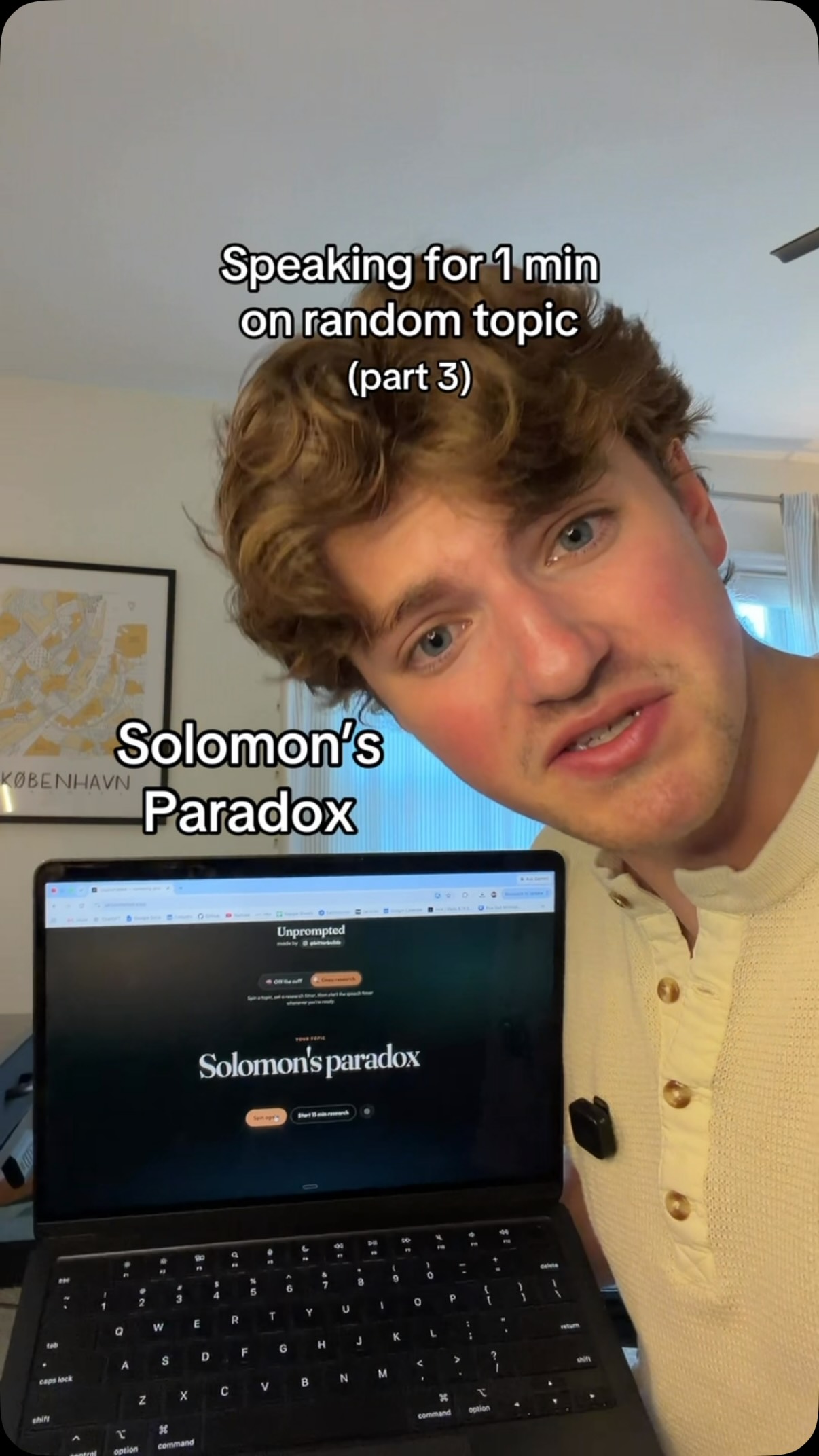
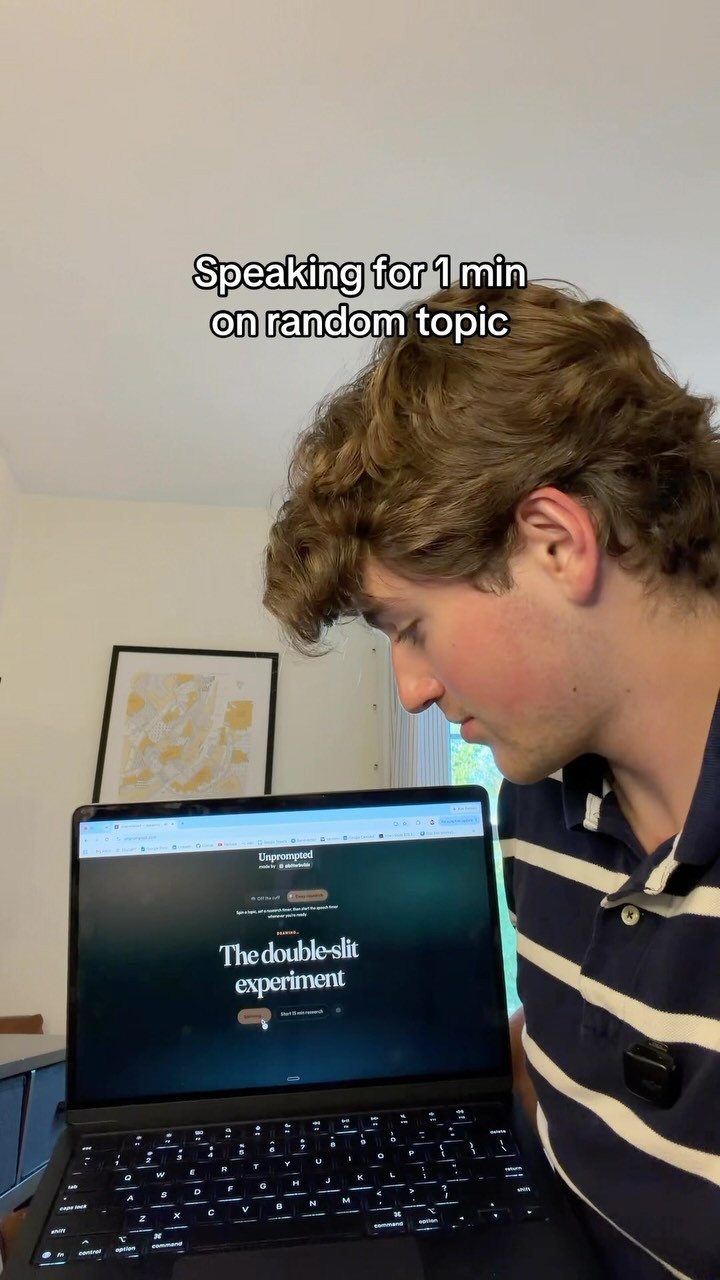
Speaking for 1 min on random topic
Verbal hook · 50%
Okay. I have no clue what that means.
Visual hook · 5%
The creator looks directly at the camera with a surprised expression while holding a laptop displaying a randomly generated, complex topic, immediately establishing a challenge.
[06]
Steal this for your own video
Okay, I have no clue what means—so I’m going to explain it in .
[07]
The promise the opener makes, and how the video pays it back
Hook
The creator establishes a high-stakes challenge with a random element and admits their own lack of knowledge, creating an immediate underdog narrative and a knowledge gap the viewer wants closed.
Payoff
The creator successfully completes the challenge within the time limit, delivering a final, empowering insight that leaves the viewer feeling both smarter and emotionally satisfied.
[08]
The structural pattern this video runs on
Framework
The Timed Expertise Challenge
A creator accepts a challenge to become a temporary expert on a randomly assigned, complex topic under a strict time limit, then must present their findings concisely.
The Roulette Reveal
A random element selects an unknown, complex topic, creating suspense and establishing the specific challenge.
The Vulnerability Hook
The creator openly admits ignorance about the topic, establishing relatable stakes and positioning themselves as a proxy for the viewer.
The Knowledge-Forging Montage
A time-lapsed or quick-cut sequence shows the constrained preparation process (research, practice), building anticipation for the final output and demonstrating effort.
The Performance Trigger
A clear, formal start to the performance (e.g., starting a timer) signals the transition from preparation to the main event, heightening the tension.
The Concept Distillation
The core of the complex topic is immediately defined in simple, accessible terms, providing the initial intellectual payoff.
The Concrete Analogy
An everyday, relatable example is used to illustrate the abstract concept, making it tangible and memorable for the audience.
The 'So What?' Application
The explanation shifts from 'what it is' to 'why it matters,' providing practical, valuable takeaways for the viewer's own life, often broken into distinct points.
This one was quite fun
title · beginning
Speaking for 1 min on random topic
contextual · beginning
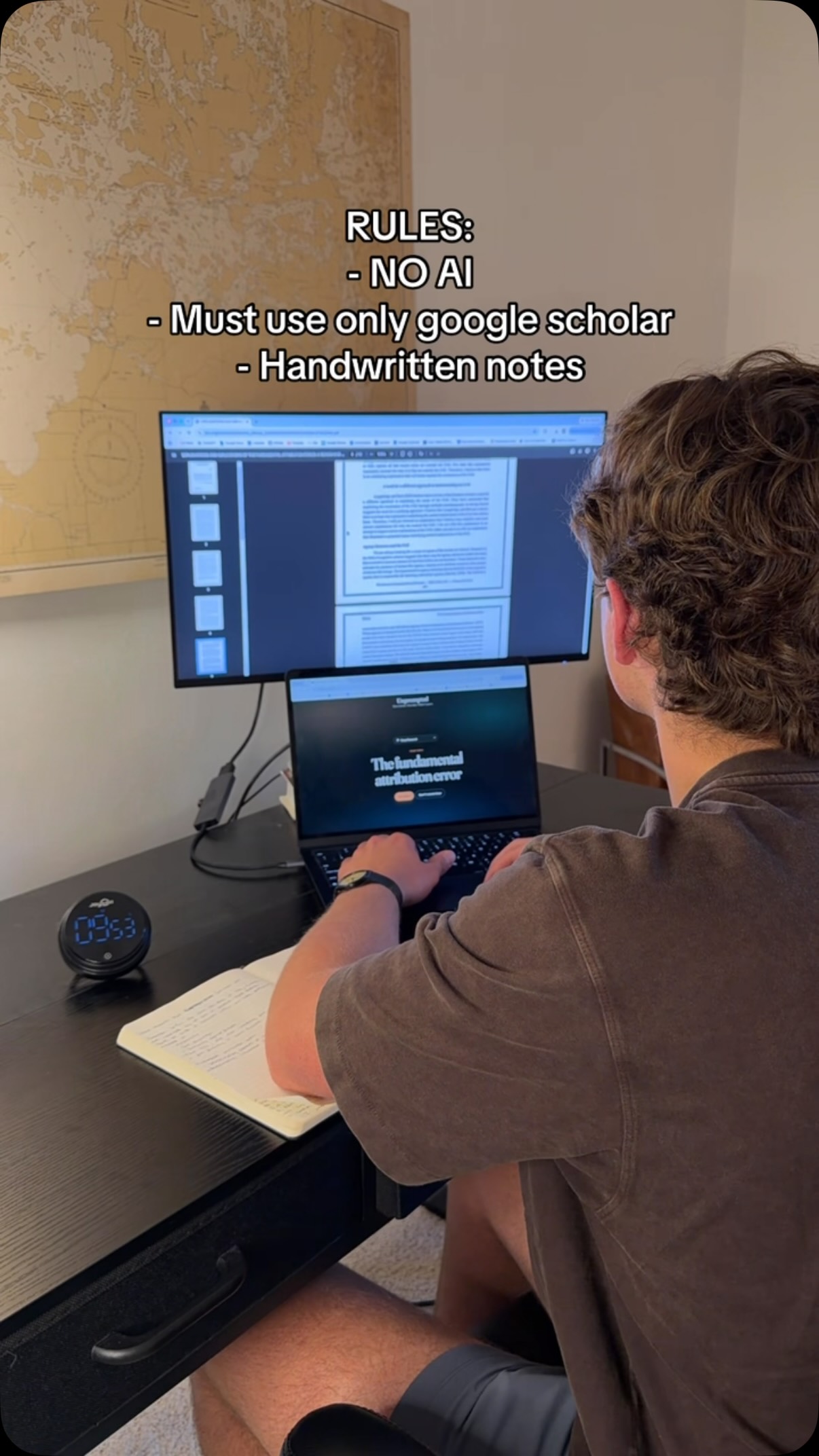
The fundamental attribution error
contextual · beginning
Deep research for 15 min
informational · beginning
RULES: - NO AI - Must use only google scholar - Handwritten notes
contextual · middle
Timer here
contextual · middle
Then 1 min presentation 😬
contextual · middle
Starting timer now.
informational · middle
Uh count: 1
informational · middle
Like count: 1
Okay. I have no clue what that means. Starting timer no. Okay. So the fundamental attribution error is basically this concept that we weigh over attribute, someone's personality tier the role of their decision making and we way under attribute the circumstances that they find themselves in. So if, like, someone trips over a pothole in front of you, we're much more likely to say they're clumsy than to consider the role that the pothole had to play in that scenario. Despite the fact that study after study, psychologists prove that our situations that we find ourselves in is the biggest predictor of how we're gonna act. So I think realizing that we make this fundamental attribution error quite often in our daily lives, it does a couple of things. A, it allows us to have more empathy for others. When we attribute their actions no to who they are, but to the situations they find themselves in, we can be kinder with each other. I also think it allows us to be kinder with ourselves. We are much more likely to reach our potential when we realize that not every error is completely our fault.