@kolbykirschner
Instagram · Talking Head Edit
@kolbykirschner “I do not ask the wounded person how he feels… I myself become the wounded person.” — Walt Whitman

@kolbykirschner
Instagram · Talking Head Edit
@kolbykirschner “I do not ask the wounded person how he feels… I myself become the wounded person.” — Walt Whitman
Performance
Video #43175 · Talking Head Edit
[01]
The creator explains the concept of 'empathetic pattern recognition' by first describing a rare type of person who subtly adapts their communication style to match the person they are speaking with. He provides examples of this adaptation for analytical, creative, and reserved individuals, highlighting their ability to notice subtle shifts in mood and behavior. The creator then names this skill and contrasts it with the common tendency to approach others from one's own psychological framework, arguing that true understanding requires quieting one's internal monologue and becoming genuinely curious about the other person's values, motivations, and fears.
[02]
[03]
 626.3K85×Greenscreen psychology communication skills explainer@kolbykirschner · Breakdown
 311.3K124.7×Explaining a rare creative intelligence@kolbykirschner · Breakdown
 120.9K9.6×Explaining a relatable personality type@justinbernardino · Vulnerable Monologue
 484.4K5.1×Text-driven personality definition montage@diogo.jared · Vulnerable Monologue
 441.9KExplains a rare personality archetype@diewithoutregretss · Opportunity Explainer
 484.3KMonologue on emotional intelligence curse@jb_copeland · Vulnerable Monologue
 94K8.5×Satirizing rare personality type videos@sensei.nick · Satirical Expertise
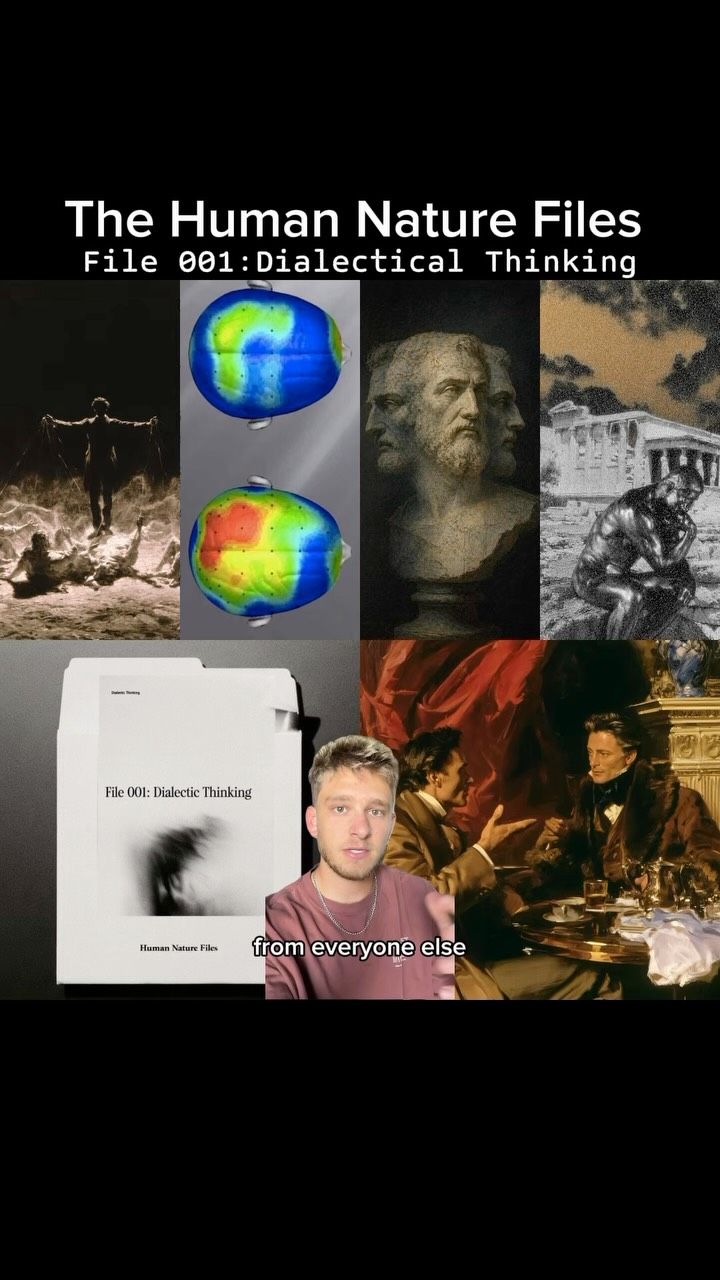 552.4K246.2×Explaining a complex thinking model@kolbykirschner · Breakdown
 628.5K61.5×Car monologue about losing respect@sensei.nick · Anecdotal Philosophy
 946.2K24.8×Explains concept with sequential text@thejaunt_ · Opportunity Explainer
 3.4M106.2×Monologue reframing a personality trait@wiseforyourage · Motivational Mantra
 1.6MExplains psychological trick for charisma@byjoshisaac · Breakdown
[04]
[05]
What stops the scroll in the first 3 seconds
Title hook · 40%
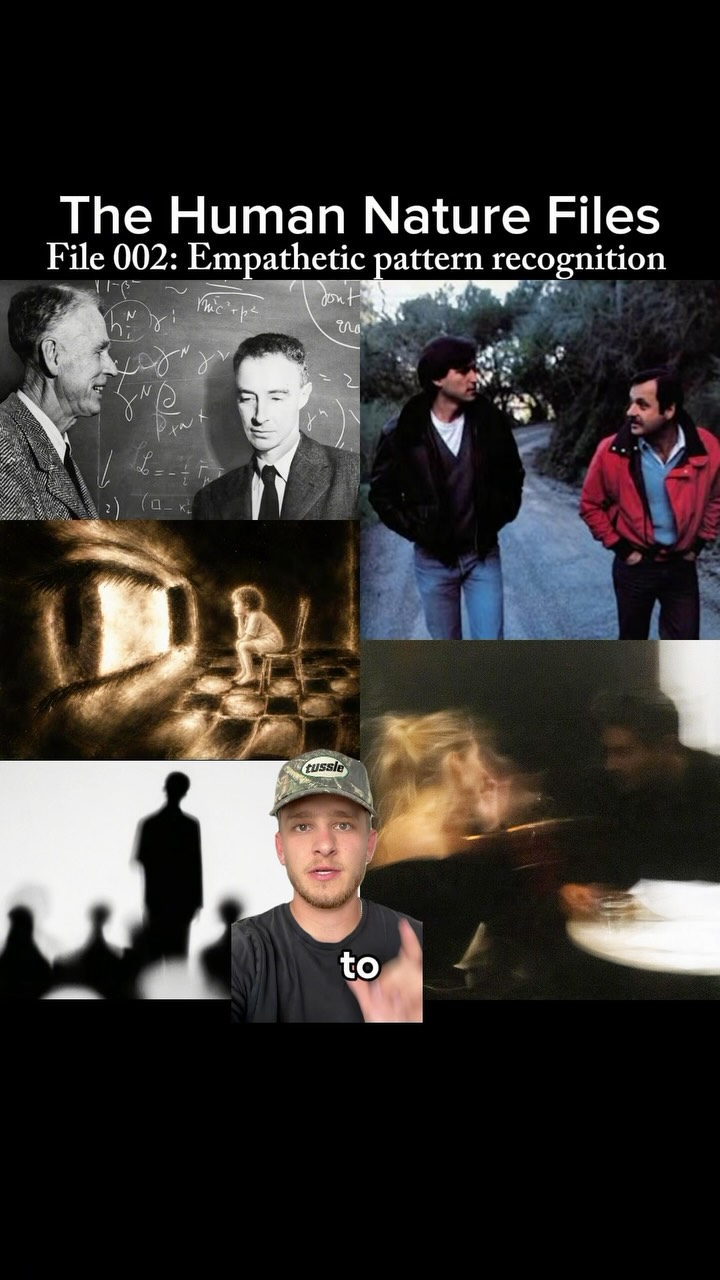
The Human Nature Files File 002: Empathetic pattern recognition
Verbal hook · 45%
There's a rare type of person who seems to become slightly different depending on the person they're talking to, but not in a fake or people pleasing type of way.
Visual hook · 15%
A quick montage of six distinct and intriguing images, including historical photos of scientists, a surreal drawing, and silhouettes, creating immediate visual variety and curiosity.
[06]
Steal this for your own video
There's a rare kind of that —but not for the reason you might think.
[07]
The promise the opener makes, and how the video pays it back
Hook
Presents a relatable but paradoxical observation about a specific type of person, reframing a common behavior in a positive, intriguing light to create curiosity.
Payoff
Summarizes the core lesson into a concise, empowering statement and a final promise, reframing the initial 'rare trait' as an attainable skill for the viewer.
[08]
The structural pattern this video runs on
Framework
The Concept Deconstruction Blueprint
To introduce a fascinating but misunderstood human behavior, deconstruct its underlying psychological mechanics, and reframe it as a learnable skill for the viewer.
The Frame & Promise
Establishes the video's authority and makes a direct promise to the viewer about the value of the information, setting the stakes for paying attention.
The Behavioral Proof
Provides a series of concrete, contrasting examples to make the abstract concept tangible and easily understood.
The Micro-Skill Revelation
Zooms in on the subtle, specific data points that define the skill, adding a layer of depth and expertise.
The Official Naming
Assigns a formal, memorable name to the concept, solidifying it as a legitimate principle in the viewer's mind.
The Core Mechanism
Explains the fundamental psychological shift required to perform the skill, revealing the 'how' behind the 'what'.
The Universal Obstacle
Identifies the common barrier that prevents most people from mastering this skill, creating a relatable 'aha' moment.
The Actionable Solution
Presents a clear, practical method for overcoming the obstacle, transforming the concept from an observation into a practice.
“I do not ask the wounded person how he feels… I myself become the wounded person.” — Walt Whitman
title · beginning
The Human Nature Files
title · beginning
File 002: Empathetic pattern recognition
title · beginning
FILE 002: Empathetic Pattern Recognition
branding · beginning
HUMAN NATURE FILES
informational · middle
Empathetic pattern recognition
A rare type of person who seems to become slightly different depending on the person they're talking to, but not in a fake or people pleasing type of way. Welcome to tier Human Nature Files, file two. If you're interested in understanding why people feel, think, behave the way they do, then this series is for you. This type of person has developed an unusually accurate read on human nature. With someone analytical, they become more precise. With someone creative, they talk in ideas. With someone more reserved, they slow down and give them space. They notice tiny shifts in somebody's mood. What makes someone light up? What makes them withdraw? What they avoid talking about or what they keep coming back to? You could call this empathetic pattern recognition. Instead of approaching everyone from their own psychology, this person would try to enter theirs. They pay close attention to their particular problems, and they even try to anticipate what the other person might do by putting themselves in a similar emotional state. And I think there's a much deeper principle tier, and that is you cannot understand people if you're constantly listening to yourself. Most of us are having an internal conversation while somebody else constantly listening to yourself. Worst of us worse having an internal conversation while somebody else is speaking, but tier very best readers of people turn that voice temporarily down. Instead, they become curious. What does this person value? What are they motivated by? What are they afraid of losing? What changes their energy? That is the skill. Stop assuming everyone operates from your psychology. Study the person in front of you. Notice their patterns. Enter their value system. The deeper you can understand someone else's internal world, the less mysterious their behavior becomes.