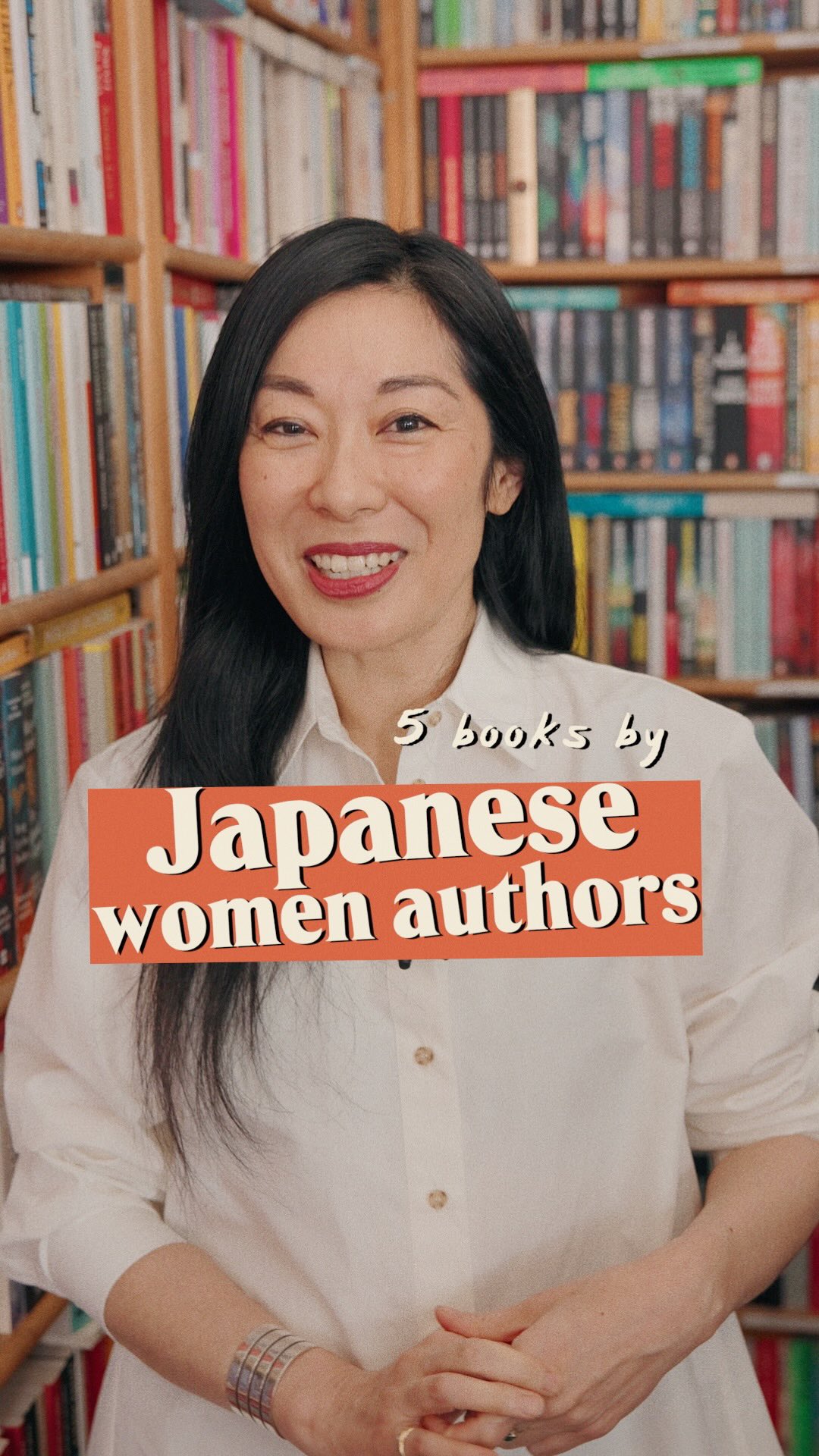
Author Katie Kitamura stands in a bookstore and presents her five favorite novels by Japanese women writers. She sequentially introduces each book—'Mild Vertigo,' 'Breasts and Eggs,' 'The Hole,' 'The Emissary,' and 'Memory Police'—by showing its cover as a graphic overlay and discussing its unique qualities, themes, and authorial style. She concludes by highlighting the importance of the current generation of Japanese female authors and the video ends with a call-to-action to subscribe to the 'Under the Cover' Substack for more content.
Post caption
Audition author Katie Kitamura is back Under the Cover to share five favourite books by Japanese women writers 🧡
Katie’s work includes Intimacies, A Separation and Audition - about an actress forced to reconcile conflicting narratives after she meets a man claiming to be her son. It was shortlisted for The Booker Prize and was a finalist for the Pulitzer.
She joined us to speak about the extraordinary new generation of Japanese authors she wants more people to read. Head to the affiliate link in our bio to order any of the titles mentioned.
Paid subscribers to our Substack can see the rest of our conversation with Katie, including her takes on adaptations, must-read translators, and the book that changed the way she looks at fiction.
🎥 Thank you so much to Primrose Hill Books in North London for having us!
📜 Katie’s list:
Audition by Katie Kitamura
Mild Vertigo by Mieko Kanai (translated by Polly Barton)
Breasts and Eggs by Mieko Kawakami (translated by Sam Bett and David Boyd)
The Hole by Hiroko Oyamada (translated by David Boyd)
The Emissary by Yoko Tawada (translated by Margaret Mitsutani)
The Memory Police by Yoko Ogawa (translated by Stephen Snyder)
Transcript
My name is Katie Kitamura, and these are my five favorite novels by Japanese female writers. The first book is mild verdict of Mieko Kanai about a mother in Tokyo. Best a day to day day domestic life, really for me, it is the quality of her sentences which are startling and hypnotic, and I really, really am hoping that Polly Barton is going to translate another one of her books. My second book is Best Eggs, Mieko Kawakami. It's probably the best known in the English speaking worse. Incredible novel about working class women, relationships between sisters, about fertility, motherhood. She uses Osaka then, which which is a particular dialect. There is something quite radical in the way she writes about class and the way she conveys that through language and not simply subject matter. The Hole by Hiroko Oyamada. She also has a wonderful book called The Factory, and she writes these surreal, playful books, that kind of make me think of Kobo Abe to a certain extent. I feel like she's writing in a very particular tradition. My next pick is The Emissary by Yoko Tawada, set in the future Japan where fertility is falling. Katakana has been, you know, vanished from the language. It has become a highly nationalist culture. So it's a really great novel about isolationism and about nationalism. It's a beautiful novel about language. My last book is Memory Police by Yoko Ogawa, another speculative novel. It is really about the way in which authoritarianism takes place through language. Ogawa is a really interesting writer. She works in so many different kinds of genres, horror adjacent, realist, and slightly surreal. I think for a long time, Japanese fiction in translation has been dominated by male writers. There is an extraordinary generation of female writers working today, and I I love discovering them, and I love reading them, and I wanted to share that. If you love Under the Cover, you can support us by subscribing to our Substack, where you'll find even more conversations with authors and bonus content for paid subscribers.