Viral Hooks
Trending short videosHistorical breakdown of photo process
G

@garrettking.co

Instagram · Greenscreen Talking Head

@garrettking.co Before digital cameras, @nba photographers used to shoot the first half, go to a darkroom in the stadium, and develop their photos in time to make the next day’s newspaper. I thought this was so fascinating so I did some research on how the process worked. Credit to @adbphotoinc & @chrispietsch for articles & interviews they’ve done over the years, as well as several of their photos used as backgrounds in the vid Story idea from my friend @henrythekidd_

View original on Instagram

The edit1 shot · 2 text
Shots Text0:35

Performance

Views
652.9K
Likes
42.6K
Comments
301
Engagement
6.6%
Outlier
92.4×
Length · 19 Oct 2026
0:35

Video #46215 · Greenscreen Talking Head

Historical breakdown of photo processfrom @garrettking.co

[01]

Overview

The creator explains the step-by-step process 1980s NBA photographers used to develop and transmit film photos during halftime to meet newspaper deadlines. He details the use of in-stadium darkrooms, the 'wirephoto' device, and the later 'Leafax' invention, contrasting the long transmission times with modern digital convenience.

[02]

Simple outline

  1. 1State a difficult historical problem
  2. 2Detail the complex old process
  3. 3Introduce a game-changing innovation
  4. 4Reveal the innovation's limitations
  5. 5Contrast with modern ease

[03]

Related videos

[04]

Classification

Concepts
BreakdownNostalgia HighlightStrange but True
Elements
Green Screen CompositeArchival FootageTitle Text Hook

[05]

Hook analysis

What stops the scroll in the first 3 seconds

Title hook · 40%

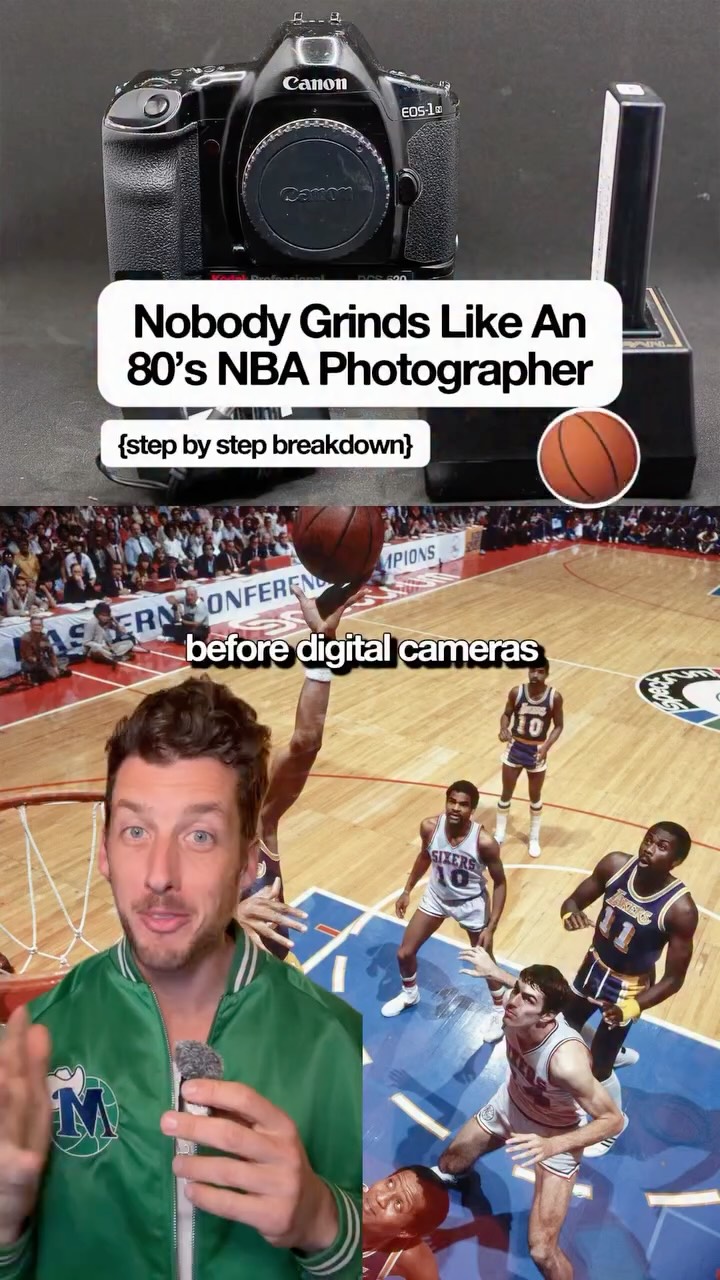
Nobody Grinds Like An 80's NBA Photographer

Verbal hook · 50%

Before digital cameras, NBA photographers used to develop film at halftime in the stadium to make the cut for tomorrow's newspaper.

Visual hook · 10%

A clear shot of a vintage Canon EOS-1 film camera, immediately establishing the theme of old photography technology.

[06]

Hook template

Steal this for your own video

Before [modern technology or convenience], [specific professionals] used to [surprisingly extreme manual task] just to [high-stakes deadline or goal].

  • — Before GPS, truck drivers used to memorize hand-drawn paper maps of entire states just to deliver freight on time.
  • — Before spreadsheets, bookkeepers used to add up entire ledgers by hand with a pencil just to close the books by Friday.
  • — Before streaming, radio DJs used to physically cue up vinyl records in real time just to keep the song going without a second of dead air.

[07]

Hook and payoff

The promise the opener makes, and how the video pays it back

Hook

State a bold, superlative claim about the difficulty of a task in a specific past era, immediately establishing a high-stakes problem that modern audiences take for granted.

Payoff

Juxtaposes the entire historical process with the equivalent modern tool or method, delivering a final moment of awe, relief, and appreciation for current technology.

[08]

Narrative framework

The structural pattern this video runs on

Framework

The 'Then vs. Now' Process Breakdown

To reveal the surprisingly difficult and complex process behind a common task from a past era, culminating in a comparison that highlights the ease of modern technology and generates appreciation.

  1. 1

    The Manual Grind

    Systematically walks through the initial, fully analog steps of the old process, using visuals to establish the baseline level of difficulty and labor.

  2. 2

    The Analog Bottleneck

    Isolates and explains a specific, major point of friction or a cumbersome piece of technology in the original workflow.

  3. 3

    The Technological Turning Point

    Introduces a key invention or innovation that partially solved the initial problem, presenting it as a major breakthrough for its time.

  4. 4

    The 'Improved' (But Still Flawed) Workflow

    Details the new process enabled by the innovation, showing how it streamlined some steps while still being constrained by the era's technology.

  5. 5

    The Lingering Limitation

    Quantifies the remaining inefficiency of the 'improved' process, revealing a final, frustrating hurdle (e.g., slow speeds, high costs) to prove the initial 'grind' thesis.

Themes

  • Technological evolution
  • Nostalgia
  • Appreciation for modern convenience

Techniques

  • Historical storytelling
  • Process breakdown

Trends

  • Explainer video
  • Niche history

Post caption

Before digital cameras, @nba photographers used to shoot the first half, go to a darkroom in the stadium, and develop their photos in time to make the next day’s newspaper. I thought this was so fascinating so I did some research on how the process worked. Credit to @adbphotoinc & @chrispietsch for articles & interviews they’ve done over the years, as well as several of their photos used as backgrounds in the vid Story idea from my friend @henrythekidd_

Text overlays

  • title · beginning

    Nobody Grinds Like An 80's NBA Photographer

  • contextual · beginning

    {step by step breakdown}

Transcript

Before digital cameras, NBA photographers used to develop film at halftime in the stadium to make the cut for tomorrow's newspaper. They'd shoot the first half, then go to the darkroom for press photographers, develop the photos, then they had to make prints, and transmit those photos using this device called the worse photo. Up until the eighties when an incredible invention called the Leafax limited the need to make a print. You could just load in and develop negative, view it on that screen right there, and then adjust crop, contrast, and put a caption on it kinda like this one, then transmit it over a standard telephone line. Black and white photos took eight minutes each and full color, thirty minutes a photo. Now let's all say grace for our nice mirrorless cameras.

Historical breakdown of photo process | Viral Hooks