Viral Hooks
Trending short videosDoctor lists five dementia prevention habits
D

@dr.vassily

Instagram · Yap

@dr.vassily Your memory doesn't disappear all at once. It erodes — quietly, over decades — and most of the forces eroding it are within your control. The Lancet Commission's dementia research identified 12 modifiable risk factors that explain roughly 40% of all dementia cases. Five of them carry the bulk of the leverage: 1. Protect your hearing. Untreated hearing loss is the single largest modifiable risk factor — 8% of all cases globally. More than smoking. More than inactivity. If you strain to hear conversations, get a formal hearing assessment. Hearing aids measurably reduce cognitive decline. 2. Keep fasting insulin under 6. Alzheimer's is increasingly called type 3 diabetes. Brain insulin resistance precedes cognitive decline by 5 to 15 years — and most labs won't flag your insulin until it hits 25. By the time your A1C is abnormal, the damage has compounded for a decade. 3. Know your ApoE status. ApoE4 carriers carry up to 12x the Alzheimer's risk. If that's you, every intervention on this list has outsized impact — and most people have never been tested. 4. Sleep 7 to 9 hours — and protect deep sleep. Deep sleep is when your glymphatic system clears beta-amyloid from brain tissue. Consistently under 6 hours measurably accelerates the buildup. 5. Stay connected, stay challenged. Chronic loneliness raises dementia risk on its own. So does a brain that never meets anything new. Connection plus cognitive challenge is some of the most powerful neuroprotection there is. These five are the start, not the whole picture. Comment BRAIN and I'll send you the full dementia prevention protocol — the 12 modifiable risk factors, what the evidence says about each one, and where to start.

View original on Instagram

The edit1 shot · 4 text
Shots Text2:15

Performance

Views
355.6K
Likes
17.9K
Comments
20K
Engagement
10.7%
Outlier
22×
Length · 23 Oct 2026
2:15

Video #47509 · Yap

Doctor lists five dementia prevention habitsfrom @dr.vassily

[01]

Overview

A longevity doctor outlines five evidence-based daily habits to significantly reduce the risk of dementia. He begins by citing research identifying 12 modifiable risk factors, then focuses on the five most impactful ones: protecting hearing, managing fasting insulin, knowing your ApoE genotype, getting adequate deep sleep, and staying socially and cognitively engaged. For each habit, he provides a brief scientific explanation and concludes with a call-to-action for viewers to comment for a more detailed prevention protocol.

[02]

Simple outline

  1. 1State high-stakes problem
  2. 2Present expert-backed solution list
  3. 3Detail each solution's rationale
  4. 4Offer bonus content for engagement

[03]

Related videos

[04]

Classification

Format
Concepts
Rapid Fire ListicleBreakdownPlaybook
Elements
Graphic OverlayJump CutTitle Text HookDM / Comment-for-Info CTA

[05]

Hook analysis

What stops the scroll in the first 3 seconds

Title hook · 45%

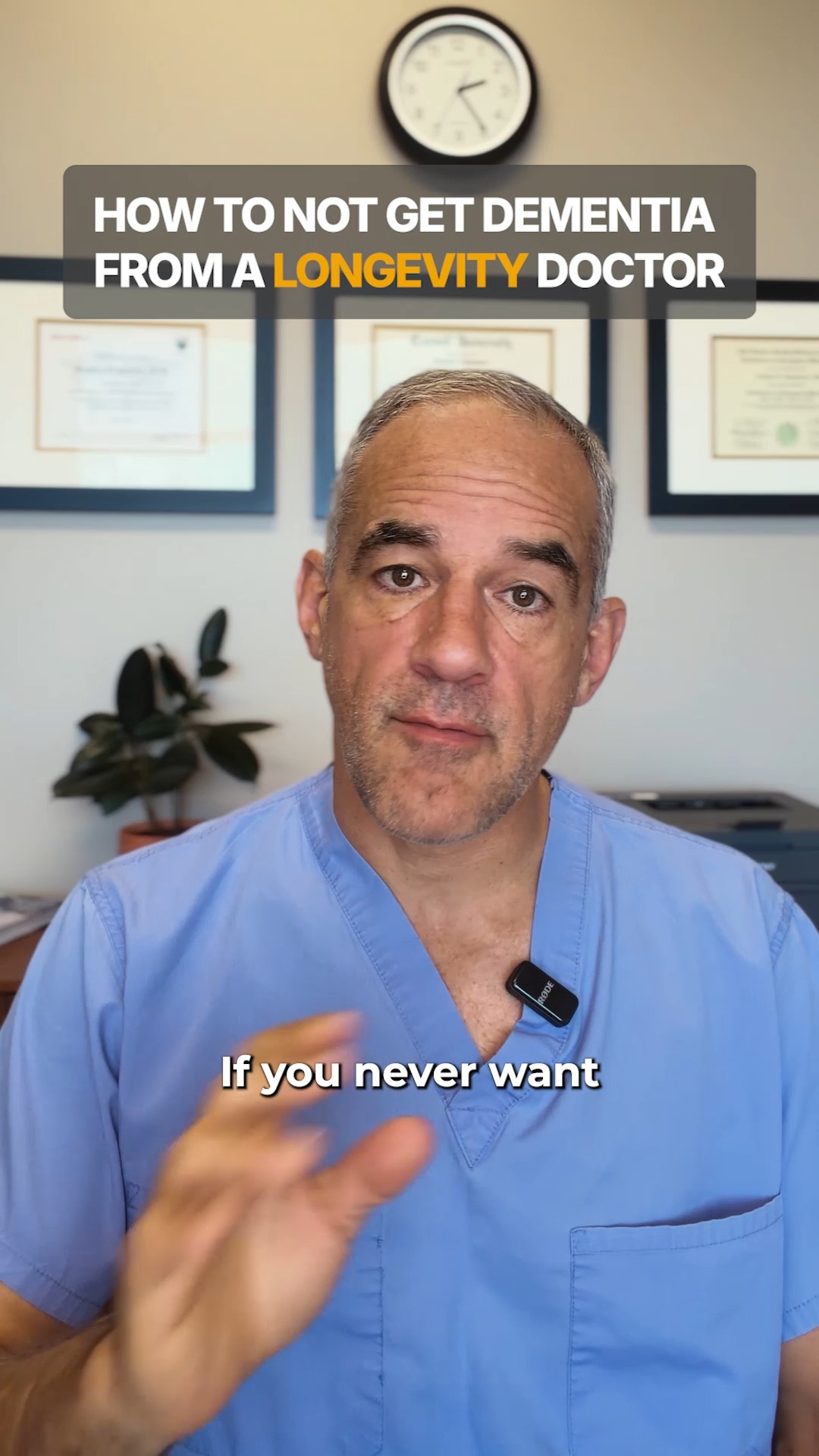
HOW TO NOT GET DEMENTIA FROM A LONGEVITY DOCTOR

Verbal hook · 55%

If you never want to be the person whose memory disappears in their seventies, here are the five daily habits that cut your dementia risk by up to eighty percent.

Visual hook

A man in medical scrubs (a doctor) speaks directly to the camera with a serious expression, establishing immediate authority and importance. The professional office setting with framed diplomas in the background reinforces his expertise.

[06]

Hook template

Steal this for your own video

If you never want to [feared outcome], here are the [number] [timeframe or frequency] habits that [specific result] by up to [percentage].

  • — If you never want to be the person who's still stuck in debt at fifty, here are the three weekly money habits that grow your savings by up to forty percent.
  • — If you never want to be the guy who throws out his back every time he picks up a toddler, here are the four daily mobility habits that cut your injury risk by up to seventy percent.
  • — If you never want to be the small business owner whose Google ranking quietly disappears, here are the five monthly website habits that boost your local traffic by up to two hundred percent.

[07]

Hook and payoff

The promise the opener makes, and how the video pays it back

Hook

A relatable, fear-based scenario is presented ('memory disappears'), immediately followed by a quantifiable promise of a solution ('cut your dementia risk by up to 80%').

Payoff

The viewer is left feeling empowered with a set of clear, actionable, and scientifically-validated steps, with a clear path to get even more detailed information.

[08]

Narrative framework

The structural pattern this video runs on

Framework

The Expert Protocol

An authority figure presents a numbered list of actionable steps to prevent a common, high-stakes negative outcome, with each step justified by data or scientific rationale, culminating in a call-to-action that offers a more comprehensive guide.

  1. 1

    The Authority Frame

    The speaker establishes their credentials ('Dr. Voss... MD from Cornell') and cites a credible external source ('Lancet Commission research') to frame the upcoming information as expert-level, evidence-based advice.

  2. 2

    The Solution Scaffolding

    The speaker explicitly states the number of items in the list ('Here are all five'), creating a clear structure and setting viewer expectations for the video's duration and content.

  3. 3

    The Prescriptive Gauntlet

    The speaker systematically presents each numbered item in the list, applying a consistent micro-pattern to each one to deliver value efficiently.

  4. 4

    The Engagement Magnet

    The speaker concludes with a direct call-to-action, offering a valuable, free resource (a 'full dementia prevention protocol') in exchange for a specific comment ('Comment BRAIN'), designed to maximize engagement metrics.

Themes

  • Preventative health
  • Aging
  • Cognitive function
  • Lifestyle medicine

Techniques

  • Expert authority
  • Data citation
  • Listicle format
  • Actionable advice

Post caption

Your memory doesn't disappear all at once. It erodes — quietly, over decades — and most of the forces eroding it are within your control. The Lancet Commission's dementia research identified 12 modifiable risk factors that explain roughly 40% of all dementia cases. Five of them carry the bulk of the leverage: 1. Protect your hearing. Untreated hearing loss is the single largest modifiable risk factor — 8% of all cases globally. More than smoking. More than inactivity. If you strain to hear conversations, get a formal hearing assessment. Hearing aids measurably reduce cognitive decline. 2. Keep fasting insulin under 6. Alzheimer's is increasingly called type 3 diabetes. Brain insulin resistance precedes cognitive decline by 5 to 15 years — and most labs won't flag your insulin until it hits 25. By the time your A1C is abnormal, the damage has compounded for a decade. 3. Know your ApoE status. ApoE4 carriers carry up to 12x the Alzheimer's risk. If that's you, every intervention on this list has outsized impact — and most people have never been tested. 4. Sleep 7 to 9 hours — and protect deep sleep. Deep sleep is when your glymphatic system clears beta-amyloid from brain tissue. Consistently under 6 hours measurably accelerates the buildup. 5. Stay connected, stay challenged. Chronic loneliness raises dementia risk on its own. So does a brain that never meets anything new. Connection plus cognitive challenge is some of the most powerful neuroprotection there is. These five are the start, not the whole picture. Comment BRAIN and I'll send you the full dementia prevention protocol — the 12 modifiable risk factors, what the evidence says about each one, and where to start.

Text overlays

  • title · beginning

    HOW TO NOT GET DEMENTIA FROM A LONGEVITY DOCTOR

  • informational · middle

    Modifying 12 risk factors might prevent or delay up to 40% of dementias

  • informational · middle

    Untreated hearing loss

  • call-to-action · end

    Comment BRAIN and I'll send you the full dementia prevention protocol.

Transcript

If you never wanna be the person whose memory disappears in their seventies, here are the five daily habits that cut your dementia risk by up to eighty percent. I'm doctor Voss, longevity physician with an MD from Cornell. And the most rigorous dementia research over the last decade has identified 12 modifiable risk factors that explain roughly forty percent of all dementias, and five of those carry the bulk of the leverage. Here are all five. One, protect your hearing. Untreated hearing loss is the single largest modifiable dementia risk factor in the Lancet Commission research, responsible for eight percent of all dementia cases globally. More than smoking, more than physical inactivity. If you struggle to hear conversations, get a formal audiological assessment. Hearing aids reduce cognitive decline measurably. Two, keep your fasting insulin under six. Alzheimer's is increasingly called type three diabetes because brain insulin resistance precedes cognitive decline by five to fifteen years. By the same time your a one c is abnormal, the damage has been compounding on your brain for about a decade. Fasting insulin is the marker that catches this early, and most labs don't flag it until it's above 25. Three, get your ApoE genotype tested. ApoE four carriers have up to 12 times higher Alzheimer's risk. If you are a carrier, the good news is that lifestyle intervention has outsized impact starting now. Four, sleep with a target of seven to nine hours nightly, and protect your deep sleep. Deep sleep is when your lymphatic system activates. That is the system that helps to clear the beta amyloid protein that builds up and forms plaque. This is the plaque most associated with Alzheimer's. Five best stay socially engaged and challenge your brain weekly. Chronic loneliness raises dementia risk independently and significantly. So does a brain that never encounters novelty or challenge. The combination of connection and cognitive stimulation is some of the most powerful neuroprotection that's available. Comment brain, and I'll send you the full dementia prevention protocol. All 12 modifiable risk factors, what the evidence says about each one, and where to start.

Doctor lists five dementia prevention habits | Viral Hooks