@davi87dp
Instagram · Single Take
@davi87dp #relatable #relationships #girl #men #mentalhealth

@davi87dp
Instagram · Single Take
@davi87dp #relatable #relationships #girl #men #mentalhealth
Performance
Video #47554 · Single Take
[01]
The creator delivers a monologue from his car, explaining that when people hate him, he doesn't get mad but instead psychoanalyzes their behavior, traces it to their childhood, and ends up feeling concerned for them. He humorously describes this as conducting an 'unofficial psychological assessment,' overthinking minor disagreements as signs of deep-seated trauma, before concluding with self-awareness that sometimes people are just being annoying and he needs to relax.
[02]
[03]
 628.5K61.5×Car monologue about losing respect@sensei.nick · Anecdotal Philosophy
 1.3M2.9×Relatable monologue on relationship overthinking@davi87dp
 484.3KMonologue on emotional intelligence curse@jb_copeland · Vulnerable Monologue
 126.7KMan in car gives hot take@higherupwellness · Hot Take
 3.2M23.5×Subverting the meaning of 'deep conversation'@couldbaret · Hot Take
 1.1M45.8×Man in car rants passionately@higherupwellness · Vulnerable Monologue
 178.4K10.8×Car yap on spiritual growth@gregcolbeck · Anecdotal Philosophy
 1.3M3.2×Relatable post-work exhaustion car rant@davi87dp · Storytime
 1.7M41.4×Monologue on dealing with manipulators@jrp.co · Vulnerable Monologue
 1.1M35.8×Car monologue on relationship accountability@higherupwellness · Cultural Rant
 3.4M106.2×Monologue reframing a personality trait@wiseforyourage · Motivational Mantra
 169.2K4.2×Raw motivational talk from car@gregcolbeck · Motivational Mantra
[04]
[05]
What stops the scroll in the first 3 seconds
Title hook
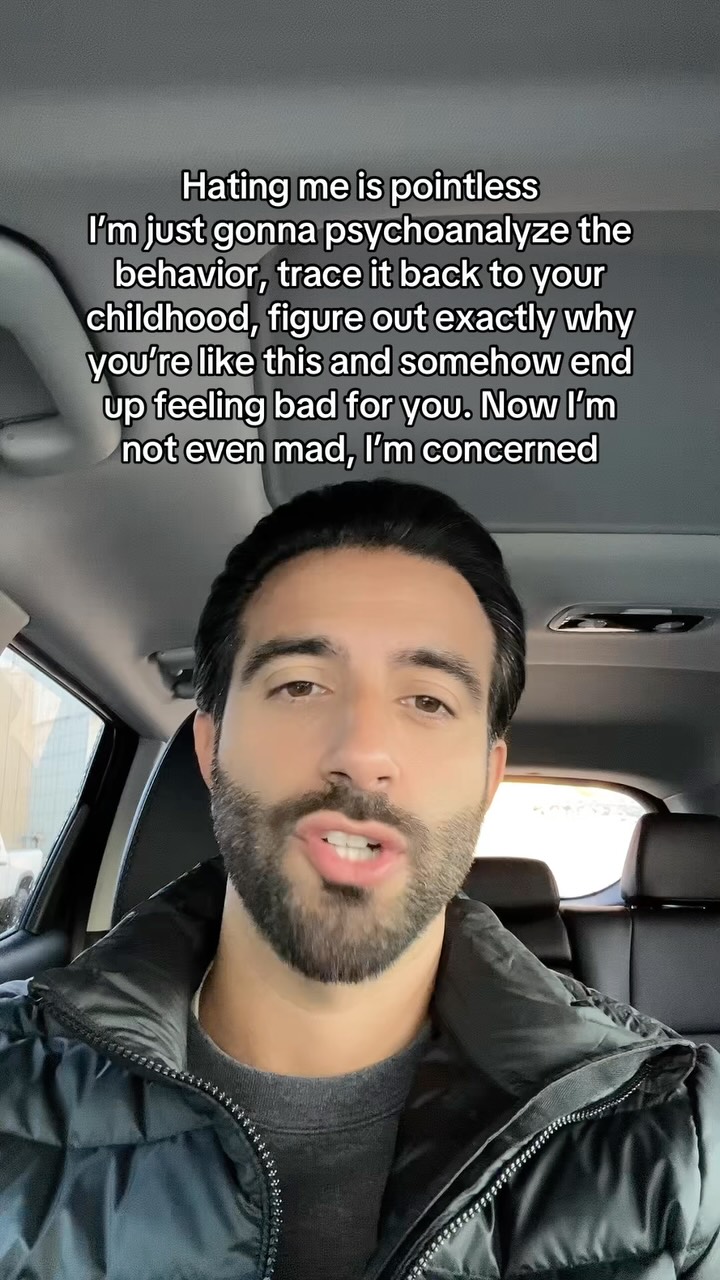
Hating me is pointless I'm just gonna psychoanalyze the behavior, trace it back to your childhood, figure out exactly why you're like this and somehow end up feeling bad for you. Now I'm not even mad, I'm concerned
Verbal hook
Hating me is pointless.
Visual hook
A medium close-up shot of a man sitting in a car, making direct eye contact with the camera, creating an immediate and personal connection.
[07]
The promise the opener makes, and how the video pays it back
Hook
Present a bold, counter-intuitive thesis that challenges a common emotional reaction, immediately establishing a unique perspective and creating curiosity about the 'why'.
Payoff
Deliver the ultimate exaggerated outcome of the internal process. This final beat demonstrates the full, ridiculous extent of the analysis and resolves the initial premise by transforming the speaker's role from victim to a detached, pitying observer.
[08]
The structural pattern this video runs on
Framework
The Overthinker's Power Flip
A narrative structure that transforms a negative external stimulus into a position of intellectual or emotional superiority through an absurdly complex and escalating internal analysis, creating humor and a relatable power fantasy.
The Method Reveal
Explain the specific, step-by-step internal process that supports the initial thesis, reframing the speaker from a passive recipient of an action to an active analyst of it.
The Role Reversal
Explicitly define the new dynamic, shifting the context from a conflict between equals to an observation or assessment, placing the speaker in a position of authority (e.g., analyst, counselor, expert).
The Triviality Contrast
Introduce a mundane, low-stakes trigger for the complex analysis. This juxtaposition creates a comedic gap between the stimulus and the over-the-top response, highlighting the absurdity.
The Feigned Self-Correction
Briefly acknowledge the irrationality or absurdity of the internal process, creating a moment of relatability and self-awareness before immediately dismissing it.
The Compulsion Reassertion
Double down on the complex process by rejecting a simple, rational explanation. This reinforces the core character trait and drives the narrative toward its final, absurd conclusion.
#relatable #relationships #girl #men #mentalhealth
title · throughout
Hating me is pointless I'm just gonna psychoanalyze the behavior, trace it back to your childhood, figure out exactly why you're like this and somehow end up feeling bad for you. Now I'm not even mad, I'm concerned
Hating me is pointless. I'm just gonna psychoanalyze the behavior, trace it back to your childhood, figure out exactly why you're like this, and somehow end up feeling bad for you. Now I'm not even mad. I'm concerned that... Because you you think we're having an argument and I'm conducting an unofficial psychological assessment. Like, you'll say something disrespectful and instead of immediately getting offended, my brain just starts asking questions. And like, oh, why did that upset them so much? Why are they reading this this way? Why they why they reacting so strongly? Who who made them feel like they they had to compete for attention. Suddenly, I'm looking at you like a concerned school counselor. You came here to insult me, but now I'm just wondering whether your parents celebrated your accomplishments enough. Like, this is not the outcome either of us expected. And the worst part is I start connecting dots that may not even worst. Like, oh, so when I disagreed with you, you felt rejected. And maybe disagreement feels threatening because you grew up around people who made love feel conditional. Meanwhile, you literally just said you didn't like my shoes. Like I need to relax because sometimes people aren't acting out of unresolved childhood trauma. Sometimes they're just being annoying. But you no, my brain refuses to accept such a simple explanation. I get... I need a timeline, a a mode of supporting evidence. At least three examples of previous behavior. By the end of the conversation I've mentally written the 12 page case study on somebody who was rude to me in a parking lot. And somehow I've gone from wanting to defend myself to thinking, I really hope they find peace.