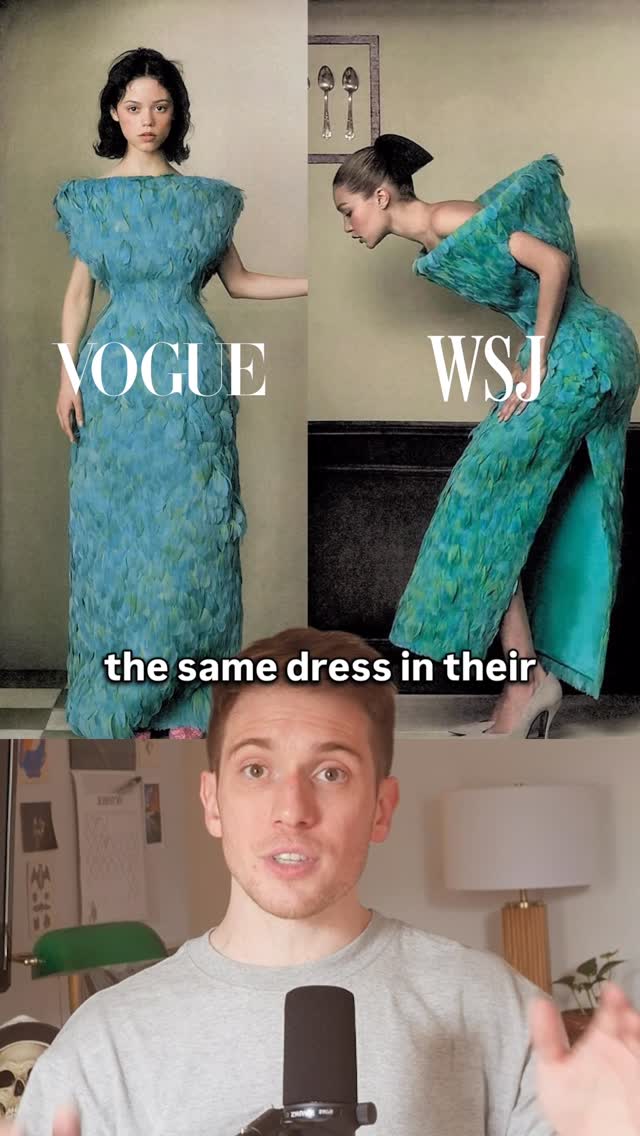
@ryanselvy ELLE, The Wall Street Journal, and Vogue all hired the same photographer for their covers this month. And they all look very similar with a very classic looking painterly style, in little diorama boxes, and similar colors.
It’s unmistakably Szilveszter Makó’s portrait photography style.
he’s had a huge year, photographing some of the biggest celebrities with repeatable motifs and compositions. Which makes it weird that any fashion industry commentators are surprised the output looks the same.
Page six is blaming him for not having “the etiquette” of being exclusive. But these publications stopped paying out exclusivity fees long ago.
There is the case that two of the shoots have the same dress, but that seems like an even bigger issue. Why are these massive publications not equipped with the thorough resources and appropriate teams to not be blindsided by this?
#vogue #magazinecover #editorialdesign #fashionphotography #messydesignhistory
Creator explains fashion media controversyfrom @ryanselvy
[01]
Overview
The creator breaks down a recent controversy where three major fashion magazines (Vogue, WSJ, Elle) used the same photographer, Szilveszter Makó, resulting in nearly identical cover concepts. He presents evidence, including side-by-side comparisons of the covers and an instance where two magazines featured the same dress. The creator then refutes the media's blame on the freelance photographer, arguing that the powerful publications are responsible for their own creative identity and should pay for exclusivity rather than expecting loyalty based on unwritten 'etiquette,' ultimately concluding they lack creative vision.
“This is a giant screw-up,” a fashion media source told Page Six.
Verbal hook · 40%
This is a giant screw up.
Visual hook · 5%
A split-screen composition with the speaker in the bottom half and a stylized, painterly fashion photograph in the top half, creating immediate visual contrast and an informational layout.
[06]
Hook template
Steal this for your own video
"[Blunt insider verdict]," a [insider job title] told [type of publication].
— "This is a giant screw-up," a fashion editor told a tabloid.
— "We never saw the lawsuit coming," a restaurant supplier told a local newspaper.
— "Nobody on the team trusts the new rollout," a hospital nurse told a trade magazine.
[07]
Hook and payoff
The promise the opener makes, and how the video pays it back
Hook
The video opens with a provocative, third-party quote that establishes immediate conflict and high stakes, framing the topic as a significant 'screw-up'.
Payoff
The video concludes with a lighthearted, self-referential joke that breaks the serious tone, followed by a clear branding statement and a call to action, solidifying the creator's identity.
[08]
Narrative framework
The structural pattern this video runs on
Framework
The Investigative Takedown
To present a popular controversy or problem, debunk the mainstream or 'official' explanation, and then reveal a more insightful counter-narrative that identifies the 'true' culprit and offers a logical solution.
1
The Context Layer
Quickly provides the essential background information (the who, what, and where) to explain why the initial hook statement is relevant and establishes the key players in the conflict.
2
The Evidence Escalation
Presents a specific, undeniable piece of evidence that elevates the problem from a general issue to a concrete, indefensible mistake, thereby increasing the narrative stakes.
3
The Investigative Pivot
Poses a direct, central question to the audience (e.g., 'Who's to blame?'), officially transitioning the video's purpose from exposition to analysis and investigation.
4
The Official Scapegoat
Introduces the mainstream or establishment's answer to the central question, presenting a 'straw man' argument or an easy target that the narrator will proceed to dismantle.
5
The Logic Takedown
Systematically refutes the 'official' answer using rhetorical questions, sarcasm, and logical reasoning, positioning the narrator as a more credible authority than the establishment source.
6
The Thesis Reveal
Presents the narrator's core argument, identifying the 'true' but less obvious culprit. This shifts blame from an individual to a systemic or institutional failure.
7
The Constructive Mandate
Offers a clear, actionable solution or a superior alternative course of action that the 'true culprit' should have taken, providing a satisfying and logical conclusion to the argument.
Themes
Creative industry ethics
Freelancer rights
Corporate responsibility
Lack of originality
Techniques
Split screen
Image overlays
Direct address
Trends
Industry commentary
News breakdown
Post caption
ELLE, The Wall Street Journal, and Vogue all hired the same photographer for their covers this month. And they all look very similar with a very classic looking painterly style, in little diorama boxes, and similar colors.
It’s unmistakably Szilveszter Makó’s portrait photography style.
he’s had a huge year, photographing some of the biggest celebrities with repeatable motifs and compositions. Which makes it weird that any fashion industry commentators are surprised the output looks the same.
Page six is blaming him for not having “the etiquette” of being exclusive. But these publications stopped paying out exclusivity fees long ago.
There is the case that two of the shoots have the same dress, but that seems like an even bigger issue. Why are these massive publications not equipped with the thorough resources and appropriate teams to not be blindsided by this?
#vogue #magazinecover #editorialdesign #fashionphotography #messydesignhistory
Text overlays
contextual · beginning
“This is a giant screw-up,” a fashion media source told Page Six.
contextual · beginning
This is a giant screw up
contextual · beginning
it’s irresponsible from the photographer’s side not to let the magazines know they’re doing the same concept.”
title · beginning
MESSY DESIGN HISTORY
contextual · beginning
Szilveszter Makó
contextual · middle
VOGUE
contextual · middle
WSJ
contextual · middle
BALENCIAGA
contextual · middle
VOGUE WSJ ELLE
contextual · middle
Still, the insider stressed that Makó is talented and deserves a long career — he just needs to learn the etiquette of a business built on exclusivity.
contextual · middle
LOYALTY
contextual · middle
...etiquette?
informational · end
IT'S NO SECRET HE REVISITS MOTIFS IN HIS WORK
contextual · end
VOGUE
I'M JUST KIDDING
branding · end
RYAN SELVY
“It’s just a joke”
Transcript
This is a giant screw up. It's irresponsible that the photographer didn't let the magazines know that they were doing the same concept. So Elle, The Wall Street Journal, and Vogue are all using the same photographer for the covers this month, Sylvester Mako. I mean, he's been all over the place this year. Get your bag thing. He photographs celebrities in his painterly style and his box format. Bogan Wall Street Journal even featured the same dress in their photoshoots. This is, like, 20 different problems, hilariously visualized, completely unattention. But who's to blame? Why is the freelancer responsible for the creative identity of multiple competing publications? Page six's insider says it's the photographer because he needs to learn the etiquette of business built on exclusivity. They're expecting loyalty from freelancers because etiquette? What mob boss did they interview? They're interview? They're supposed to be peak culture. They have access to anyone, and the most exciting thing that they can come up with is the same as everybody else. And if you want exclusivity, that's fine. Just pay for it. Or maybe get more thorough tier, ones that know what the competition is doing or have enough creative vision to stand out using the same talent. Unless they wanna put me on all the covers, and then I'm just kidding. It's a joke. I'm Ryan Selby. Follow for more yes design history.
Creator explains fashion media controversy | Viral Hooks