Viral Hooks
Trending short videosRetirement calculator case study
D

@dallasdoesmoney

Instagram 路 Split screen

@dallasdoesmoney Looking into this 43 year old鈥檚 retirement trajectory based on his current investment habits and the potential changes he can make! He makes $93k/year as an electrician and wants to retire with $80k/year of income! We鈥檙e using a 10% rate of return and 3% for inflation as our assumptions. How do you feel about your retirement right now?馃憞

View original on Instagram

The edit1 shot 路 8 text
Shots Text2:36

Performance

Views
134.1K
Likes
2K
Comments
2.1K
Engagement
3%
Length 路 8 Oct 2026
2:36

Video #49079 路 Split screen

Retirement calculator case studyfrom @dallasdoesmoney

[01]

Overview

The creator walks through a hypothetical retirement plan for a 43-year-old electrician starting with no savings. He first calculates the total investment needed to supplement Social Security, then uses a spreadsheet to model different scenarios: starting with an employer 401k match, adding a Roth IRA contribution, increasing the 401k contribution to 12%, and finally, delaying retirement by two years to successfully exceed the income goal.

[02]

Simple outline

  1. 1Present a relatable, high-stakes persona.
  2. 2Calculate the daunting target number.
  3. 3Model a series of escalating solutions.
  4. 4Reveal the achievable winning formula.

[03]

Related videos

[04]

Classification

Concepts
Case Study BreakdownTutorial / How To
Elements
Text OverlayScreen RecordingSplit ScreenDM / Comment-for-Info CTATitle Text Hook

[05]

Hook analysis

What stops the scroll in the first 3 seconds

Title hook

Retirement Calculator

Verbal hook

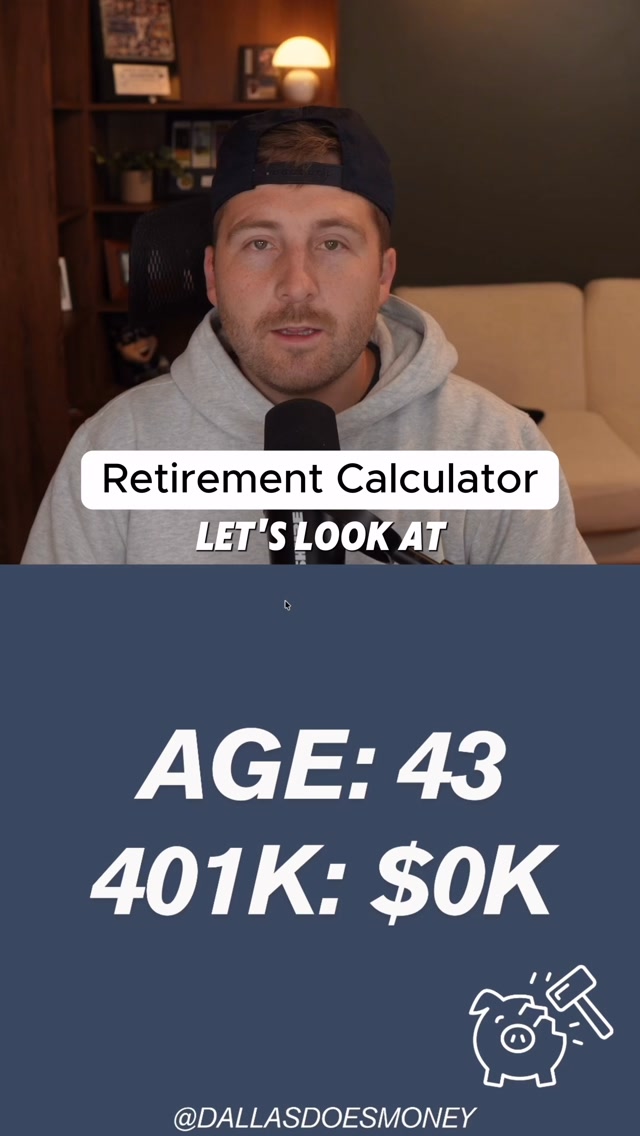
Let's look at a 43 year old who has $0 in the 401k right now.

Visual hook

The video opens with a split-screen layout. The bottom half features large, high-contrast text overlays on a dark blue background that change every few seconds, presenting key data points like 'AGE: 43' and '401K: $0K'.

[07]

Hook and payoff

The promise the opener makes, and how the video pays it back

Hook

Introduce a protagonist facing a common, high-stakes problem with a specific, daunting starting point (e.g., starting from zero), making the situation immediately relatable and creating a sense of urgency.

Payoff

Reveal the final, winning combination of actions that allows the protagonist to not just meet, but exceed the goal. This provides a highly satisfying resolution and delivers a clear, actionable, and achievable formula for the viewer.

[08]

Narrative framework

The structural pattern this video runs on

Framework

The Scenario Solver

To present a relatable, high-stakes problem, quantify a specific goal, and then systematically model a series of escalating solutions within a visual tool to demonstrate an achievable path to success. The narrative builds tension by showing initial, simpler solutions falling short before revealing a winning combination of actions.

  1. 1

    The Goal Quantification

    Translate the protagonist's desired lifestyle outcome into a concrete, intimidating numerical target. This establishes the 'mountain to climb' and sets the stakes for the rest of the video.

  2. 2

    The Guide's Toolkit & CTA

    Introduce the specific tool or system (e.g., a spreadsheet, a calculator) that will be used to solve the problem, positioning the creator as the expert guide and providing a direct call-to-action for viewers to acquire the tool.

  3. 3

    The 'Free Money' Baseline

    Model the first, most obvious, and lowest-effort action the protagonist can take. This establishes a baseline result and provides an initial sense of progress.

  4. 4

    The Reality Check Gap

    Reveal that the baseline action, while beneficial, is insufficient to reach the goal. This creates a 'gap' and introduces the primary narrative tension: 'How will we close this gap?'

  5. 5

    The Incremental Tweak

    Introduce and model a second, manageable action. This demonstrates that small, additional efforts can create progress, but it's strategically designed to still fall short of the ultimate goal.

  6. 6

    The 'Big Lever' Pull

    Introduce and model the most significant and impactful action the protagonist can take. This beat serves as the narrative's turning point, showing a dramatic leap towards the goal.

  7. 7

    The 'Almost There' Climax

    Show the result of the 'Big Lever' pull, which brings the protagonist tantalizingly close to the target but just shy of it. This maximizes suspense before the final resolution.

  8. 8

    The Final Variable Adjustment

    Instead of simply increasing the previous action, introduce a different variable to tweak (e.g., time, efficiency). This demonstrates lateral thinking and offers an alternative path to success.

Themes

  • Financial planning
  • Late-start retirement
  • Investment strategy
  • Goal setting

Techniques

  • Case study
  • Step-by-step tutorial
  • Data visualization

Post caption

Looking into this 43 year old鈥檚 retirement trajectory based on his current investment habits and the potential changes he can make! He makes $93k/year as an electrician and wants to retire with $80k/year of income! We鈥檙e using a 10% rate of return and 3% for inflation as our assumptions. How do you feel about your retirement right now?馃憞

Text overlays

  • title 路 beginning

    Retirement Calculator

  • informational 路 beginning

    AGE: 43 401K: $0K

  • informational 路 beginning

    ELECTRICIAN SALARY: $93K

  • informational 路 beginning

    GOAL $80K/YR

  • informational 路 beginning

    SOCIAL SECURITY $33K/YR

  • informational 路 beginning

    GOAL: $80K (SS: $33K) =47K

  • informational 路 beginning

    4% RULE $47K/YR X25 =$1.175M

  • branding 路 beginning

    @DALLASDOESMONEY

Transcript

Look at a 43 year old who has $0 in the four zero one k right now. He is starting from complete scratch. He's an electrician right now. He's making $93,000 a year of income. His goal is to have $80,000 a year when he actually ends up retiring, and he is going to have about $33,000 a year from his Social Security. So we need to close that gap between 80,000 and $33,000 a year. 80 minus 33 is tier, and using the 4% rule, this means that we need about $1,175,000 by the time he actually retires in order to achieve that $80,000 a year of income goal. We're gonna calculate this using my retirement calculator. It's available at the link in my bio or just comment template down below, and I will send you a link for you to check it out. So you can see he's 43 years old. He wants to retire age 65. He makes $93,000 a year. He expects 2% inflationary raises every single year rank he's not currently investing anything rank he doesn't currently have any investments. So the very first thing that we're gonna do is we're gonna get his employer match. His employer matches 4% as long as he contributes 6%. So we're gonna put in six percent for him and 4% for his employer and see where that gets us right no. That puts us at $625,000 by age tier. And using the 4% tier, that puts us at about $25,000 a year. And remember, we need to better that $47,000 a year mark because then when we add 33,000 on social security, that gets us to the 80,000. Now like I said, we are just starting here with the employer match, the 6% and the 4%. There are still many other things that he can do and there are two things specifically that said he would like to try. The first one is investing about $200 a month into his Roth IRA. So if we add $200 a month into his Roth IRA, that now puts him at about $760,000 total assets by the age 65, which still is about $400,000 short short of where we need to be. The biggest lever that we're gonna have is that four zero one k contribution. And he said he's willing to go up to 12% with this number. So we're gonna type in what would happen if he put 12% to his four zero one k. That now puts him at $1,136,000 of total assets and $45,000 a year, which is only $2,000 short of where he needs to be. The other thing we can look at is his retirement age because right no, this is what he said is the maximum amount that he can invest total right now. Maybe that will change in the future, but right no, this is where we're at. But he did say he could push his retirement age to to 66, 67, maybe even 68. So let's just see what that looks like if we change this from 65 to 66. That puts him at 1,245,000. 67, which is a typical retirement age now, puts us at $1,360,000 and that gives him $54,000 a year using the 4% rule. If we add his $33,000 of social security, that puts him now at $87,000 a year of income. Like I said, comment template down below if you wanna check out this spreadsheet that I built and also if you wanna submit your own information for the next video, just visit the link in my bio and submit it completely free.

Retirement calculator case study | Viral Hooks