Viral Hooks
Trending short videosExplaining a hidden financial crisis
M

@maxxrosenblum

Instagram · Greenscreen Talking Head

@maxxrosenblum The global financial system runs on 220 billion lines of COBOL code written in a language from 1959. The people who understand it are retiring at 10% a year. Universities stopped teaching it decades ago. And nobody has a plan. This isn’t a technology problem. It’s a knowledge problem and the window to fix it is closing. #economics #finance #computerscience #cobol

View original on Instagram

The edit1 shot · 1 text
Shots Text2:18

Performance

Views
552.1K
Likes
31K
Comments
605
Engagement
5.7%
Outlier
120.3×
Length · 11 Aug 2026
2:18

Video #39066 · Greenscreen Talking Head

Explaining a hidden financial crisisfrom @maxxrosenblum

[01]

Overview

The creator explains the 'COBOL knowledge crisis,' detailing how the global financial system relies on an outdated programming language understood by a rapidly retiring workforce. He uses statistics, economic concepts like tacit knowledge, and real-world analogies like the Boeing 737 Max case to illustrate the systemic risk and the escalating cost of inaction due to decades of neglect in knowledge transfer.

[02]

Simple outline

  1. 1State a hidden crisis
  2. 2Reveal shocking scale
  3. 3Reframe the core problem
  4. 4Show a cautionary tale
  5. 5Pose a final question

[03]

Related videos

[04]

Classification

Concepts
BreakdownCase Study BreakdownStrange but True
Elements
Title Text HookData Visualization GraphicGreen Screen Composite

[05]

Hook analysis

What stops the scroll in the first 3 seconds

Title hook · 55%

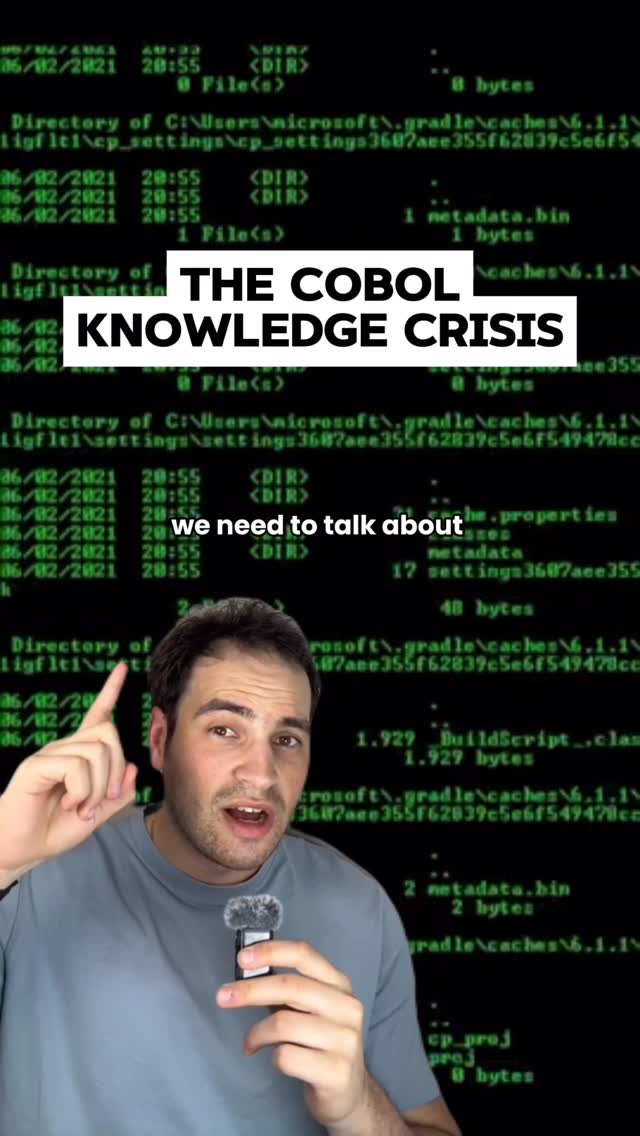
THE COBOL KNOWLEDGE CRISIS

Verbal hook · 30%

We need to talk about the COBOL knowledge crisis.

Visual hook · 15%

The background is a rapidly scrolling green-on-black command line interface, creating immediate visual motion and establishing a tech/coding theme. The speaker points upward, directing attention to the title text.

[06]

Hook template

Steal this for your own video

THE [HIDDEN SYSTEM] CRISIS

  • — THE COBOL KNOWLEDGE CRISIS
  • — THE ACTUARIAL TALENT CRISIS
  • — THE GRID INFRASTRUCTURE CRISIS

[07]

Hook and payoff

The promise the opener makes, and how the video pays it back

Hook

Introduce a high-stakes problem through a single, relatable human archetype who represents a critical point of failure, immediately establishing personal relevance and a sense of impending doom.

Payoff

Deliver an intellectual payoff by leaving the viewer with a haunting, unresolved question that reframes their understanding of the world, creating a lasting sense of unease and intellectual curiosity rather than a neat conclusion.

[08]

Narrative framework

The structural pattern this video runs on

Framework

The Hidden Crisis Unveiled

To expose a critical, overlooked vulnerability in a system we take for granted by systematically revealing its scale, complexity, and the human-centric threat to its stability, leaving the audience with a profound sense of newfound awareness and unease.

  1. 1

    The Human Single Point of Failure

    Frame the crisis around a single, aging expert whose retirement threatens a system we all use, making the abstract problem personal and urgent.

  2. 2

    The Shocking Scale of Dependency

    Use hard, surprising data and statistics to quantify the system's importance and the magnitude of the vulnerability, establishing the global stakes.

  3. 3

    The Paradox of Reliability

    Explain that the system's own success and stability is the root cause of its neglect, creating a compelling and counterintuitive irony.

  4. 4

    The Unwritten Institutional Memory

    Reframe the problem from a simple technical issue to a deeper crisis of uncodified, historical knowledge that exists only in people's minds.

  5. 5

    The Demographic Time Bomb

    State the core human threat: the experts are disappearing faster than they can be replaced, creating a non-negotiable deadline for the crisis.

  6. 6

    The Academic Framework

    Introduce a formal concept or theory (e.g., tacit vs. explicit knowledge) to lend intellectual credibility to the argument and provide a new lens for understanding the problem.

  7. 7

    The Cautionary Tale

    Use a well-known, disastrous real-world example as an analogy to make the abstract threat of knowledge loss feel concrete, tangible, and severe.

  8. 8

    The Exponential Cost of Delay

    Quantify the financial consequences of inaction, demonstrating how waiting makes the problem exponentially harder and more expensive to solve.

  9. 9

    The Institutional Blind Spot

    Show how established institutions (academia, government, etc.) failed to foresee or address the problem, reinforcing the idea that there is no easy fix or external savior.

  10. 10

    The Unresolved Future

    Conclude not with a solution, but by affirming the system's permanence while posing a haunting, open-ended question about who will be left to maintain it.

Themes

  • Knowledge Transfer
  • Systemic Risk
  • Technological Debt
  • Workforce Aging

Techniques

  • Visual Storytelling
  • Analogical Explanation
  • Data-driven Argument

Post caption

The global financial system runs on 220 billion lines of COBOL code written in a language from 1959. The people who understand it are retiring at 10% a year. Universities stopped teaching it decades ago. And nobody has a plan. This isn’t a technology problem. It’s a knowledge problem and the window to fix it is closing. #economics #finance #computerscience #cobol

Text overlays

  • title · beginning

    THE COBOL KNOWLEDGE CRISIS

Transcript

Need to talk about the COBOL knowledge crisis. Somewhere right no, a 55 year old in a golf shirt is the only person on earth that knows why your direct deposit worse, and he's thinking about retiring and no one is training to replace him. The language he writes is called COBOL, and it handles 95% of ATM swipes, dollars 3,000,000,000,000 in daily transactions, and the bad end of nearly every system that touches your money. It just worse. And that's actually the problem because as long as it works, nobody feels the urgency to understand what's behind it. And what's inside it is not code in the way most people think about code. It's forty years of tax law, benefits eligibility rules, and court rulings no one remembers anymore encoded directly into business logic that was never written down anywhere else. It's effectively the institution's memory, and the only people who can read it are retiring at about 10% per year with no pipeline behind them. But to understand why this matters so much, you have to understand how economists think about knowledge. They split it into two types: explicit knowledge, which is the kind of knowledge you can write in a manual and teach in a classroom, and tacit knowledge, the opposite, the kind that only exists because someone has done a specific thing for decades. Right now, the Harvard Business Review estimates that Fortune 500 companies lose around $31,500,000,000 a year best from employees failing to share knowledge before they leave. If that still doesn't make sense and you want an example, look to the skies. Boeing is a textbook case. They outsourced production, laid off some of their most experienced engineers to cut costs, and took their process knowledge with them. And we saw how that ended. COBOL is that same pattern running at the scale of rank entire knowledge transfer takes years of overlap, and worst companies never funded that overlap. A modernization consultant might put a price on the cost of that neglect at millions of dollars for a business to reverse engineer their own systems and reconstruct business logic from code no current employee understands. Tasks that if done five years earlier, will from code no current employee understands. Tasks that if done five years earlier while the original programmers were still on staff might have cost $200,000 and taken one tenth of the time. And now every year they wait, that cost multiplies roughly by five. Most universities saw this drop off happening. In fact, 85% of them dropped COBOL from the curriculum in the nineties thinking the language would die off. And three decades later, we can see they were wrong. The language didn't die, but the workforce did. In fact, Social Security alone runs on 60,000,000 lines of COBOL and about 30% of that agency's IT leadership is eligible for retirement right now. And sure, everyone wants to talk about the fix, AI migration, cloud conversion, rewriting it all in Java. It's very clear the code will outlive all of us. The question is whether anyone will be left who knows what it means.

Explaining a hidden financial crisis | Viral Hooks