Video #37847 · Speaker address
Creator ranks student research ideasfrom @lumiere_edu
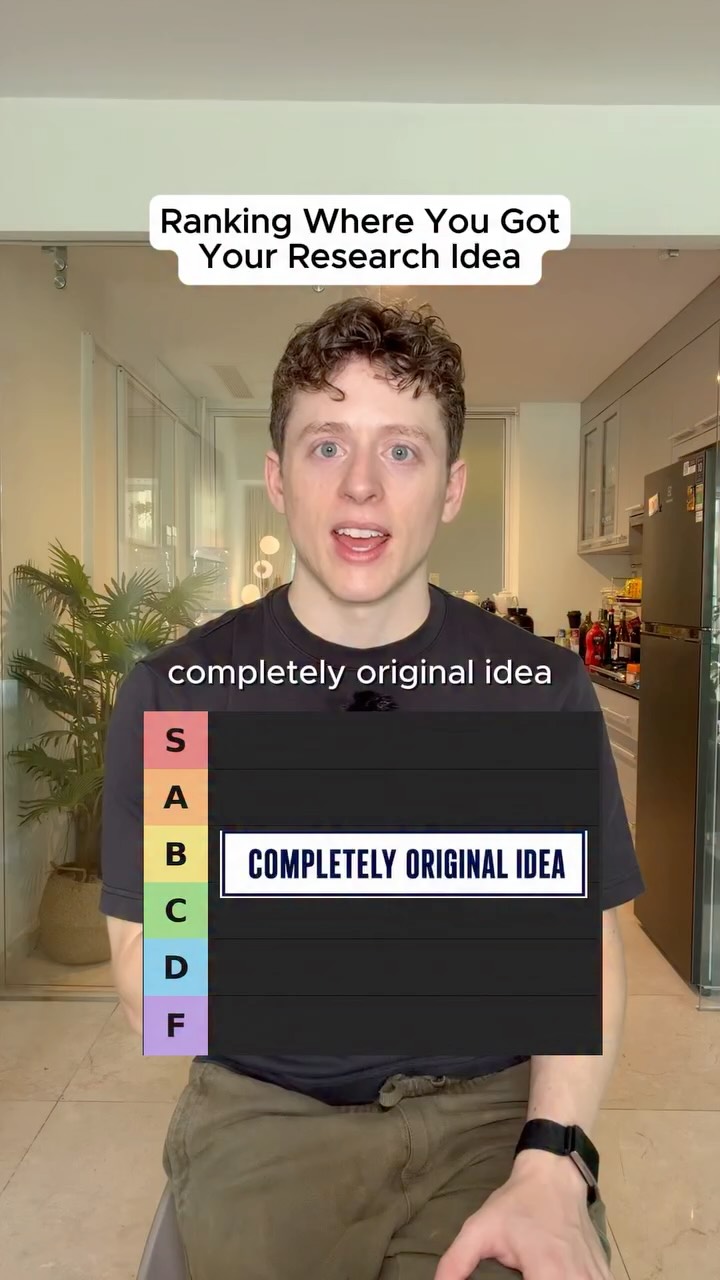
The creator ranks different sources for high school research ideas using a tier list graphic. He places 'completely original idea' in F tier, 'copying an ISEF winner' and 'replication with new population' in A tier, 'mentor's leftover project' in C tier, and 'future work section of a paper' in S tier, providing a brief justification for each ranking.
- 1State controversial low rank
- 2Rank good/better options
- 3Reveal the ultimate S-tier
ConceptsRapid Fire ListicleExpert Rate/Rank
ElementsTier List GraphicText OverlayJump Cut
[05]
Hook analysis
What stops the scroll in the first 3 seconds
Title hook · 35%
Ranking Where You Got Your Research Idea
Verbal hook · 30%
Completely original idea.
Visual hook · 35%
A large, centrally-placed tier list graphic (S, A, B, C, D, F) immediately establishes the video's ranking format and creates a clear visual structure for the content.
[07]
Hook and payoff
The promise the opener makes, and how the video pays it back
Hook
A title card that clearly states the topic and the ranking format ('Ranking Where You Got Your Research Idea'), immediately setting viewer expectations for a comparative judgment.
Payoff
The final item ('Future work section of a paper') is revealed as the 'S-tier' or ultimate best option. It's positioned as an insider secret that solves the core problem most effectively, delivering the ultimate piece of advice the video has been building towards.
[08]
Narrative framework
The structural pattern this video runs on
Framework
The Contrarian Tier List
A rapid-fire ranking of items within a specific niche, starting with a controversial low ranking of a commonly accepted 'good' item to hook the viewer, and building to the reveal of a 'secret' top-tier item.
- 1
The Contrarian Takedown
The first item presented is a commonly held belief or popular option ('completely original idea'), which is immediately given a surprisingly low rank ('F tier'). This subverts expectations and establishes the creator's unique, authoritative perspective.
- 2
The High-Value Alternatives
The next items presented are superior, practical alternatives ('Copying ISEF winner', 'Replication with new population'), receiving a high rank ('A tier'). This provides immediate value and justifies the controversial opening.
- 3
The Nuanced Middle Ground
An item with both pros and cons ('Mentor's leftover project') is ranked in the middle tier ('C tier'). This adds credibility and shows the creator's judgment is balanced, not just extreme.
Themes
- Academic guidance
- Productivity
- Strategy
Techniques
- Tier list ranking
- Direct address
- Educational content
Trends
Post caption
Ranking where high schoolers get their research ideas 🚫 Every experienced researcher steals from papers, datasets, and other people's unfinished work.
Follow and comment "TIER" for the full tier list!
Text overlays
title · beginning
Ranking Where You Got Your Research Idea
informational · beginning
completely original idea
informational · beginning
COMPLETELY ORIGINAL IDEA
informational · middle
COPYING ISEF WINNER
informational · middle
REPLICATION WITH NEW POPULATION
informational · middle
MENTORS LEFTOVER PROJECT
informational · middle
FUTURE WORK SECTION OF A PAPER
Transcript
Completely original idea. F tier. This is the most common mistake of high school students. Don't start with an original idea. Start with something that already works and then build on top of it. Copying an ISEF winner. A tier. This is a great place to get started. Copy an existing ISEF project and then extend upon it. Replication with new population. Yeah. This is A tier. This is really respect to the academic community, and the great thing about it is that it's already derisked because it's already been shown in one other research paper. Your mentor's leftover project. C tier, this is okay, but oftentimes it's gonna be hard for you to defend why you did this project if you didn't start with it from the beginning. Future worse section of a paper. S tier, this is the best way for high school students to get started. They've already identified a next step and created methodology that you can then copy.