@arrionknight
Instagram · Split screen
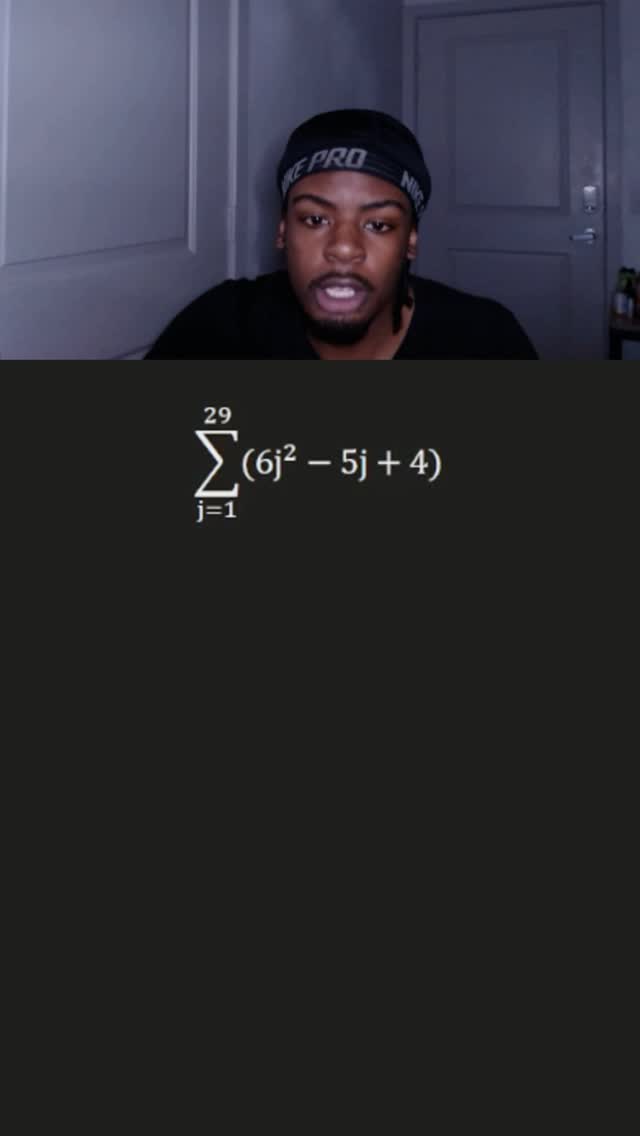
@arrionknight Summation Formulas are essential in calc and analysis of algorithms #computerscience #calculus #math #memes #hoodcoding

@arrionknight
Instagram · Split screen
@arrionknight Summation Formulas are essential in calc and analysis of algorithms #computerscience #calculus #math #memes #hoodcoding
Performance
Video #5337 · Split screen
[01]
The creator solves a summation problem by first breaking it down into three separate parts. He then applies the standard summation formulas for the sum of squares, the sum of natural numbers, and the sum of a constant, calculating the value for each part and finally combining them to arrive at the final answer.
[02]
[03]
 160.4K71.5×How scientists think about problems@kolbykirschner · Breakdown
 4.2M71.1×Explaining a famous movie problem@scientific_american · Breakdown
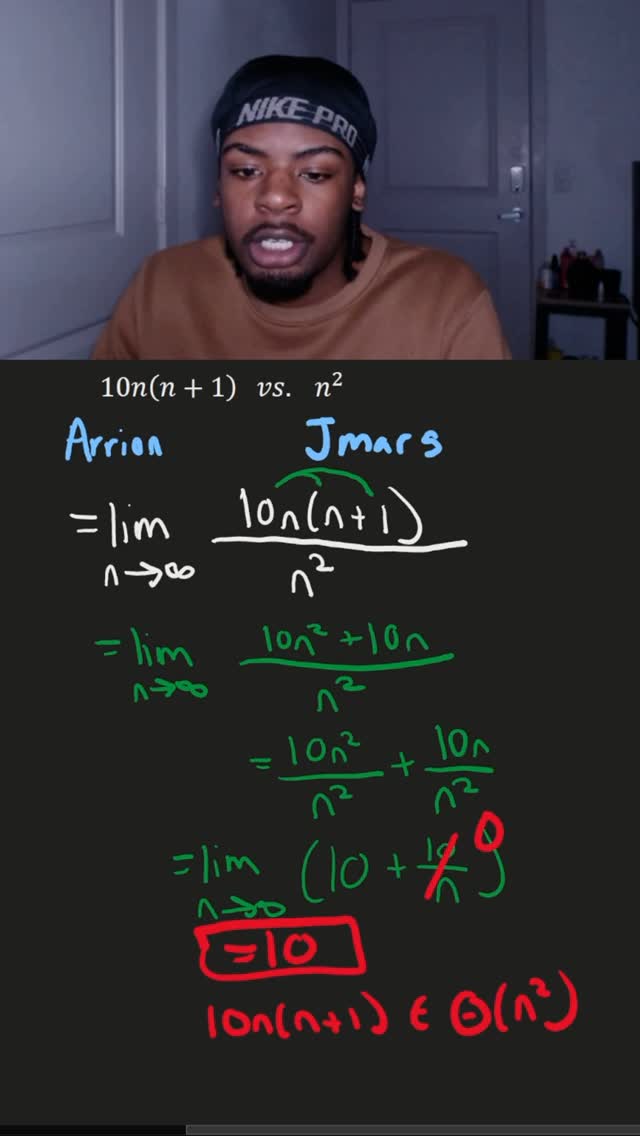 155KHood math explains calculus limit.@arrionknight · Breakdown
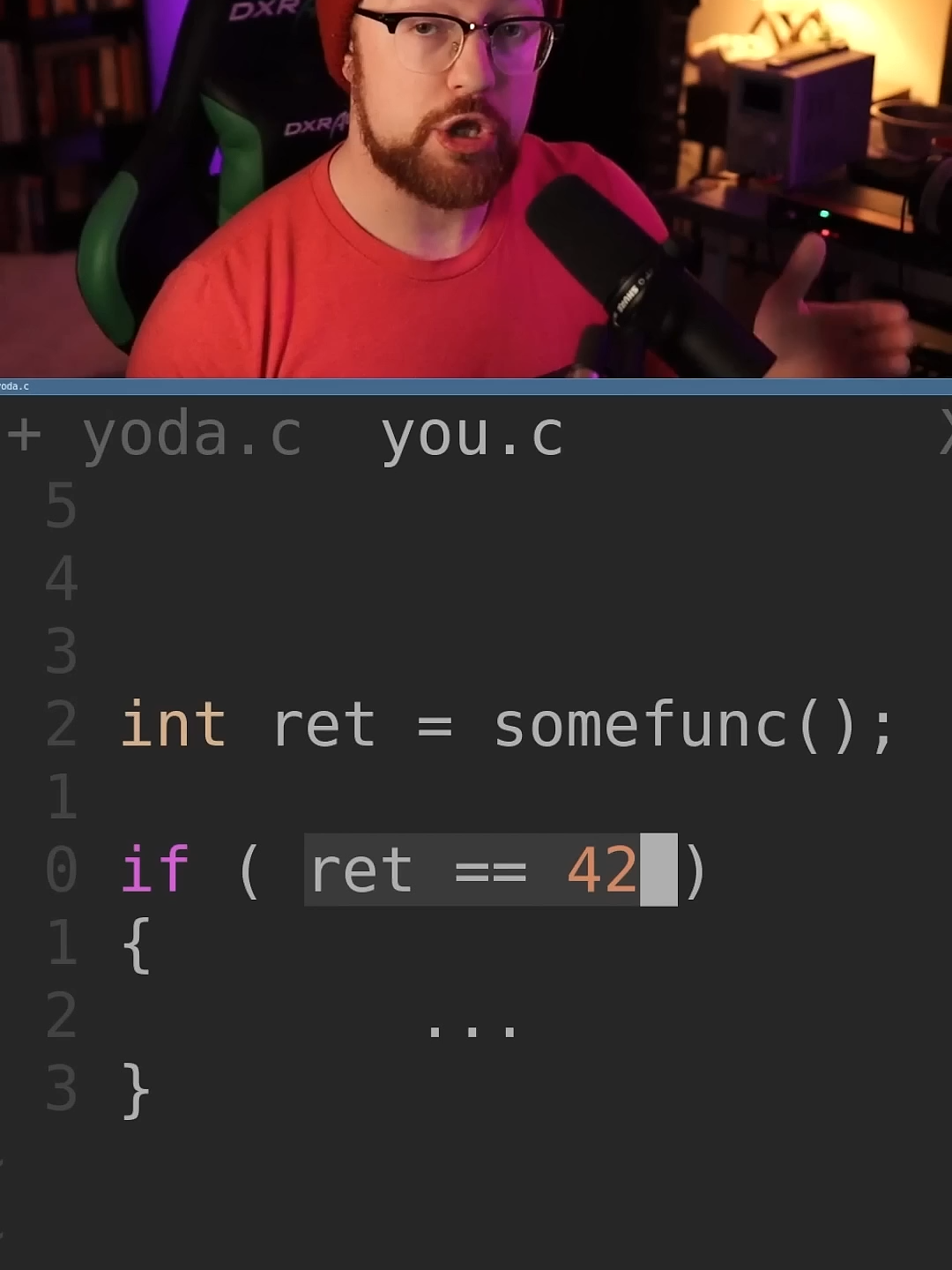 92K2.1×Explains Yoda notation coding trick@node.io · Good vs Bad
 295.3K73.8×Ranking academic competitions by difficulty@lumiere_edu · Rapid Fire Listicle
 134.1KRetirement calculator case study@dallasdoesmoney · Case Study Breakdown
 3.1M106.2×Surreal doodle on math homework@coolmathgames
 120.1K2.6×Explaining how banks create money@womp_tomp · Breakdown
 156.8KCreator answers question about science@thecuriositybox · Q&A Response
 234.3KTwo-step guide to learn cybersecurity@node.io · Breakdown
 129.8K39.3×Creator ranks student research ideas@lumiere_edu · Rapid Fire Listicle
 517.8K11×Viral hook then coding lesson@node.io · Breakdown
[04]
[05]
What stops the scroll in the first 3 seconds
Title hook · 55%
Σ(6j² - 5j + 4)
Verbal hook · 30%
No cap. This is one of the easiest problems you'll ever see.
Visual hook · 15%
A split-screen layout with the creator in the top frame making an expressive face and a complex math equation displayed prominently below.
[07]
The promise the opener makes, and how the video pays it back
Hook
A bold, counterintuitive claim that contradicts the visual evidence (e.g., 'this is easy' about a complex problem), creating an immediate knowledge gap the viewer wants to close.
Payoff
The results from the individual components are combined (synthesized) to produce the final, satisfying answer, thereby proving the initial hook's claim was true and rewarding the viewer's attention.
[08]
The structural pattern this video runs on
Framework
The Deconstructive Proof
Presenting a complex-looking problem and revealing its underlying simplicity by breaking it down into a series of manageable steps, each solved with a specific rule or tool.
The Prerequisite Reveal
The creator establishes a condition or 'secret knowledge' required to validate the hook's claim, framing the video as a lesson and setting the viewer's expectations.
The Relevance Justification
The creator explains the practical importance or real-world application of the skill, giving the viewer a compelling reason to invest their attention beyond simple curiosity.
The Strategic Deconstruction
The complex problem is explicitly broken down into a clear list of smaller, less intimidating components, making the solution feel achievable.
The Systematic Solve
Each component is addressed sequentially, applying a specific rule, formula, or technique to solve it. This creates a repeatable and easy-to-follow pattern of problem -> rule -> solution.
Summation Formulas are essential in calc and analysis of algorithms #computerscience #calculus #math #memes #hoodcoding
informational · beginning
Σ(6j² - 5j + 4) from j=1 to 29
informational · beginning
Summation Formulas
informational · middle
Σ j² = n(n+1)(2n+1) / 6
informational · middle
= 51,330
informational · middle
Σ j = n(n+1) / 2
informational · middle
= 2,175
informational · end
Σ c = cn
informational · end
= 116
informational · end
= 49,271
No cap. This is one of the easiest problems you'll ever see. But you gotta hear me out. It's an easy problem, but you gotta know your summation formulas. You're definitely gonna see these summation formulas in calculus and algorithms. Alright. Now for the question, our goal is to find the value of this sum. We're gonna break this question down into three different parts. The first one is gonna be six j squared, the second one is gonna be five j, and the third one is best gonna be four. Alright. So for the first part, you see we have six j squared. So this means that we're gonna be getting the sum of squares from one to tier, six times. So let's ignore our constant of six and just get tier sum of squares from one to 29. And this is why knowing your formulas is so important because all we have to do is get our n, which is 29, and plug it into the sum of squares formula. And when we do this, we get 8,555. But remember, we still got our six on the outside, so let's multiply six times 8,555 and we get 51,330. That's our first part. And for our second part, five j, we want the sum of numbers from one to twenty nine five times. But we're in luck because there's another summation formula for that. So let's take out our five, then we're gonna plug our no, which is 29, into the sum of the first n natural numbers formula. And when we do this, we get 435, but we still have to multiply tier five, then we get 2,175. Then for the third part, there is gonna be another summation formula, but it's just gonna be 29 times four, and we get one sixteen. Then we just plug those numbers we got from those three parts back into the equation, then we get 49,271.