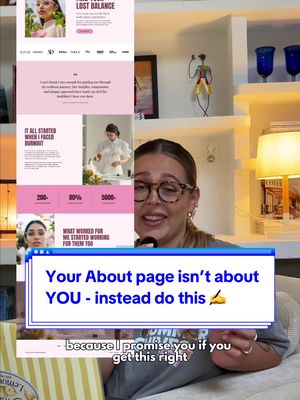
The creator provides a step-by-step guide on how to structure a website's 'About' page for maximum conversion. She argues against making it a personal biography and instead outlines a customer-centric framework, using a website example as a visual aid. The structure includes: a hero section focused on customer problems, an authority section with social proof, a purposeful personal story to build empathy, a data section with stats to build logical trust, a bridge from her story to the customer's transformation, and a final, clear call-to-action.
Post caption
Your “About me” page on your website isn’t about you at all, don’t do this mistake 😅 it’s not your biography, if you want to convert visitors into customers, do this instead. #webdesigner #webdesign #websitedesign #uxdesigner #webdesigntips
Transcript
Your about page on your website isn't about you at all. No one wants to read your life tier. Instead, this is how you should structure it. Your whole page should always answer these questions because this is what your customers really wants to know about you. Can you solve their problem? Can they trust you? And do you actually understand them? So start with a clear top or hero section where you immediately tell people how you can help them, not who you are. This instantly hooks visitors and shows them that they are in the right place. Then add a bit of authority, press logos, brand names, strong testimonials. This builds credibility. And this is not about bragging. It's about building trust no people can feel safe to scroll and keep reading. After that, share your personal tier, but with a purpose. This is not a biography. Show them that you understand what they're going through and that your journey has given you tools that you can help them with. This will create emotional connection and position you as someone who gets it. Then you can back it up again with some quick trust builders as we call them. Stats, success rates, numbers, this will give people logical reason to trust you. It's gonna turn from, okay. She clearly understands into, okay. She clearly knows what she's doing. Next, bridge your story to their transformation. Show how what worked for you worse for others too. And this is where your method or your work becomes real because it's not just your story anymore, it's a proof that your approach works. And finally, end with a clear next step, call to action. Don't just inspire them, guide them. Give them one simple call to action so they know what to do when they're ready to work with you. Make it stupidly easy for them. And make sure you save this video because I promise you, if you get this right, it's not gonna be just a read, it's gonna convert.