Viral Hooks
Trending short videosStorytelling formula for boring topics
H

@hilzuckerman

Instagram · Graphic Yap

@hilzuckerman How to make boring content addictive 👇 Steal these 4 lines for any topic: 1. “I have [too many of something] and I still can’t [what you need].” 2. “Last week that cost me [a real number].” 3. “I thought the problem was [what everyone blames]. It was [what you found].” 4. “Tonight, take 5 minutes and [one clear action].” This week: fill these in for your most boring post idea. Stuck on line 1? Your DMs already have the words. Save this, then send it to the friend with great ideas who struggles to turn them into content. Follow @hilzuckerman 🫶🏻 I’ve spent 22 years building brands for other people. Now I’m building my own from zero to 20,000 by Thanksgiving and sharing everything I’m learning as I go. #contentcreatortips #contentstrategy #personalbranding #instagramgrowth #womeninbusiness

View original on Instagram

The edit1 shot · 8 text
Shots Text2:23

Performance

Views
100.2K
Likes
3.3K
Comments
93
Engagement
3.4%
Length · 5 Nov 2026
2:23

Video #49729 · Graphic Yap

Storytelling formula for boring topicsfrom @hilzuckerman

[01]

Overview

The creator, a marketing expert, presents a four-step storytelling formula to make any topic engaging. She uses the consistent example of 'organizing phone photos' to demonstrate each step: 1) start with a relatable moment, 2) add a consequence to the problem, 3) show the 'turn' or the moment of realization, and 4) provide a specific, actionable takeaway. The video concludes by summarizing the four questions creators should ask themselves before posting and includes a call-to-action to follow her journey of building her personal brand.

[02]

Simple outline

  1. 1Identify a shared struggle
  2. 2Present a structured solution
  3. 3Prove the solution's value
  4. 4Deliver a practical tool

[03]

Related videos

[04]

Classification

Concepts
Tutorial / How ToCase Study BreakdownPlaybook
Elements
Text OverlayData Visualization GraphicImage OverlayJump CutGraphic OverlayVoiceoverTitle Text Hook

[05]

Hook analysis

What stops the scroll in the first 3 seconds

Title hook · 50%

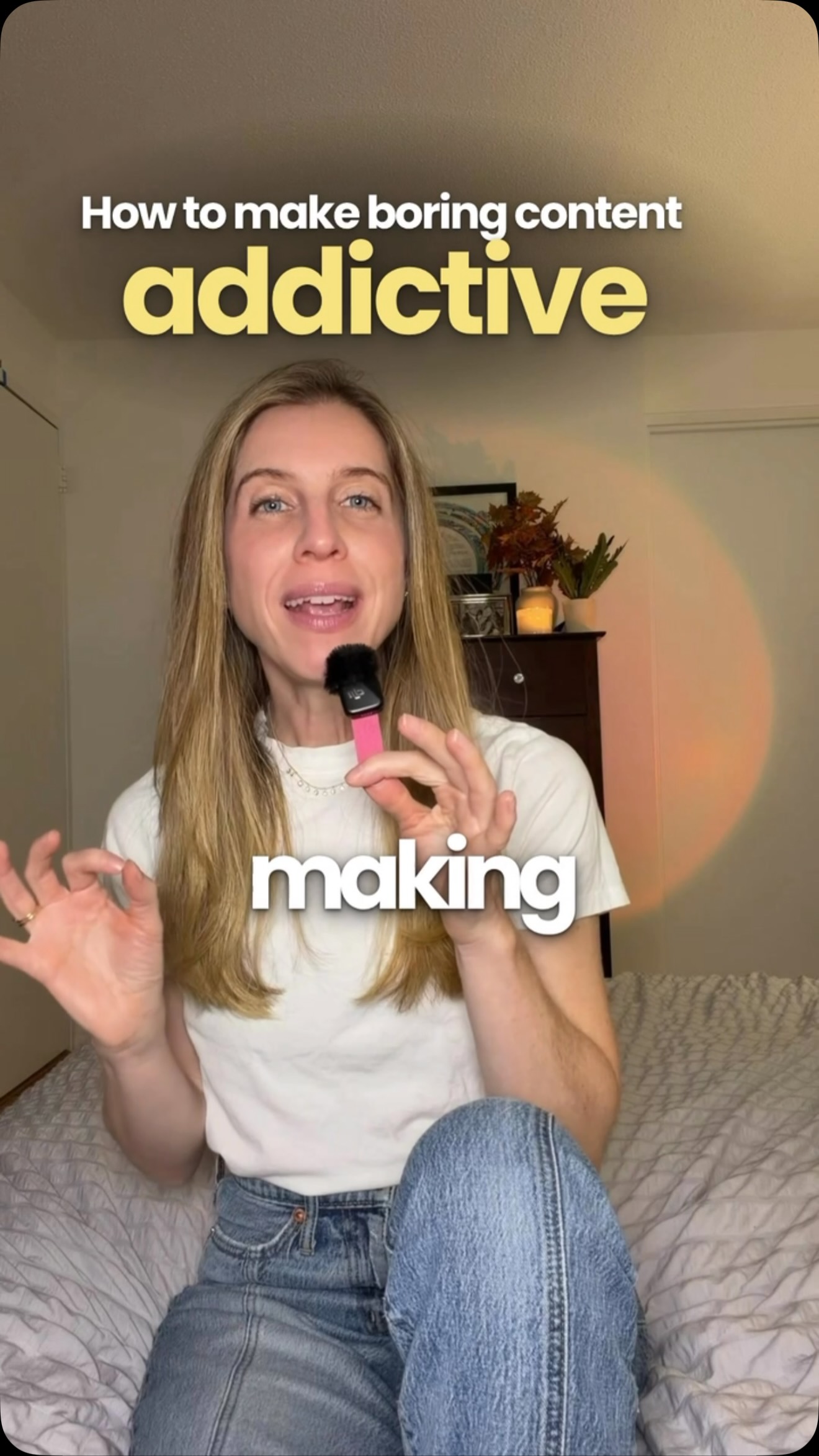
How to make boring content addictive

Verbal hook · 45%

If you're making helpful content but nobody's watching it, I wanna show you how to make even the most boring topic interesting.

Visual hook · 5%

A woman in a casual setting (on a bed) speaks directly to the camera holding a small, bright pink microphone. A warm, circular light is projected on the wall behind her, creating a distinct and visually interesting background that differs from a standard room.

[06]

Hook template

Steal this for your own video

How to make [boring topic] [desirable outcome]

  • — How to make tax paperwork addictive to watch
  • — How to make stretching routines impossible to scroll past
  • — How to make dental hygiene tips actually entertaining

[07]

Hook and payoff

The promise the opener makes, and how the video pays it back

Hook

Directly state a common, frustrating problem the target audience experiences ('making helpful content but nobody's watching') to create immediate relevance and a desire for a solution.

Payoff

A multi-layered Call to Action that encourages utility (Save this formula), community (Send to a friend), and long-term investment (Follow my journey), framing the follow as participation in a public growth story.

[08]

Narrative framework

The structural pattern this video runs on

Framework

The Transformation Formula

A multi-step teaching framework that transforms a 'boring' topic into an 'addictive' story by systematically layering narrative elements (a moment, a consequence, a change, an action) onto a single, consistent example to prove the framework's value in real-time.

  1. 1

    The Core Premise & Authority Claim

    Establish the video's central thesis (it's not the topic, it's the story) and assert credibility to teach it ('I've spent 22 years in marketing').

  2. 2

    The Roadmap Declaration

    Explicitly outline the structure of the video ('I'm going to give you four things to do') and the method of demonstration ('we're gonna use the exact same example for all four'). This manages expectations and promises a clear, easy-to-follow lesson.

  3. 3

    Principle 1: The Moment Anchor

    Introduce the first step of the formula ('start with a moment, not a topic'). Demonstrate its power by contrasting a generic, topic-based hook with a specific, relatable, moment-based hook that forces the audience to self-identify with the problem.

  4. 4

    Principle 2: The Stakes Injection

    Introduce the second step ('give the problem a consequence'). Explain its critical function (answering 'so what?') and demonstrate it by adding a tangible cost (time, motivation) to the running example, transforming an abstract problem into a costly one.

  5. 5

    Principle 3: The Revelation Turn

    Introduce the third step ('show the moment something changed'). Frame this as the narrative 'turn' that creates curiosity for the solution. Demonstrate it by reframing the initial problem to reveal a deeper, unexpected root cause.

  6. 6

    Principle 4: The Actionable Blueprint

    Introduce the final step ('give them something they can actually do'). Warn against vague advice and demonstrate by providing a concrete, simple, and immediately applicable task or system that directly solves the revealed problem.

  7. 7

    The Final Synthesis

    Consolidate the entire 4-step framework into a simple, memorable checklist or set of questions that the viewer can use as a practical tool before they create their own content.

Themes

  • Storytelling
  • Audience Engagement
  • Value Proposition
  • Actionable Advice

Techniques

  • Direct Address
  • Step-by-step guide
  • Problem-Solution Framework
  • Case Study Illustration

Post caption

How to make boring content addictive 👇 Steal these 4 lines for any topic: 1. “I have [too many of something] and I still can’t [what you need].” 2. “Last week that cost me [a real number].” 3. “I thought the problem was [what everyone blames]. It was [what you found].” 4. “Tonight, take 5 minutes and [one clear action].” This week: fill these in for your most boring post idea. Stuck on line 1? Your DMs already have the words. Save this, then send it to the friend with great ideas who struggles to turn them into content. Follow @hilzuckerman 🫶🏻 I’ve spent 22 years building brands for other people. Now I’m building my own from zero to 20,000 by Thanksgiving and sharing everything I’m learning as I go. #contentcreatortips #contentstrategy #personalbranding #instagramgrowth #womeninbusiness

Text overlays

  • title · beginning

    How to make boring content addictive

  • informational · beginning

    it's not the topic it's how you introduce it

  • title · beginning

    step 1 start with a moment, not a topic.

  • title · middle

    step 2 give the problem a consequence.

  • title · middle

    step 3 show the moment something changed.

  • title · end

    step 4 give them something they can actually do.

  • informational · end

    ask yourself 4 questions 1. Did I start with a moment someone recognizes? 2. Did I explain why it matters? 3. Did I show what changed? 4. Did I give them something useful to take away?

  • call-to-action · end

    0 -> 20,000 by Thanksgiving. come watch.

Transcript

You're making helpful content better nobody's watching it, I wanna show you how to make even the most boring topic interesting. I've spent twenty two years in marketing and branding, and one thing I've learned is that almost anything can become a good story. It's usually not the topic that's boring. It's how you're introducing it. So I'm gonna give you four things to do, and we're gonna use the exact same example for all four no you can see how much the story changes. And step two is where I think so many creators lose people. Step one, start with a moment, not a topic. Let's say you make content about organizing your phone. Not exactly the most exciting subject in the world. You could open with, here are five ways to organize your camera roll. Fine. But you've probably heard that advice a 100 times. Instead, try this. I have 18,000 photos on my phone and somehow can't find a single one when I need it. Now you've given someone a situation they can actually recognize, and that's what makes them stop scrolling. They're not thinking about organizing photos anymore. They're thinking about their 18,000 photos. Step two, give the problem a consequence. And this is where I think so many creators lose people. They explain what the problem is, but they never explain why someone should care. So let's keep going with our camera roll example. Saying something like, last week, I spent twenty minutes looking for a video I needed for Instagram. By the time I found it, I'd completely lost interest in making the post. Now we've gone from a boring organization tip to something that's actually costing someone time, and that's a problem most people care about. Step three, show the moment something changed. This is the part that makes people curious about your solution. What did you finally figure out? What were you doing wrong? What did you try instead? Maybe you realized the problem wasn't having too many photos. It was having no system for finding the useful ones. So you created three simple albums, content ideas, videos to edit, and ready to post. Do you notice what happened? We haven't changed the topic. We're still talking about organizing photos. But now the viewer has a reason to keep watching because she wants to see how you fixed it. And step four, give them something they can actually do. Don't spend three minutes building up a problem, and then leave people with vague advice. Show them exactly how to create the albums. Tell them what goes in each one. Give them a five minute exercise they can try tonight. Because when someone watches your video and immediately knows what to do next, that's the kind of content they save. So before you post your next video, ask yourself four questions. Did I start with the moment someone recognizes? Did I explain why it matters? Did I show what changed? And did I give them something useful to take away? You don't need a more interesting topic. You need to make your audience care about the one you've already chosen. Save this four step formula for your next filming day and send it to a friend who has great ideas better struggles to turn them into content. And follow along. I've spent twenty two years building brands for other people, and now I'm building mine from tier, and I'm sharing all the strategies I'm using along the way.

Storytelling formula for boring topics | Viral Hooks