@rileybrown.ai ChatGPT's new image generator is a viral sensation, and it works in a completely different way than other image generators. Previous image generators are primarily built on diffusion models that generate entire images by gradually removing noise from random patterns all at once, while GPT-4o uses an autoregressive approach that creates images sequentially from top to bottom and left to right, similar to how text is written. This autoregressive technique enables GPT-4o to excel at text rendering within images and accurate "binding" of multiple objects in specific positions, capabilities that diffusion models have historically struggled with. Though slower than diffusion-based generation, the autoregressive method produces remarkably detailed images with perfectly legible text and better consistency when generating multiple objects. The trade-off between speed and quality has proven worthwhile, as shown by the overwhelming popularity that has led to OpenAI temporarily limiting usage while they work to make the system more efficient.
Demonstrating new AI image generator features.from @rileybrown.ai
[01]
Overview
The creator demonstrates the capabilities of OpenAI's new image model, GPT-4o. He shows how it can transfer artistic styles onto photos, render images directly from code, create new images like YouTube thumbnails from a prompt, and edit existing images with high precision, while also explaining the underlying technology that makes it unique.
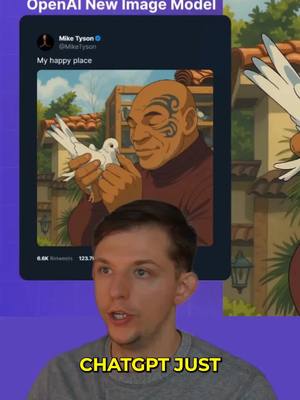
ChatGPT just released a new AI image generator and it is completely taken over the Internet.
Visual hook · 15%
A speaker is framed against a dynamic graphic background featuring the OpenAI logo and a colorful, anime-style image from a tweet.
[06]
Hook template
Steal this for your own video
[company or tool] just released a new [product category], and it’s completely taking over [your industry or community].
— OpenAI just released a new AI image generator, and it’s completely taking over the internet.
— Nike just released a new running shoe, and it’s completely taking over marathon training circles.
— Duolingo just released a new language-learning feature, and it’s completely taking over study TikTok.
[07]
Hook and payoff
The promise the opener makes, and how the video pays it back
Hook
A high-stakes, superlative claim about a new innovation that has 'taken over' or is changing everything, creating immediate curiosity and setting the stage for proof.
Payoff
A concluding call-to-action that promises future value and expertise, encouraging the viewer to follow for more insights on the now-proven disruptive technology.
[08]
Narrative framework
The structural pattern this video runs on
Framework
The Escalating Proof
To prove a bold claim about a new tool or concept by presenting a series of increasingly complex and impressive demonstrations, moving from a basic function to a paradigm-shifting capability, and finally to a practical, iterative workflow.
1
The Foundational Demo
Establishes the tool's basic, most widely understood function. This grounds the viewer with a simple, impressive example and sets a baseline expectation to be shattered later.
2
The Paradigm Shift Proof
Pivots from the expected function to reveal a surprising, non-obvious capability that fundamentally changes the viewer's understanding of what the tool can do. This is the core 'wow' moment.
3
The Industry Disruption Claim
Explicitly states the real-world consequences of the paradigm-shifting capability, framing the tool as a threat to established incumbents and raising the stakes of the demonstration.
4
The Creator Workflow Demo
Translates the tool's abstract power into a tangible, relatable, step-by-step creative process, showing how a user can go from a blank slate to a finished product.
5
The Iterative Power Play
Demonstrates the ability to refine and edit a previous creation using simple commands, proving the tool is not just a one-shot generator but a collaborative and controllable creative partner.
Themes
Technological advancement
AI capabilities
Future of design tools
Techniques
Live demonstration
Screen recording
Comparative analysis
Trends
AI image generation
GPT-4o launch
Post caption
ChatGPT's new image generator is a viral sensation, and it works in a completely different way than other image generators. Previous image generators are primarily built on diffusion models that generate entire images by gradually removing noise from random patterns all at once, while GPT-4o uses an autoregressive approach that creates images sequentially from top to bottom and left to right, similar to how text is written. This autoregressive technique enables GPT-4o to excel at text rendering within images and accurate "binding" of multiple objects in specific positions, capabilities that diffusion models have historically struggled with. Though slower than diffusion-based generation, the autoregressive method produces remarkably detailed images with perfectly legible text and better consistency when generating multiple objects. The trade-off between speed and quality has proven worthwhile, as shown by the overwhelming popularity that has led to OpenAI temporarily limiting usage while they work to make the system more efficient.
Text overlays
title · beginning
OpenAI New Image Model
title · middle
Is Figma Dead?
call-to-action · end
FOLLOW FOR MORE TUTORIALS
Transcript
ChatGPT just released a new AI image generator and it is completely taken over the Internet. So not only can you upload an image to ChatGPT and then say, turn this into this style of Studio Ghibli. And it will literally start generating the image and there you no. It just turned that image into this style. But it's not just images. Here, I had ChatGPT generate the code for a home screen of an app. So then it generated this code and it immediately took the code and it rendered this image. This is not running the code. It is turning code into an image and rendering it pixel by pixel all the way down and it looks exactly like Duolingo. GPT four o renders code as images and that's why some people are saying Figma and Photo Shop are dead. No, on ChatChibi Tea, I can paste in an image of myself and say, make a YouTube thumbnail, with this person holding a broom saying AI is scary. And you rank see it's starting to generate. Notice how it's generating from top to bottom. It's actually generating the top row of pixels and generating all of them top down. And so in this way, it's actually able to get text perfectly right. And so tier is the image. And so if you'd say, turn the broom into a pitchfork and give the man blonde hair and earrings. You rank see tier, it's only changing this part of the image right here rank it understands what should go behind this part of the broom. And so best by copying and pasting this image and then using two text prompts, we went from this to this to this. So many more AI image tutorials coming soon. So follow for more.
Demonstrating new AI image generator features. | Viral Hooks