Viral Hooks
Trending short videosAnalyzing how aesthetics drive compassion
I

@internet.anthropology

Instagram · Greenscreen Talking Head

@internet.anthropology Is empathy conditioned on aesthetic pleasure? Avatar should make us question why beauty so often unlocks our compassion and why we don’t always extend that compassion towards Others we don’t find beautiful or attractive #avatar #avatarfireandash #internetanthropology #anthopology #filmtheory

View original on Instagram

The edit1 shot · 1 text
Shots Text

Performance

Views
3.4M
Likes
292.5K
Comments
2.8K
Engagement
8.8%
Outlier
24.1×

Video #13877 · Greenscreen Talking Head

Analyzing how aesthetics drive compassionfrom @internet.anthropology

[01]

Overview

The creator presents a critical analysis of the movie Avatar, questioning why the Na'vi characters were designed to be aesthetically pleasing to humans. She connects this to problematic tropes like the 'White Savior' complex and the fetishization of indigenous cultures, then broadens the argument to a larger societal issue by introducing the concept of 'charismatic megafauna' in conservation, where visually appealing animals receive disproportionate funding. The video concludes by suggesting that our compassion is often tied to aesthetic pleasure and that we should look to alternative frameworks for empathy.

[02]

Simple outline

  1. 1Pose provocative pop culture question
  2. 2Connect to real-world evidence
  3. 3Reveal the underlying bias
  4. 4State the negative consequences
  5. 5Propose an alternative perspective

[03]

Related videos

[04]

Classification

Concepts
Breakdown
Elements
Image OverlayB-Roll Cutaway

[05]

Hook analysis

What stops the scroll in the first 3 seconds

Title hook · 45%

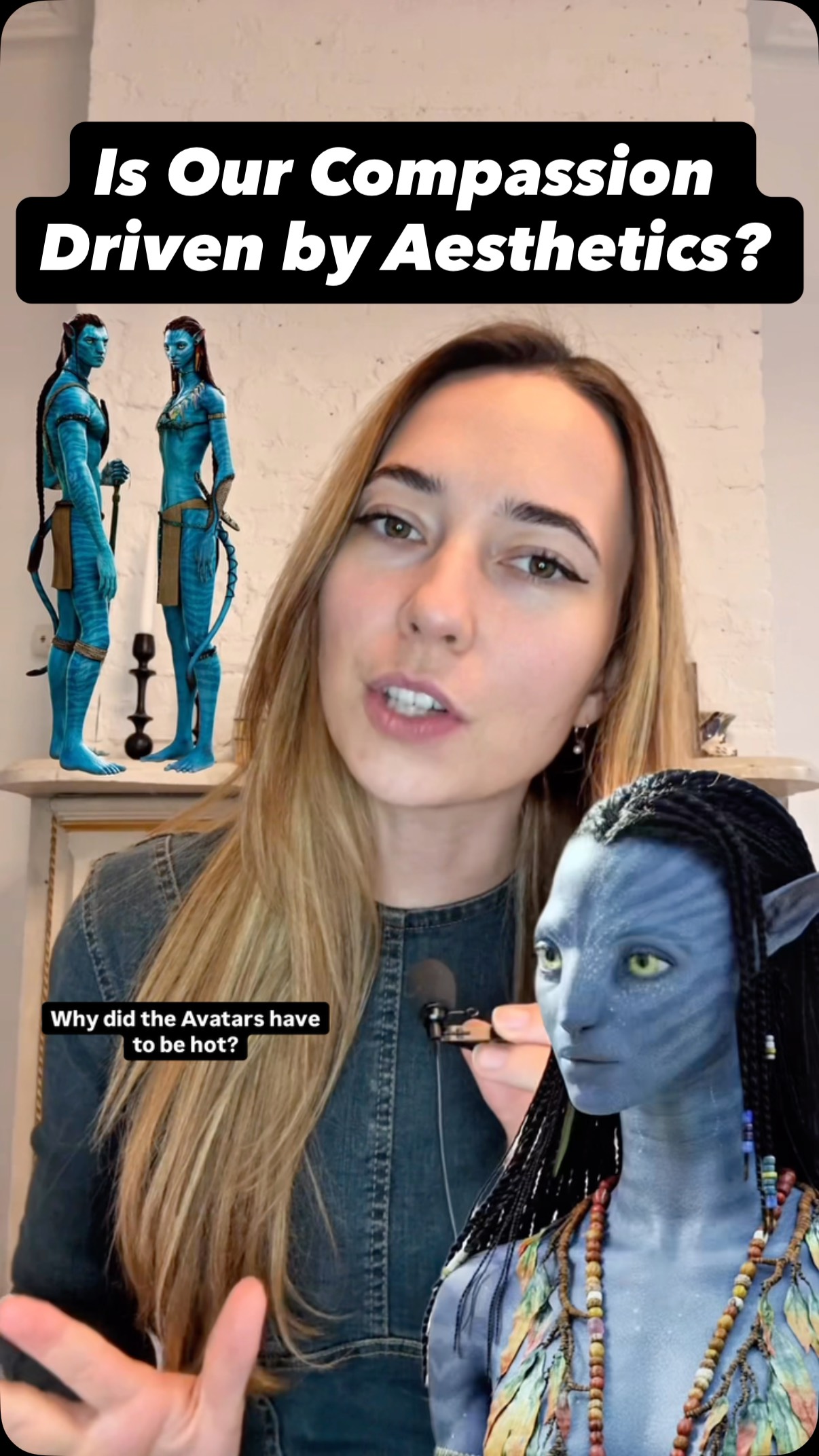
Is Our Compassion Driven By Aesthetics?

Verbal hook · 50%

Why did the Avatars have to be hot?

Visual hook · 5%

Direct-to-camera address with overlaid images of the Avatar characters, creating immediate context and visual interest.

[07]

Hook and payoff

The promise the opener makes, and how the video pays it back

Hook

A provocative, counter-intuitive question about a widely accepted element of a popular piece of media, forcing the viewer to reconsider something they took for granted.

Payoff

Proposes an alternative framework for thinking, shifting from the problematic model (empathy via aesthetic pleasure) to a constructive one (empathy via kinship and shared history), offering the viewer a new, more conscious perspective.

[08]

Narrative framework

The structural pattern this video runs on

Framework

The Analogical Bridge

Use a familiar piece of pop culture as a case study to introduce and explain a complex, less-known concept, thereby revealing a hidden societal bias and its real-world consequences.

  1. 1

    The Pop Culture Deconstruction

    Analyzes the specific choices within the cultural artifact (a movie) and questions their necessity, highlighting how they cater to a specific bias (aesthetic desirability).

  2. 2

    The Credibility Anchor

    Briefly references existing, well-established critiques of the artifact to build authority and situate the new argument within a larger critical conversation.

  3. 3

    The Central Inquiry

    Explicitly states the core thesis as a question, broadening the scope from the specific artifact to a general human behavior concerning empathy and aesthetics.

  4. 4

    The Evidentiary Bridge

    Introduces a parallel, data-backed concept from a different, more 'serious' domain (conservation science) that perfectly mirrors the bias observed in the pop culture artifact.

  5. 5

    The Data Hammer

    Provides specific statistics and terminology ('charismatic megafauna') to prove the real-world existence and impact of the bias, solidifying the analogy.

  6. 6

    The Consequence Reveal

    Explains the tangible, negative outcomes of this aesthetic bias, demonstrating that the issue is not just academic but has high stakes for the real world (ecological risk).

Themes

  • Aesthetic bias
  • Media criticism
  • Colonial tropes
  • Conservation ethics
  • Empathy

Techniques

  • Direct address
  • Rhetorical questions
  • Case study analysis
  • Visual aids

Post caption

Is empathy conditioned on aesthetic pleasure? Avatar should make us question why beauty so often unlocks our compassion and why we don’t always extend that compassion towards Others we don’t find beautiful or attractive #avatar #avatarfireandash #internetanthropology #anthopology #filmtheory

Text overlays

  • title · beginning

    Is Our Compassion Driven By Aesthetics?

Transcript

Why did the Avatars have to be hot? It's always kind of bothered me that the Na'vi have characteristics that are seen as stereotypically desirable to humans. Would we still have the same compassion for the plight of the Na'vi if they were short, green, hairy, round, clunky, ugly with weird little voices? How much of this movie wouldn't work if they weren't hot? This is Internet anthropology and indigenous critiques of Avatar have very importantly called attention to the white savior complex and the caricature of indigenous life portrayed in the movie without real input from indigenous people. Another core trope that occurs in this film is the protagonist falling in love with the beautiful, enchanting indigenous woman. These narratives do raise the question, would he still be trying to save these people if he didn't find this woman hot? Even as viewers, Avatar fetishizes the Na'vi way of life to us, specifically through their beauty and their grace and their deeply aestheticized cultural practices. Why does our ability to find them aesthetically desirable provoke our empathy and our compassion? This is kind of a huge issue that we have as a culture. This is research reported on by The Guardian that finds that in conservation fundraising, the concept of charismatic megafauna describes how animals that are visually appealing or emotionally engaging receive disproportionate amounts of attention and funding. As a result, 83% of conservation funding is directed towards mammals and bad. Species more likely to be perceived as charismatic and photogenic. This aesthetic bias diverts resources away from less visually appealing better ecologically critical species, ultimately putting our ecosystems at risk. These are things like algae, snails, mollusks, flies that don't look good on a t shirt or a banner. This isn't an avatar take down video, I just want to call attention to how our availability of compassion and empathy for others has often been tied to their aesthetic qualities and markability tier a way that is harming our planet. In the settler colonial frame, empathy is often rooted through visual pleasure of the other. Maybe we can learn from indigenous relational frameworks that center empathy in kinship, reciprocity tier shared shared histories, not just aesthetic pleasure and beauty.