@jason_swet
Instagram · Talking Head Edit
@jason_swet 1/2 This is a speedy run through a lesson I’ve been giving to creatives about hooks in storytelling. Would love your thoughts, questions, or feedback on this 🙏

@jason_swet
Instagram · Talking Head Edit
@jason_swet 1/2 This is a speedy run through a lesson I’ve been giving to creatives about hooks in storytelling. Would love your thoughts, questions, or feedback on this 🙏
Performance
Video #15135 · Talking Head Edit
[01]
The creator delivers a mini-lecture on the concept of a 'hook,' arguing that it's a timeless storytelling device, not just a social media trend. He deconstructs the idea by providing and analyzing numerous examples from literature (The Hunger Games, 1984), film (Breaking Bad, The Dark Knight), music, book covers, journalism, and advertising campaigns to illustrate that a true hook both grabs and holds attention.
[02]
[03]
 240.5K57×Deconstructing hooks across different media@jason_swet · Case Study Breakdown
 1.2M2.6×Viral video hook breakdown@robertmckeaveney · Case Study Breakdown
 135.4K41.7×Expert explains hook stacking strategy@rich_somers · Breakdown
 398.3K54.7×Explaining video hooks with examples@thepostprotocol · Breakdown
 6M334.6×Three examples of video hooks@thepostprotocol · Breakdown
 218.6KStorytelling core concepts for creators@johnbucog
 534.5K31×Explaining different video hook types@thepostprotocol · Breakdown
 137.2KExplains three-step hook writing framework@iamaayushswamy · Tutorial / How To
 51.4KCreator explains marketing hook strategy@briarcochran · What Is X?
 1.4M71.4×Viral hook marketing case study@thepostprotocol · Breakdown
 173K4.9×Creator explains credibility building framework@briarcochran · Breakdown
 101.9KCreator lists seven tips for hooks@briarcochran · Rapid Fire Listicle
[04]
[05]
What stops the scroll in the first 3 seconds
Title hook · 35%
Part 1
Verbal hook · 30%
The Lost Art of the Hook.
Visual hook · 35%
The video opens on the creator, then immediately cuts to a surreal black and white animation of multiple eyes opening and closing, creating a strong visual pattern interrupt.
[07]
The promise the opener makes, and how the video pays it back
Hook
A contrarian statement that challenges a popular assumption about the topic, promising to reveal a deeper, more nuanced truth and change the viewer's perspective.
Payoff
The full realization that the topic is not just a simple technique but a fundamental, multi-faceted principle that governs effective communication across all creative fields. The video ends with a meta-hook (a cliffhanger for Part 2) to drive further engagement.
[08]
The structural pattern this video runs on
Framework
The Expanding Thesis
To deconstruct a common concept by challenging its modern definition, then rebuilding a broader, more powerful understanding through a rapid succession of examples from diverse, credible sources, culminating in the elevation of the concept to a universal principle.
The Literary Foundation
Grounds the argument in a classic, respected medium (literature) to establish intellectual credibility and historical context, proving the concept's longevity.
The Core Principle Reveal
Pauses the examples to articulate the central thesis—a concise, powerful definition that serves as the analytical lens for all subsequent examples and differentiates the concept from lesser versions (e.g., gimmicks, clickbait).
The Pop Culture Gauntlet
Demonstrates the principle in dynamic, visual media (film) using popular and critically acclaimed examples to make the concept relatable and prove its effectiveness in modern storytelling.
The Cross-Discipline Expansion
Systematically applies the core principle to a rapid series of different disciplines (music, visual design, journalism) to prove its universal nature and adaptability across various formats.
The Conceptual Leap
Elevates the argument by asserting that the principle applies not just to tangible executions, but to the core ideas themselves, using famous campaigns as the final, definitive proof.
1/2 This is a speedy run through a lesson I’ve been giving to creatives about hooks in storytelling. Would love your thoughts, questions, or feedback on this 🙏
title · beginning
Part 1
title · beginning
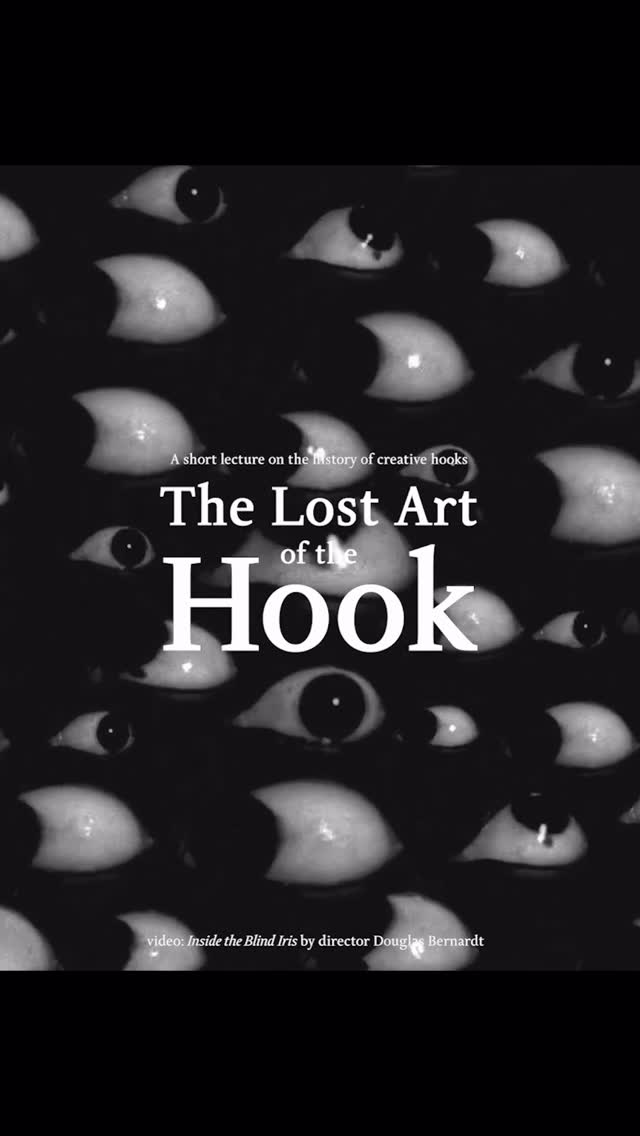
The Lost Art of the Hook
contextual · beginning
A short lecture on the history of creative hooks
contextual · beginning
video: Inside the Blind Iris by director Douglas Bernhardt
informational · beginning
Social media didn't invent hooks
informational · beginning
What is a hook?
informational · beginning
“When I wake up, the other side of the bed is cold…This is the day of the reaping.”
informational · middle
“It was a bright cold day in April, and the clocks were striking thirteen.”
informational · middle
A hook is what grabs & holds your attention.
contextual · middle
Breaking Bad
contextual · middle
The Dark Knight
informational · middle
Music: hook ≠ chorus
informational · middle
{visual + audio + text}
informational · end
The idea itself needs a hook
contextual · end
Dumb Ways to Die
call-to-action · end
finish the lesson in Part 2
contextual · end
#LikeAGirl
The Worst Art of the Hook. I want to change the way you think about hooks, especially in social media content, because social media didn't invent hooks. It's not just the first three seconds of a video. In fact, the idea of a hook has existed in other creative disciplines and industries for a long time. What is a hook? Well, rather than define it for you, I want to broaden your vision of what a hook can best. And I'm gonna do that by showing you a bunch of examples of some great hooks. When I wake up, the other side of the bed is cold. This is the day of the reaping. The first page or on the first page of The Hunger Games, in my opinion, a great good. An example of how hooks are in other mediums of storytelling. It was a bright cold day in April and the clocks were striking thirteen. That's the first line of 1984. And as you can already see, a hook is what grabs and holds your attention. It needs to hold your attention and that's what differentiates it from gimmicks and clickbait. So let's keep going. More examples. The first scene of Breaking Bad. It's longer than three seconds. One of the first things you see are pants flying through the air. Instant questions going off in my head. Why are these pants flying? Where did they come from? Now we're in an RV. Why is he wearing a gas mask? Oh no, is that guy dead? You bad hear all the questions going off in my head. This is a great hook. In a similar fashion, the first scene of The Dark Knight is one of the greatest hooks of all time. So many questions are flying off in my head. Is this guy Heath Ledger? Is that Joker Heath Ledger? And that's two different mediums. Music also uses the term hook. Most people think a hook is the chorus, but they're not synonymous, and I might have some music professionals coming after me for that. But what's fascinating here is it's not always the first three seconds of the song. It's whatever is attention grabbing or the most memorable part of the song, at least from my limited understanding. Better what's also interesting is now that streaming is more popular, you'll notice that artists are putting the hook at the beginning of the song. Beyond just the storytelling of a novel, I think book covers can have great hooks. I actually haven't read this, but these are some of the books that were really grabbing my attention a couple years ago. Visuals that instantly made me think, oh, I wanna I wanna pick up that book. I wanna read more into this one. But probably where the term hook was most prevalent was in the newsroom. What is the headline that's gonna stop the scroll? And great advertising can have a good. It's not just a video format. I remember early in my career getting feedback from a creative director, and they asked, what's the hook? And I had no idea what they were talking about. So I don't think there's a formula to it, but if you think about your senses and how you experience storytelling, it can be visual, audio, best, as in you're reading it, maybe in experiential formats. It could be smell and touch. But what takes a hook beyond just being clickbait is when it can hold your attention, and that's why ideas need strong hooks as well. Some famous advertising campaigns with strong hooks even in just the title of the campaign, dumb ways to die, hashtag.