Viral Hooks
Trending short videosCultural critique of prediction markets
G

@ghostinthesam

Instagram · Talking Head Edit
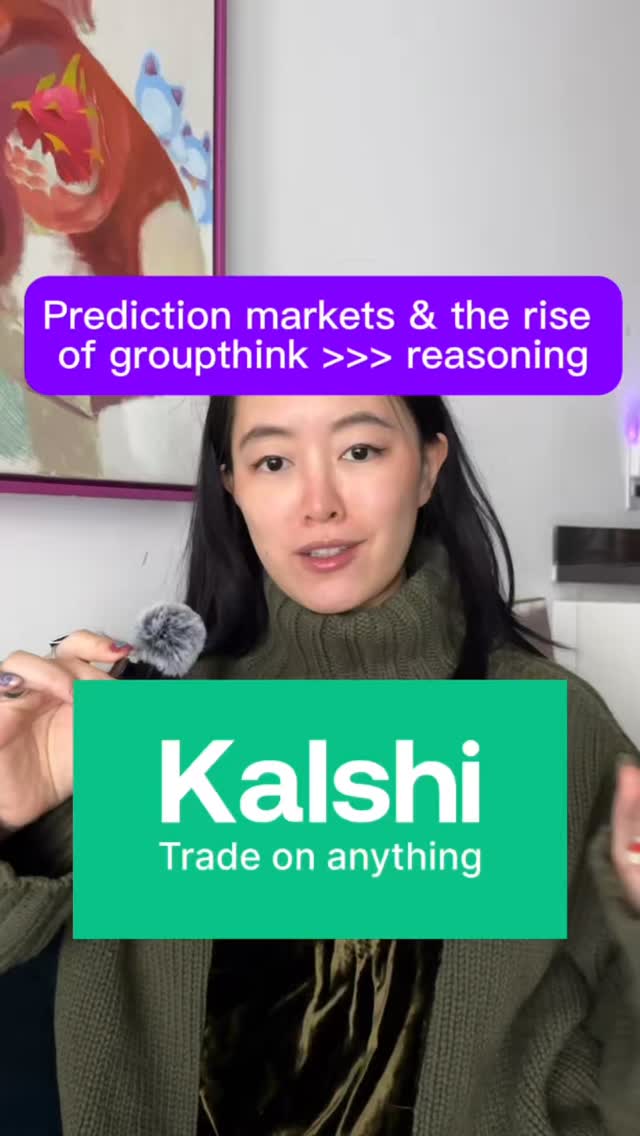
@ghostinthesam 💭THINKING ABOUT: THE RISE OF PREDICTION MARKETS LIKE KALSHI AND POLYMARKET💭 and how they are symptomatic of our current relationship to critical thinking. We are so inundated with poor quality information that we’ve become reliant on intermediaries, be it ChatGPT or your favorite influencer, to process what is happening on our behalf. It’s no coincidence that in a moment where we are ceding a lot of that independent thinking, here comes a tool that makes the personal opinion the subject of the wager. So many of our modern tools like generative AI treat reasoning as this vestigial intermediate step - only valuable insofar as it gets you to the correct answer. And the emergence of betting markets takes this idea to an extreme place via financial incentive. The natural outcome is speculation, because what use is there in understanding fundamentals and deducing outcomes if you can still get the coin toss wrong? Let’s talk about the problem with valuing outcomes alone and not reasoning behind them. Further reading: - “Blank Space: A Cultural History of the 21st Century” by W. David Marx @wdavidmarx - “The Life of The Mind” by Hannah Arendt, also specifically recommend her essay “Truth and Politics” - “Prediction Markets and the Suckerfication Crisis” by Max Read on Substack #culturalanalysis #predictionmarkets #kalshi #polymarket #criticalthinking


View original on Instagram

The edit1 shot · 9 text
Shots Text

Performance

Views
99.4K
Comments
118
Engagement
0.1%

Video #17204 · Talking Head Edit

Cultural critique of prediction marketsfrom @ghostinthesam

[01]

Overview

The creator presents a cultural critique arguing that the rise of prediction markets is a symptom of society's declining ability to form informed opinions. She parallels the 'attention economy' with a new 'opinions & takes economy,' where people are unequipped to understand information, leading them to rely on intermediaries like AI and prediction markets that offer 'truth without meaning.' The creator uses quotes, articles, and charts as evidence to deconstruct the value system these platforms promote, which prioritizes profitable outcomes over the reasoning process, ultimately discouraging the pursuit of knowledge and fostering a mob mentality over collective wisdom.

[02]

Simple outline

  1. 1State a cultural problem
  2. 2Define the new landscape
  3. 3Expose players' motives
  4. 4Challenge underlying values
  5. 5Reveal the cynical incentive

[03]

Related videos

[04]

Classification

Concepts
BreakdownHot Take
Elements
B-Roll CutawayImage OverlayJump CutText Overlay

[05]

Hook analysis

What stops the scroll in the first 3 seconds

Title hook · 55%

Prediction markets and the rise of groupthink >>> reasoning

Verbal hook · 40%

It's no surprise prediction markets are surging because we've never been less equipped to have informed opinions.

Visual hook · 5%

A medium close-up of the speaker addressing the camera directly while holding a small, professional-looking microphone, establishing an authoritative and direct mode of communication.

[07]

Hook and payoff

The promise the opener makes, and how the video pays it back

Hook

A bold, counterintuitive statement that connects a niche, emerging trend to a widespread, relatable cultural deficiency.

Payoff

The Cynical Payoff: Reveals the core profit motive, concluding that the antagonists do not require truth or positive outcomes to succeed, but thrive on the very uncertainty and chaos the trend generates.

[08]

Narrative framework

The structural pattern this video runs on

Framework

The Cultural Critique Cascade

To deconstruct a contemporary trend by presenting a provocative thesis, systematically building an argument with analogies and evidence, and culminating in a revelation of the cynical underlying incentive structure.

  1. 1

    The Defining Analogy

    Frames the new, complex problem by drawing a direct parallel to a well-understood existing concept, making the thesis immediately accessible.

  2. 2

    The Crisis Context

    Broadens the scope by linking the central problem to a cluster of other major contemporary anxieties (e.g., AI, misinformation, institutional decay), thereby increasing the stakes.

  3. 3

    The Antagonist Introduction

    Identifies the specific actors, platforms, or systems that are capitalizing on the cultural vacuum, framing them as entities offering a flawed solution ('truth without meaning').

  4. 4

    The 'Smoking Gun' Quote

    Presents direct, irrefutable evidence from a primary source (e.g., a founder, a CEO) that explicitly states the antagonist's ambitious and often alarming intentions.

  5. 5

    The Strategic Concession & Pivot

    Acknowledges a potential counter-argument or surface-level benefit of the trend, only to immediately pivot to a deeper, more profound philosophical critique that invalidates the initial point.

  6. 6

    The Value System Challenge

    Questions the societal implications of prioritizing outcomes over process, arguing that this new system devalues foundational skills like reasoning and critical thinking.

  7. 7

    The Semantic Trap

    Exposes the deceptive marketing language used by the antagonists and draws a parallel to another field where similar language masks a fundamental flaw (e.g., AI's 'intelligence').

  8. 8

    The Inevitable Outcome

    Projects the logical conclusion of the trend, arguing that given the current environment, the result will be a negative mass behavior (e.g., mob mentality) rather than the idealized positive one (e.g., group wisdom).

  9. 9

    The Cultural Parallel

    Reinforces the argument by connecting the specific trend to a broader, established cultural shift, demonstrating that it is part of a larger, more dangerous pattern.

Themes

  • Decline of critical thinking
  • Technology's impact on society
  • Financialization of opinion
  • Information overload

Techniques

  • Cultural critique
  • Argumentative essay
  • Visual evidence

Trends

  • Prediction markets
  • Creator as analyst

Post caption

💭THINKING ABOUT: THE RISE OF PREDICTION MARKETS LIKE KALSHI AND POLYMARKET💭 and how they are symptomatic of our current relationship to critical thinking. We are so inundated with poor quality information that we’ve become reliant on intermediaries, be it ChatGPT or your favorite influencer, to process what is happening on our behalf. It’s no coincidence that in a moment where we are ceding a lot of that independent thinking, here comes a tool that makes the personal opinion the subject of the wager. So many of our modern tools like generative AI treat reasoning as this vestigial intermediate step - only valuable insofar as it gets you to the correct answer. And the emergence of betting markets takes this idea to an extreme place via financial incentive. The natural outcome is speculation, because what use is there in understanding fundamentals and deducing outcomes if you can still get the coin toss wrong? Let’s talk about the problem with valuing outcomes alone and not reasoning behind them. Further reading: - “Blank Space: A Cultural History of the 21st Century” by W. David Marx @wdavidmarx - “The Life of The Mind” by Hannah Arendt, also specifically recommend her essay “Truth and Politics” - “Prediction Markets and the Suckerfication Crisis” by Max Read on Substack #culturalanalysis #predictionmarkets #kalshi #polymarket #criticalthinking

Text overlays

  • title · beginning

    Prediction markets and the rise of groupthink >>> reasoning

  • contextual · beginning

    a cultural critique

  • title · beginning

    Attention Economy

  • contextual · beginning

    What should I look at?

  • title · beginning

    “Opinions & Takes” Economy

  • contextual · beginning

    What am I looking at?

  • contextual · middle

    aka truth without meaning

  • contextual · middle

    *or your methodology (polling) sucks

  • contextual · end

    *As in it is another way populism is being twisted to encourage groupthink

Transcript

It's no surprise prediction markets are surging because we've never been less equipped to have informed opinions. If the attention economy emerged because we are unequipped to sort through how much we were seeing, the opinions and takes economy emerges because we are unequipped to understand what we are seeing, especially in this age of AI, rage best, and institutional decline. And into that vacuum steps actors and platforms that promise clarity without the burden of understanding, AKA truth without meaning. The founder of Calcia said The long term vision is to financialize everything and create a tradeable asset out of any difference in opinion. And I think if you do build a general purpose exchange that can resolve differences of opinions, anything like asset out of any difference in opinion. And I think if you do build a general purpose exchange that can resolve differences of opinions on anything, like, the time is quite massive. And I'll concede. On pure accuracy, probabilistic guessing can rival reasoning, especially if you're completely uninformed. Better what kind of value system best worse where outcomes matter financially and rationale does not? If we're saying foundational skills like reasoning have no inherent value because you still might get the answer wrong, then what incentive is there to seek knowledge at all? Prediction markets love to call themselves collective intelligence engines, but this is the same verbal trap we fall into as with AI. Real intelligence is based on reasoning and conclusions, not just instinctual consensus thinking. Within your average information diet, it feels insane to think that we're gonna land on the group wisdom end of the spectrum and not the mob mentality one. In a lot of ways, I'm reminded of the conversation around poptimism and the decline of true criticism, and this feels like a really extreme version of that, going from its popularity makes it valuable to its popularity makes it true, which is a recipe for mass delusion. And that's rather the point. Max uncertainty is the world where these platforms profit the most. Remember that the house doesn't need truth. It just needs action.

Cultural critique of prediction markets | Viral Hooks