Viral Hooks
Trending short videosJournalistic real estate case study
P

@planetmoney

Instagram · Talking Head Edit

@planetmoney What would you build on a piece of land if all the normal rules went out the window? Book pre-order and live show tix: planetmoneybook.com Producer: Sam Yellowhorse Kesler / NPR. Editor: Jess Jiang / NPR.

View original on Instagram

The edit1 shot · 4 text
Shots Text1:53

Performance

Views
236K
Likes
5.4K
Comments
167
Engagement
2.4%
Outlier
3.3×
Length · 8 Apr 2026
1:53

Video #24015 · Talking Head Edit

Journalistic real estate case studyfrom @planetmoney

[01]

Overview

The creator reports on location in Vancouver to showcase a massive new housing development, then cuts to a studio co-host to explain the economic and legal context—specifically indigenous land rights—that allowed the Squamish Nation project to bypass traditional city zoning laws.

[02]

Simple outline

  1. 1Pose systemic problem
  2. 2Show anomalous solution
  3. 3Reveal legal loophole
  4. 4Provide historical context

[03]

Related videos

[04]

Classification

Concepts
Case Study Breakdown
Elements
B-Roll CutawayGraphic Overlay
Account

[05]

Hook analysis

What stops the scroll in the first 3 seconds

Title hook · 75%

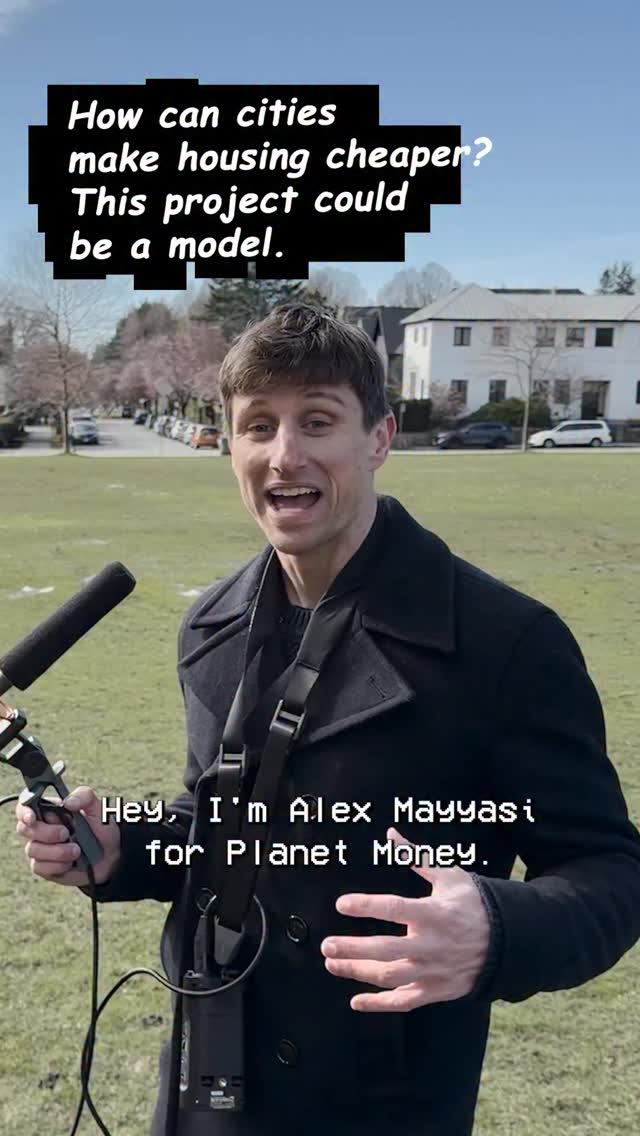
How can cities make housing cheaper? This project could be a model.

Verbal hook · 15%

Hey. I'm Alex Beosin for Planet Money.

Visual hook · 10%

A reporter standing in a park holding a professional microphone, looking directly at the camera with a large, high-contrast text overlay posing a question.

[06]

Hook template

Steal this for your own video

How can [industry] make [outcome] cheaper? This [solution type] could be a model.

  • — How can hospitals make healthcare cheaper? This clinic model could be a model.
  • — How can restaurants make fine dining cheaper? This membership structure could be a model.
  • — How can gyms make personal training cheaper? This group format could be a model.

[07]

Hook and payoff

The promise the opener makes, and how the video pays it back

Hook

Pose a massive, relatable systemic problem and immediately point to a physical, real-world anomaly as the potential solution.

Payoff

Establish the unique historical conditions that make this location a perfect, rule-breaking case study.

[08]

Narrative framework

The structural pattern this video runs on

Framework

The Loophole Case Study

Hook viewers with a massive systemic problem, show a visually striking real-world anomaly that solves it, and explain the unique legal or historical loophole that made it possible.

  1. 1

    The Anomaly Introduction

    Introduce the location and visually contrast the massive project with its normal surroundings to establish scale and intrigue.

  2. 2

    The Mystery Setup

    State that this project breaks all the normal rules and tease the reason why with a counter-intuitive fact.

  3. 3

    The Context Shift

    Transition to an explanatory mode to frame the investigation and set up the premise of what happens when standard constraints disappear.

  4. 4

    The Rule Contrast

    Briefly explain the standard constraints that normally prevent this type of project to emphasize its uniqueness.

  5. 5

    The Loophole Reveal

    Reveal the specific legal, jurisdictional, or historical exception that allows this anomaly to exist.

Themes

  • Urban planning
  • Indigenous land rights
  • Housing crisis solutions
  • Legal loopholes

Techniques

  • On-location hosting
  • Studio cutaways
  • Informational graphics
  • Dynamic captions

Trends

  • Educational journalism
  • Bite-sized documentaries

Post caption

What would you build on a piece of land if all the normal rules went out the window? Book pre-order and live show tix: planetmoneybook.com Producer: Sam Yellowhorse Kesler / NPR. Editor: Jess Jiang / NPR.

Text overlays

  • title · beginning

    How can cities make housing cheaper? This project could be a model.

  • branding · beginning

    Hey, I'm Alex Mayyasi for Planet Money.

  • branding · middle

    Jeff Guo Co-host, Planet Money

  • contextual · middle

    Source: Wikimedia Commons

Transcript

Hey. I'm Alex Beosin for Planet Money. I'm in Vancouver, Canada. This is Kitz Point, this very nice residential neighborhood. But I am here because of this huge development project that is happening. It's one of the largest complexes going up in Vancouver, going up in North America, and very few people can build like this. And the reason it's happening is because this is technically not Vancouver. Recently, Planet Money took a trip to Vancouver to see what happens when all the usual rules about building stuff go off the window. You see, in most cities in North America, there are lots of rules about how tall and wide and dense you can build. But this land belongs to the Squamish nation. They're a nation of about 5,000 indigenous members living in Worst Canada. Their ancestors used to live here. And in 2003, the Squamish Nation won a lawsuit against the Canadian government that gave them some of this land back. The location of this land is

Journalistic real estate case study | Viral Hooks