Video #25785 · Speaker address
Explaining why dirty water is healthyfrom @kidflamess
A scientist stands in the Everglades and explains to the camera why the water's murky appearance is not a sign of being dirty, but rather a sign of a healthy ecosystem. He attributes the color to tannins from decomposing plants, peat, and other materials, using the analogy of a tea bag, and concludes that this 'dirty' look indicates the water is rich in nutrients.
- 1Pose common question
- 2Explain with simple analogy
- 3Reveal counterintuitive truth
ElementsSequential text revealText OverlayTitle Text Hook
[05]
Hook analysis
What stops the scroll in the first 3 seconds
Title hook · 45%
Why water looks dirty in the Everglades
Verbal hook · 35%
Why water looks dirty in the Everglades?
Visual hook · 20%
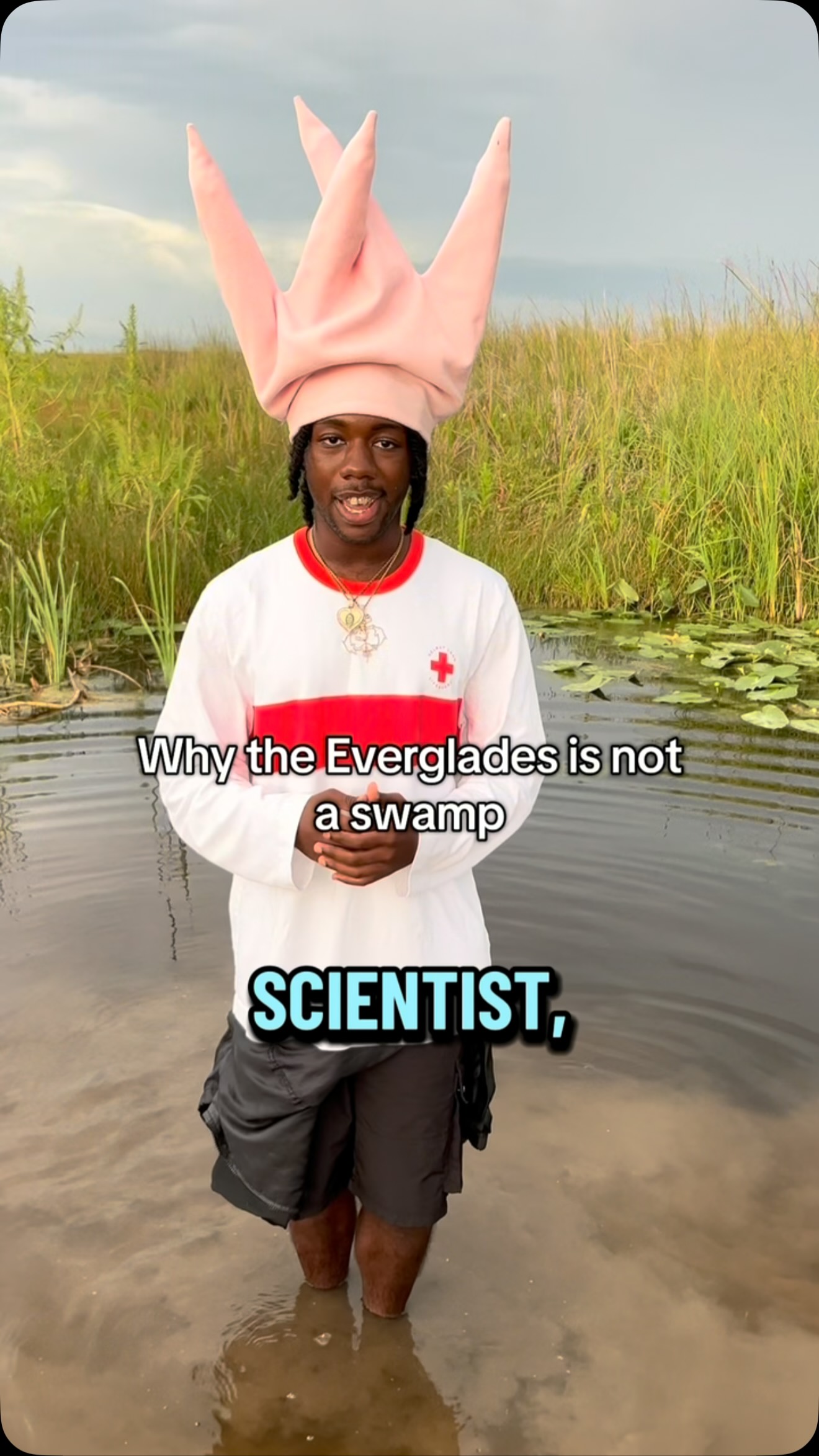
A man stands barefoot in murky water in a wetland environment, wearing a unique, sculptural white hat, creating an unusual and attention-grabbing scene.
[07]
Hook and payoff
The promise the opener makes, and how the video pays it back
Hook
A direct question that challenges a common visual assumption, creating an immediate knowledge gap the viewer wants filled.
Payoff
A powerful reinterpretation that transforms the viewer's understanding, turning a perceived negative into a confirmed positive and rewarding their attention with a valuable piece of 'insider' knowledge.
[08]
Narrative framework
The structural pattern this video runs on
Framework
The Expert Reframe
To debunk a common misconception by establishing expert authority, providing a simple, analogous explanation, and concluding with a surprising, positive reinterpretation of the initial observation.
- 1
The Authority Claim
The creator immediately establishes their credibility and expertise on the subject, positioning themselves as a reliable source of information.
- 2
The Primary Explanation
The core scientific or technical reason behind the phenomenon is stated clearly and concisely.
- 3
The Analogical Bridge
A complex concept is simplified by comparing it to a common, easily understood object or experience, ensuring the audience can follow along.
- 4
The Supporting Layers
Additional contributing factors are introduced to build a more robust and complete explanation.
- 5
The Systemic Context
The explanation is grounded in the broader environment or system, showing how external conditions influence the outcome.
Themes
- education
- science communication
- nature
- ecology
- myth-busting
Techniques
- on-location filming
- direct address
- analogy
Trends
- educational content
- expert explainer
Post caption
The water in wetlands isn't necessarily dirty, it looks like that because of tannins from the vegetation, soil and different materials that make up the system. #researcher #wetlands #scientist #biology #stem
Text overlays
title · beginning
Why water looks dirty in the Everglades
contextual · beginning
WHY WATER
contextual · beginning
IN THE
contextual · beginning
I'M A SCIENTIST
contextual · beginning
RESEARCH IN
contextual · beginning
THE EVERGLADES,
informational · middle
DECOMPOSING PLANT MATERIAL IN THE SYSTEM.
informational · middle
TANNINS, SIMILAR TO TEA BAG.
informational · middle
ORGANIC AND INORGANIC MATERIAL IN THE SYSTEM AS WELL.
informational · middle
IT HELPS TO TRAP ALL OF THESE THINGS.
informational · end
AND PROVIDES NUTRIENTS FOR THE SYSTEM.
informational · end
THE SYSTEM IS HEALTHY.
Transcript
Why water looks dirty in the Everglades? I'm a scientist that they're researching the Everglades, and water usually looks like this in wetland due to all the decomposing plant material in the system tier release tannins, similar to tier bad when you put it in the water. It changes coloration of the better, And it's also from all the peat and also organic and inorganic material in the system as well. And the fact that the water moves very slow, it helps to trap all of these things that's good and provides nutrients for the system. So if the water looks like this, that means the system is healthy.