@kidflamess
Instagram · Talking Head Edit
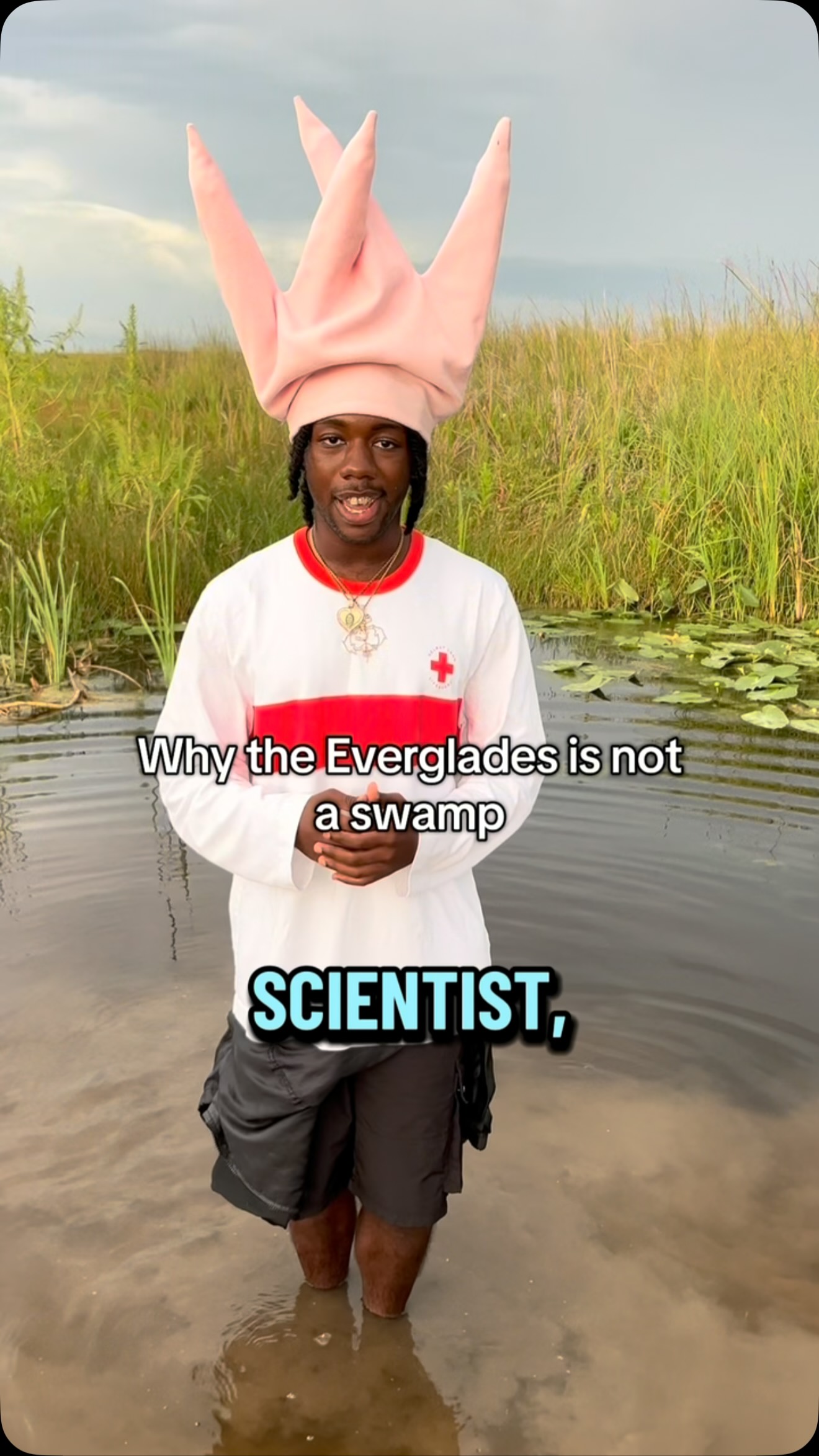
@kidflamess Many people would consider this ecosystem a swamp, however it’s technically a freshwater marsh, which is a type of wetland. #scientist #wetlands #everglades #stem

@kidflamess
Instagram · Talking Head Edit
@kidflamess Many people would consider this ecosystem a swamp, however it’s technically a freshwater marsh, which is a type of wetland. #scientist #wetlands #everglades #stem
Performance
Video #39470 · Talking Head Edit
[01]
The creator, identifying as an Everglades scientist, stands in a wetland and explains why the Everglades is not a swamp. He defines a swamp as being tree-covered and contrasts it with the grass-covered Everglades, also known as the 'River of Grass,' using B-roll footage of both ecosystem types to illustrate his points.
[02]
[03]
 250.2K7.7×Explaining Everglades geology layer by layer@kidflamess · Breakdown
 1.7M63.6×Underwater forest exploration video@kidflamess · Ambient Escape
 8.5M312.4×Scientist's day in the life@meta · Day In The Life
 872.6K36.9×Explaining why dirty water is healthy@kidflamess · Explainer
 308.4K13×Scientist explains ecology in field@kidflamess · Explainer
 2.4M11.2×Montage of a scientist's fieldwork@kidflamess · Day In The Life
 1.8M4.7×Scientist's research journey montage@kidflamess · Journey Documentation
 3.1M101.5×Montage of research to degree@kidflamess · Journey Documentation
 1.5M56.7×Exploring wildlife below the surface@kidflamess · Ambient Escape
 964.4K16.9×Split-screen explainer on water lilies@shepherd.farm · Split Screen Explainer
 11.2M468.1×Scientist's candid wildlife sighting reaction@kidflamess · Candid Spectacle
 96.8KStudent explains his environmental research.@fiuenvironment · Breakdown
[04]
[05]
What stops the scroll in the first 3 seconds
Title hook · 45%
Why the Everglades is not a swamp
Verbal hook · 10%
The Everglades is not a swamp.
Visual hook · 45%
A man stands in knee-deep water in a wetland wearing a large, uniquely shaped pink crown-like hat, creating an unusual and attention-grabbing visual.
[07]
The promise the opener makes, and how the video pays it back
Hook
A bold, counter-intuitive statement that directly challenges a widely held belief, creating an immediate curiosity gap.
Payoff
A final, concise restatement of the initial thesis, cementing the new knowledge in the viewer's mind and providing a satisfying, circular conclusion.
[08]
The structural pattern this video runs on
Framework
The Myth-Buster Formula
To debunk a common misconception by presenting a simple, contrasting definition and providing clear evidence, thereby re-educating the audience and making them feel smarter.
The Immediate Reclassification
The correct term or category is provided immediately after the hook, satisfying the initial curiosity while setting the stage for the explanation.
The Authority Claim
The creator establishes their credibility on the subject, giving weight to their claims and encouraging the viewer to trust the information.
The Contrast Definition
The creator defines the *incorrect* category (the misconception) based on its key characteristic, often supported by a visual example.
The Evidentiary Rebuttal
The creator defines the *correct* category by contrasting its key characteristic with the one just mentioned, providing the core proof for their argument, also supported by a visual.
The Poetic Reinforcement
An additional, memorable piece of information or a well-known nickname is introduced to make the core argument more 'sticky' and shareable.
The Nuance Acknowledgment
The creator addresses potential counter-arguments or exceptions to their main point, demonstrating expertise and building trust by showing they aren't oversimplifying.
Many people would consider this ecosystem a swamp, however it’s technically a freshwater marsh, which is a type of wetland. #scientist #wetlands #everglades #stem
title · throughout
Why the Everglades is not a swamp
informational · beginning
THE EVERGLADES
informational · beginning
IT'S A FRESHWATER MARSH
informational · middle
RIVER OF GRASS
The Everglades is not a swamp. It's a freshwater marsh worse a type of wetland. I'm an Everglades scientist, and a swamp is mostly covered by trees. However, the Everglades is mostly covered by grass, specifically sawgrass. And it's also a slow moving tier, which is why it's called the River Of Grass. Even though there are swampy areas with cypress trees and mangroves, most of the Everglades is a freshwater marsh.