Viral Hooks
Trending short videosExpert advice on selling business
H

@hormozi

Instagram · Clip

@hormozi When I was 20, I wanted to be a millionaire. Once I was a millionaire, I wanted to be in my 20s. Which means everything that I make between now and the end of time, I’d pay at the end of time to be back here now. We always trade the thing we have most for the thing we want most.

View original on Instagram

The edit1 shot · 1 text
Shots Text2:31

Performance

Views
2.6M
Likes
122K
Comments
1K
Engagement
4.7%
Outlier
14.4×
Length · 9 May 2026
2:31

Video #28018 · Clip

Expert advice on selling businessfrom @hormozi

[01]

Overview

Business expert Alex Hormozi responds to an entrepreneur's question about whether to sell his $5M revenue company. Hormozi challenges the idea that selling equates to freedom, probes the entrepreneur's personal motivations, and uses a philosophical framework about human desire to argue against selling, suggesting instead that the entrepreneur should restructure his life to find fulfillment within his current business.

[02]

Simple outline

  1. 1Pose a high-stakes dilemma
  2. 2Challenge the core assumption
  3. 3Introduce a universal principle
  4. 4Reframe the problem's solution
  5. 5Deliver a philosophical conclusion

[03]

Related videos

[04]

Classification

Format
Concepts
Q&A ResponseAnecdotal Philosophy
Elements
Split ScreenJump CutDynamic Word-by-Word Captions

[05]

Hook analysis

What stops the scroll in the first 3 seconds

Title hook · 55%

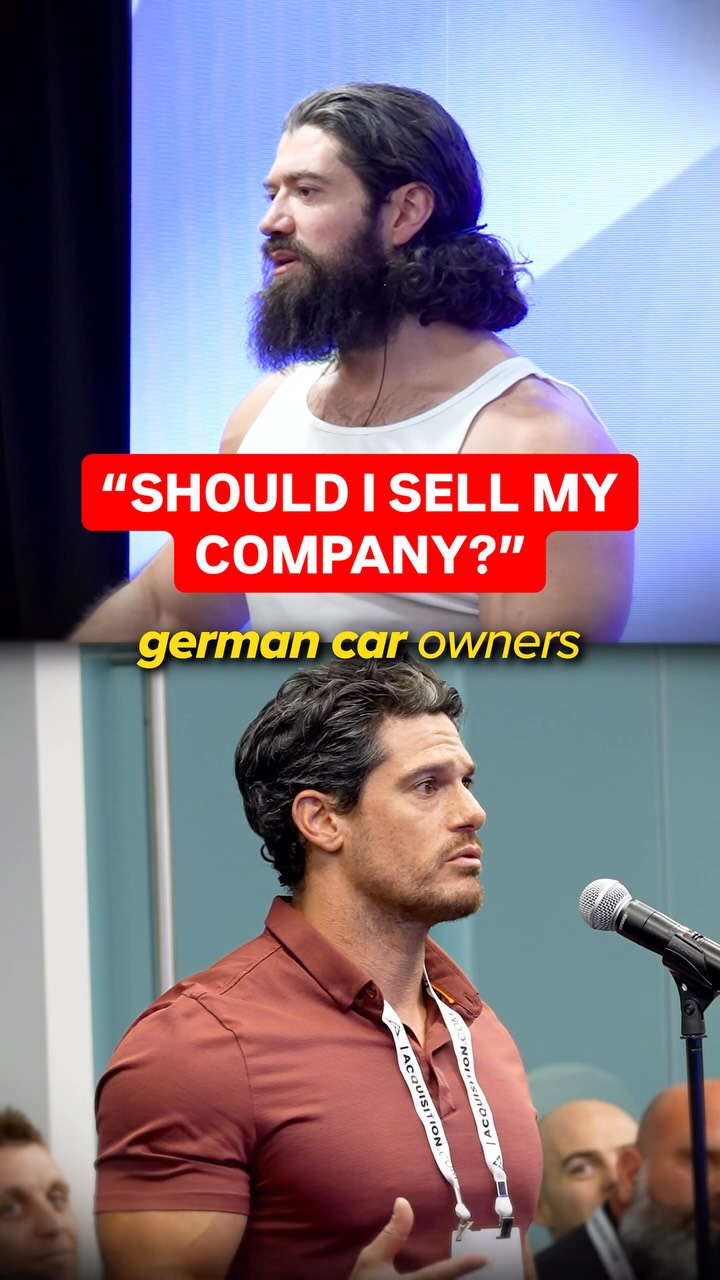
“SHOULD I SELL MY COMPANY?”

Verbal hook · 30%

I sell performance upgrades to German car owners.

Visual hook · 15%

Split-screen view of a muscular speaker on stage and an audience member asking a question, creating immediate conversational context and visual interest.

[07]

Hook and payoff

The promise the opener makes, and how the video pays it back

Hook

A relatable, high-stakes question is presented by an individual, immediately establishing a clear problem and creating audience investment in the outcome.

Payoff

The specific advice is elevated into a memorable, philosophical mic-drop. It addresses the deeper, unspoken desire behind the original question (e.g., the desire for certainty), providing a profound and satisfying conclusion that transcends the initial problem.

[08]

Narrative framework

The structural pattern this video runs on

Framework

The Socratic Reframe

A common 'Should I do X?' question is systematically deconstructed by challenging the questioner's underlying assumptions. The advisor uses a series of targeted questions and universal principles to lead the questioner (and the audience) to a more profound re-framing of the original problem, rather than providing a simple yes/no answer.

  1. 1

    The Premise Challenge

    The advisor immediately invalidates the primary assumption behind the questioner's desire (e.g., the idea of 'retiring' or 'being done'), creating a pattern interrupt that forces a re-evaluation of the goal itself.

  2. 2

    The Lifestyle Interrogation

    A series of rapid, personal questions are asked to expose the lack of a concrete plan for the 'after' scenario, highlighting the potential void or unforeseen consequences of the proposed change.

  3. 3

    The Universal Truth Anchor

    The advisor introduces a broad, philosophical principle about human nature (e.g., 'the grass is always greener') and proves it with a quick succession of relatable, binary examples, making the principle feel undeniable.

  4. 4

    The Consequence Revelation

    The universal principle is directly applied to the questioner's specific situation, framing the proposed action not as a pure gain, but as a trade-off that involves losing unacknowledged positives.

  5. 5

    The Future Regret Simulation

    The advisor paints a vivid, specific picture of the future regret the questioner will likely experience, often bolstering this prediction with a statement of personal experience to establish authority.

  6. 6

    The Identity Check

    A blunt, often humorous question is used to assess the questioner's identity and skills outside of their current situation, reinforcing their dependency on the very thing they consider leaving.

  7. 7

    The 'Both/And' Reframe

    The advisor shifts from deconstruction to construction, proposing an alternative path that allows the questioner to achieve their desired feeling or outcome without making the drastic, irreversible change they initially proposed.

Themes

  • Personal Fulfillment
  • Entrepreneurial Mindset
  • Regret

Techniques

  • Split Screen
  • Direct Questioning
  • Anecdotal Evidence

Trends

  • Repurposed Content
  • Expert Q&A

Post caption

When I was 20, I wanted to be a millionaire. Once I was a millionaire, I wanted to be in my 20s. Which means everything that I make between now and the end of time, I’d pay at the end of time to be back here now. We always trade the thing we have most for the thing we want most.

Text overlays

  • title · beginning

    “SHOULD I SELL MY COMPANY?”

Transcript

I sell performance upgrades to German car owners. We're doing about 5,000,000 in revenue last year. I do like it Yeah. But I'm working a lot. A question that's kinda come up a few tier, which is, like, how do you know when it's the right time to sell? I've got a good offer. Okay. Is that appealing to you? Well, it's an it's definitely enough to not have to work. I think I figured it would make it worse it. Yeah. Yeah. I'm just like, let me just save you this part. You're gonna work again. Yeah. True. True. Like, you can get drunk for, like, a week, and then you're like, I can't do this forever because then I will be an alcoholic. Do you have kids? No. Okay. Are you married? Nope. Well, what are you gonna do? You're just gonna wake up and be like, like, you gonna golf? You no, like what like I'm being so real with you though. Like, what would you do? Well, to be honest, you know, like a lot of people in here, you know, had my head down in a warehouse, in my house for the last decade and it's like, I just wanna, like, go out and see stuff. Yeah. You know? So this is an entirely personal decision. I'm just walking you through how I'd think through it. One of the things that I've, like, I know absolutely for certain is that we always want what we don't have. And so, like, single people wanna get married, married people dream about the time they were single, people who have kids wish they could not have the kids for the day, people who don't have kids wanna have kids. You know, employees wanna be entrepreneurs, entrepreneurs wish they could just get a stable paycheck. Like, it's it's endless. Like, we always want what we can't have. And so the moment you sell the business, you'll wish you had the business. Yeah. If all of that's gone, you get rid of the good and the bad. Yeah. And people forget about getting rid of the good. And so now you've gotta somehow replace the good, which means you're gonna start a business again, and then you're gonna be like, fuck. I wish I had my whole team. I only say this having done this before. Yeah. Like, you're like, I really wish I had all my people, but I can't because I just sold the company and I have a non compete, and I can't take them. Are you good at other stuff? No. Okay. I would encourage you before selling to see like is there a way that I can get the business to continue to make money and go out and see stuff? Maybe that's traveling once a quarter. Maybe every 12 weeks you take a week off. Yeah. I already do that. Alright. Every six week you take a week off. You can do whatever you worst, obviously. I think that if we if we think about it from the frame, I don't know what you gain. And I think what you're hoping for is a guarantee from a world that will never give you one. Okay. Thank you.

Expert advice on selling business | Viral Hooks