@fineasjackson
Instagram · Talking Head Edit
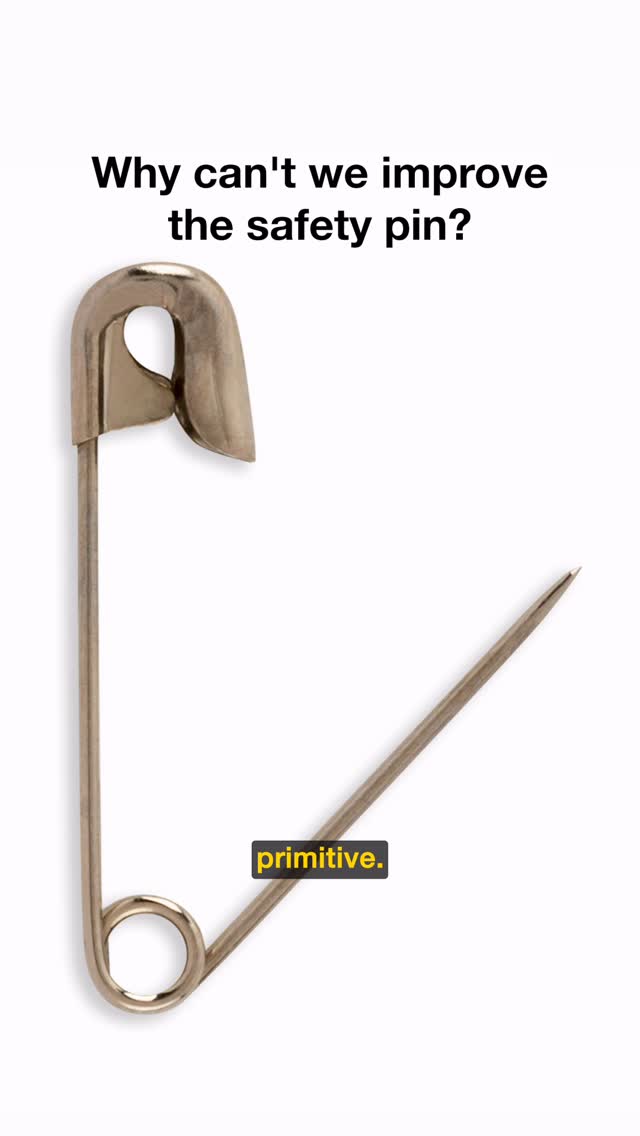
@fineasjackson It looks like bent wire, but it’s perfect. Why the safety pin hasn’t changed in 177 years…

@fineasjackson
Instagram · Talking Head Edit
@fineasjackson It looks like bent wire, but it’s perfect. Why the safety pin hasn’t changed in 177 years…
Performance
Video #32686 · Talking Head Edit
[01]
The creator explains why the seemingly primitive safety pin is a perfect piece of engineering that has resisted improvement for over 170 years. He tells the origin story of its invention by Walter Hunt in 1849, breaks down the mechanical functions of its spring and clasp, and discusses the single manufacturing change made in its history. The video concludes by revealing that while ancient precursors existed, Hunt's genius was in creating a simple, mass-producible design.
[02]
[03]
 7.3M1.5×Redesigning keyrings using safety pin mechanics@craighillcompany · Breakdown
 15.7M3.6×Design breakdown of money clip mechanics@craighillcompany · Breakdown
 1.1MStory behind unique key design@craighillcompany · Behind The Scenes
 727.1KExplains G-Shock prototype and design@imsteviesells · Origin Story
 1M2.5×Man reviews radial engine watch@imsteviesells · Product Showcase
 4.8M1×Redesigning keyrings with a tab@craighillcompany · Origin Story
 2.7M1.6×Product design origin story@craighillcompany · Origin Story
 1.3M11.9×Hacking a Fitbit for watches@thespenceryan · Quest Recap
 5.9M1193.8×Physical demo then CAD breakdown@shivam_playground · Breakdown
 4.9M1.1×Fixing card case design flaw@craighillcompany · Origin Story
 3.3M6.5×Product design problem-solution breakdown@craighillcompany · Case Study Breakdown
 3.4MAssembling a movie prop replica@infinitycollectionstudios · Process
[04]
[05]
What stops the scroll in the first 3 seconds
Title hook · 55%
Why can't we improve the safety pin?
Verbal hook · 40%
Look at this little wire pin. It looks primitive.
Visual hook · 5%
A direct-to-camera shot of the speaker in a hoodie, using expressive hand gestures to immediately engage the viewer in a conversational manner.
[06]
Steal this for your own video
Why can't we improve ?
[07]
The promise the opener makes, and how the video pays it back
Hook
Challenge the viewer's perception of a common, everyday object by labeling it as primitive or outdated, creating an immediate question about its persistence.
Payoff
Synthesize the entire narrative by redefining the inventor's genius not as pure invention, but as the radical simplification of an ancient, over-engineered concept. This delivers a final, powerful insight that reframes the entire story and leaves the viewer with a memorable takeaway.
[08]
The structural pattern this video runs on
Framework
The Hidden Genius Framework
To re-frame a mundane or overlooked subject as a masterpiece of design or thought by deconstructing its history and function, revealing its non-obvious perfection.
The Counter-Thesis
Immediately pivot to a contradictory and bold claim: the object is not flawed, but a pinnacle of engineering whose perfection has resisted all attempts at improvement. This establishes a central paradox the video will solve.
The Human Origin Story
Anchor the object's creation in a relatable, human narrative. Detail the inventor, the specific problem they faced (often personal or financial), and the 'aha' moment of invention, making the abstract concept tangible and emotionally resonant.
The Mechanical Deconstruction
Use animated graphics and close-ups to dissect the object's design, explaining the function of each component. This provides the logical 'proof' for the 'hidden genius' claim made earlier, satisfying the viewer's curiosity about *how* it works so well.
The Manufacturing Evolution
Introduce the *only* significant change made to the original design, typically for mass-production efficiency. This reinforces the core design's robustness by highlighting how little it has needed to change.
The Ancient Precedent (The Twist)
Introduce a surprising historical plot twist: the core concept of the object is not new but has existed for millennia in a different form. This deepens the narrative and adds a layer of unexpected discovery.
The Ancient Flaw
Explain why the ancient predecessors failed to achieve the modern version's ubiquity, usually due to over-complexity, cost, or lack of scalability. This creates a direct comparison that elevates the modern design's key virtue.
It looks like bent wire, but it’s perfect. Why the safety pin hasn’t changed in 177 years…
title · beginning
Why can't we improve the safety pin?
branding · beginning
"Chasing Beauty" Episode 52
informational · middle
Spring or Coil
informational · middle
Clasp or Guard
informational · end
Fibulae
Good at this little wire pin. It looks primitive. It looks like something we should have upgraded by no. Like a relic sitting in your grandmother's sewing kit next to those buttons that she'll never use. But that bent piece of wire is one of the most quietly perfect pieces of engineering ever made and every attempt to replace it has failed. This is Chasing Best episode 52 and today we're looking at the most overqualified object in your junk drawer. In 1849, a mechanic named Walter Hunt was sitting at his desk. He was twisting a piece of brass wire while he tried to figure out how to pay off a $15 debt. In about three hours, he bent that single wire into a coiled loop at one end and the clasp at the other. He then walked it over to a manufacturer and sold the rights for $400. That afternoon of fidgeting produced one of the only consumer products in history whose core design has never been improved upon. Look at what the wire actually does. The coil at the center isn't decorative. It's a spring. It constantly forces the two arms apart. A safety pin's default resting state is wide open. You have to squeeze it against its own will to latch it. Once tucked inside the hood, the spring's outward tension presses the sharp point fiercely against the metal casing, locking it in place. Then there's the clasp, that flat little hood that covers the sharp tier. But pick one up and look at it. That clasp isn't part of the wire. It's a separate piece of stamped sheet metal that's been crimped on, which is funny because Hunt's original 1849 design was all one piece. The clasp was the same brass wire that was folded back on itself. But bending wire back into a reliable channel is tough to do a billion times a year. So at some point, manufacturers split the design in two. That was the only successful redesign in a hundred seventy seven years. But the part that's often overlooked is hunt and invent the concept of a safe pin. Bronze fasteners called fibulae show up in graves from over three thousand years ago. Some were ornate, spring loaded, beautiful. People had actually been shielding the sharp end of the pin for millennia, but those ancient solutions were complex. Multi part brooches, decorative jewelry, status symbols made of gold and ivory. They worse, but they didn't scale as a product. And over the centuries, they were forgotten. Replaced by the straight pin, which simply stabbed through fabric and left the point exposed again. So Hunt's genius was simplicity. Take a problem that people have been over engineering for three thousand years and solve it with a single wire.