Viral Hooks
Trending short videosBreaking down the 'yapping' trend
B

@bonusfootage

Instagram · Yap
@bonusfootage Type “sprint” to get on the free “15 Day Yap Sprint Challenge (Waitlist) Yap Content Fundamentals The core truth: Looks casual, actually well thought out. The rawness is the aesthetic, not the process. Yap content is usually based on lived experience. Lived experience is ChatGPT proof. Specific, messy details that only you could know. “I just left a meeting where my boss said this exact thing” beats generic advice. ChatGPT couldn’t have experienced that meeting. The best yap videos are built for shares, not just views. People share when they think “finally someone said it” or “my friend needs to hear this” or “this confirms something I was thinking but didn’t know how to articulate.” When you’re starting out, focus on one clear point. Don’t try to sound smart. Try to be understood. The “So What?” test & Examples (from the book “Get To The Point”) After you say your point out loud, ask “so what?” If the answer is “obviously” or “duh,” you have a truism, not a point. Real points have tension. Someone could disagree. Duh: “Hustle culture is toxic and we need better work-life balance.” So what? Everyone agrees. Good: “Hustle culture is destroying people’s ability to think long-term.” Now we’re talking. Duh: “Being healthy is important.” So what? Good: “Most health advice is designed for people with free time and money, which is why it doesn’t work for most people.” My MF man. Duh: “Hard work matters.” So what? Good: “Hard work is the excuse successful people use to avoid talking about luck and timing.” That’s a point. Execution basics Keep a notes tab in your phone. Jot down moments, reactions, things that made you feel something. That's your content bank. Pacing and energy matter; no rambling. Even though it looks unscripted, the best ones have momentum. You're building towards something. One take mentality: a couple of cuts are fine but the final edit should feel like one continuous thought. . #contentcreator

View original on Instagram

The edit1 shot · 2 text
Shots Text0:57

Performance

Views
59.4K
Likes
50.5K
Comments
1.4K
Engagement
87.4%
Length · 14 Feb 2026
0:57

Video #33165 · Yap

Breaking down the 'yapping' trendfrom @bonusfootage

[01]

Overview

The creator debunks the common misconception that 'yapping' videos are purely spontaneous, explaining that successful ones have a raw aesthetic but are built on a deliberate point. He introduces and demonstrates the 'So What?' test from the book 'Get to the Point' as a framework for creating impactful content. Using contrasting examples, he illustrates the difference between a weak truism and a strong, debatable point, concluding with a call-to-action to find more examples in the description.

[02]

Simple outline

  1. 1Identify common failure
  2. 2Reveal hidden truth
  3. 3Introduce simple test
  4. 4Demonstrate test with examples
  5. 5Offer more value

[03]

Related videos

[04]

Classification

Format
Concepts
BreakdownTutorial / How ToGood vs Bad
Elements
Title Text HookJump CutGraphic OverlayRead Below CTA

[05]

Hook analysis

What stops the scroll in the first 3 seconds

Title hook · 40%

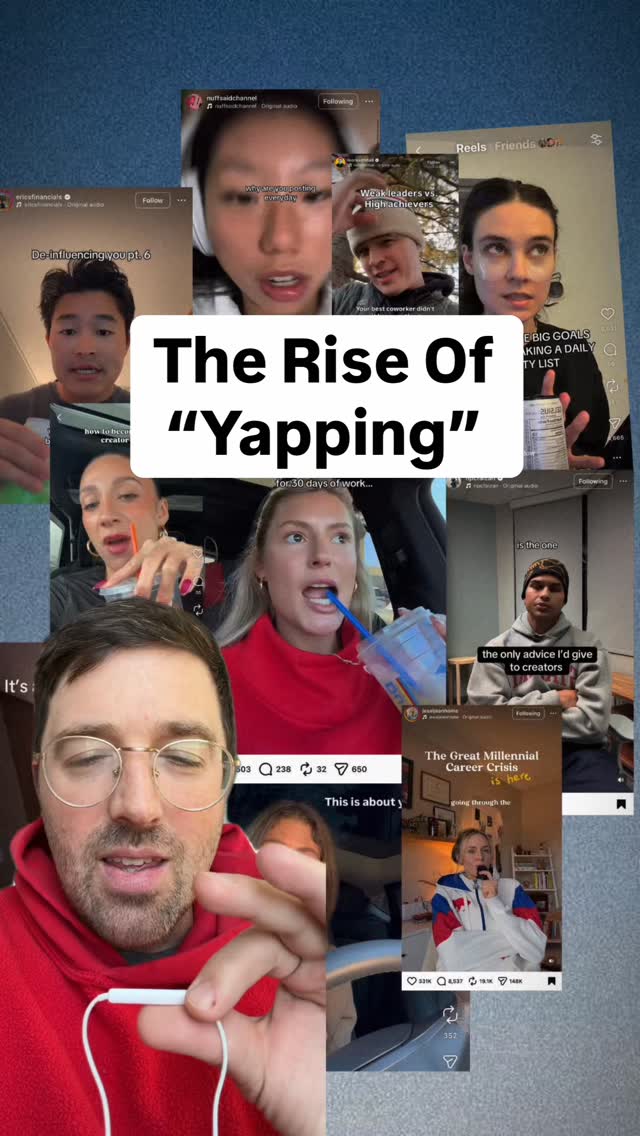
The Rise Of "Yapping"

Verbal hook · 50%

Yapping on camera looks easy, but everyone's missing the point.

Visual hook · 10%

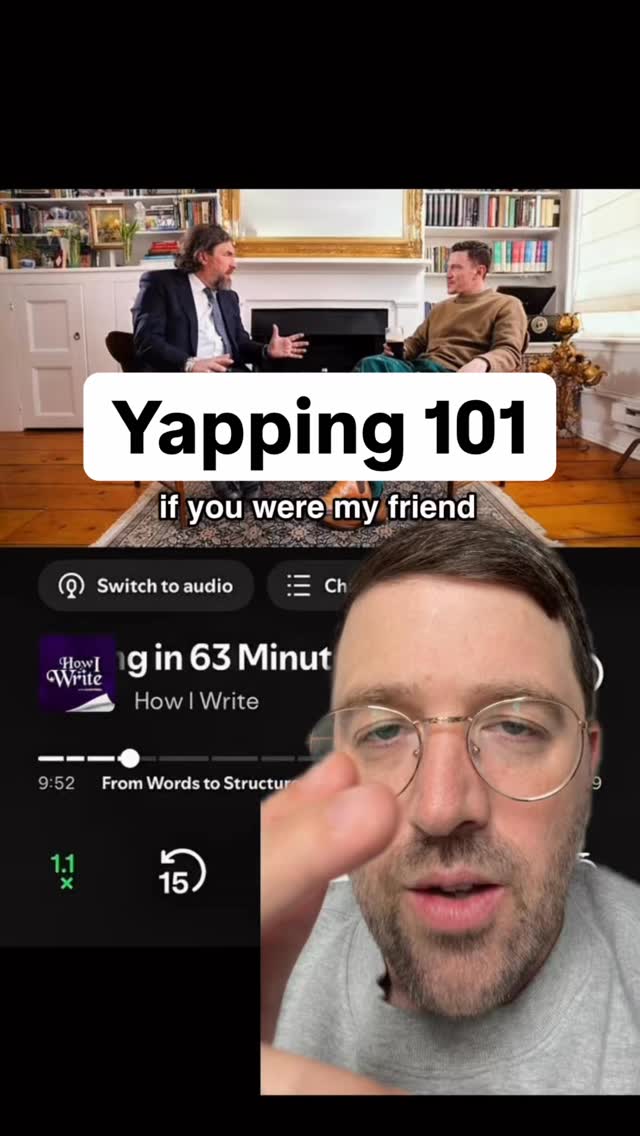
A speaker is positioned in front of a busy collage of multiple other social media videos, creating a visually dense and layered background that immediately signals the topic.

[06]

Hook template

Steal this for your own video

[Popular approach] looks easy, but everyone's missing the point: [overlooked principle].

  • — Budgeting looks easy, but everyone's missing the point: plan for irregular expenses.
  • — Meal prep looks easy, but everyone's missing the point: make food you'll actually want to eat.
  • — Learning a language looks easy, but everyone's missing the point: practice saying what you actually need to say.

[07]

Hook and payoff

The promise the opener makes, and how the video pays it back

Hook

Identify a popular trend or activity and immediately claim that the common understanding of it is flawed, creating an information gap that promises a secret insight.

Payoff

Conclude by reinforcing the value of the newly revealed framework and funneling the now-enlightened viewer toward a specific call-to-action that offers deeper engagement or additional value.

[08]

Narrative framework

The structural pattern this video runs on

Framework

The Contrarian Reveal

Debunking a common misconception about a popular trend by revealing a single, simple 'test' or 'secret' that separates amateurs from experts, then proving its value with a clear comparative example.

  1. 1

    The Flawed Premise

    Articulate the common, surface-level approach to the topic and explain why it consistently fails, validating the audience's own struggles and frustrations.

  2. 2

    The Hidden Strategy

    Reveal that the perceived simplicity or casualness of experts is a deliberate aesthetic, while the underlying process is actually strategic and calculated.

  3. 3

    The Singular Test

    Introduce a simple, memorable, and actionable rule or test, often backed by an authority source (like a book or study), that serves as the key to unlocking the expert strategy.

  4. 4

    The Comparative Proof

    Demonstrate the test in action with a clear 'bad' example that fails the test versus a 'good' example that passes it, creating a satisfying 'aha' moment of clarity for the viewer.

Themes

  • Authenticity
  • Strategy
  • Communication
  • Creator Education

Techniques

  • Direct address
  • Framework explanation
  • Example-based teaching

Trends

  • Yapping

Post caption

Type “sprint” to get on the free “15 Day Yap Sprint Challenge (Waitlist) Yap Content Fundamentals The core truth: Looks casual, actually well thought out. The rawness is the aesthetic, not the process. Yap content is usually based on lived experience. Lived experience is ChatGPT proof. Specific, messy details that only you could know. “I just left a meeting where my boss said this exact thing” beats generic advice. ChatGPT couldn’t have experienced that meeting. The best yap videos are built for shares, not just views. People share when they think “finally someone said it” or “my friend needs to hear this” or “this confirms something I was thinking but didn’t know how to articulate.” When you’re starting out, focus on one clear point. Don’t try to sound smart. Try to be understood. The “So What?” test & Examples (from the book “Get To The Point”) After you say your point out loud, ask “so what?” If the answer is “obviously” or “duh,” you have a truism, not a point. Real points have tension. Someone could disagree. Duh: “Hustle culture is toxic and we need better work-life balance.” So what? Everyone agrees. Good: “Hustle culture is destroying people’s ability to think long-term.” Now we’re talking. Duh: “Being healthy is important.” So what? Good: “Most health advice is designed for people with free time and money, which is why it doesn’t work for most people.” My MF man. Duh: “Hard work matters.” So what? Good: “Hard work is the excuse successful people use to avoid talking about luck and timing.” That’s a point. Execution basics Keep a notes tab in your phone. Jot down moments, reactions, things that made you feel something. That's your content bank. Pacing and energy matter; no rambling. Even though it looks unscripted, the best ones have momentum. You're building towards something. One take mentality: a couple of cuts are fine but the final edit should feel like one continuous thought. . #contentcreator
Text overlays

  • title · beginning

    The Rise Of "Yapping"

  • title · beginning

    (AND HOW TO START)

Transcript

Yapping on camera looks easy, but everyone's missing the point. So you pick up your phone, you yap on camera, there's minimal editing, there's a vibe of I just gotta tell you this right now, and then you post it, but it doesn't hit. Just because the top creators look like they do those things, doesn't mean that's why it's working. Because their videos only look rank, they look off the cuff, that's the aesthetic. Point they're making is more deliberate and thought through. They're casual on camera better calculated in the message. So I'm a psycho and I studied 84 Yap videos and the best ones all passed this one test from the book Get to the point. After you say your take out loud, you ask worse, so what? The answer is obviously you don't have a point. It's a truism. Actual points have tension. Someone can say, nah. I disagree. Here's an example. Communication is key in relationships. And they just go on about the importance of communication. So what? There's nothing to engage in. It's just noise. But an actual point would be saying, most relationship problems aren't communication problems. You communicated just fine. You just don't like what you heard. Now there's something to chew on. And if you want three more examples of the so what test, I put them in the description.

Breaking down the 'yapping' trend | Viral Hooks