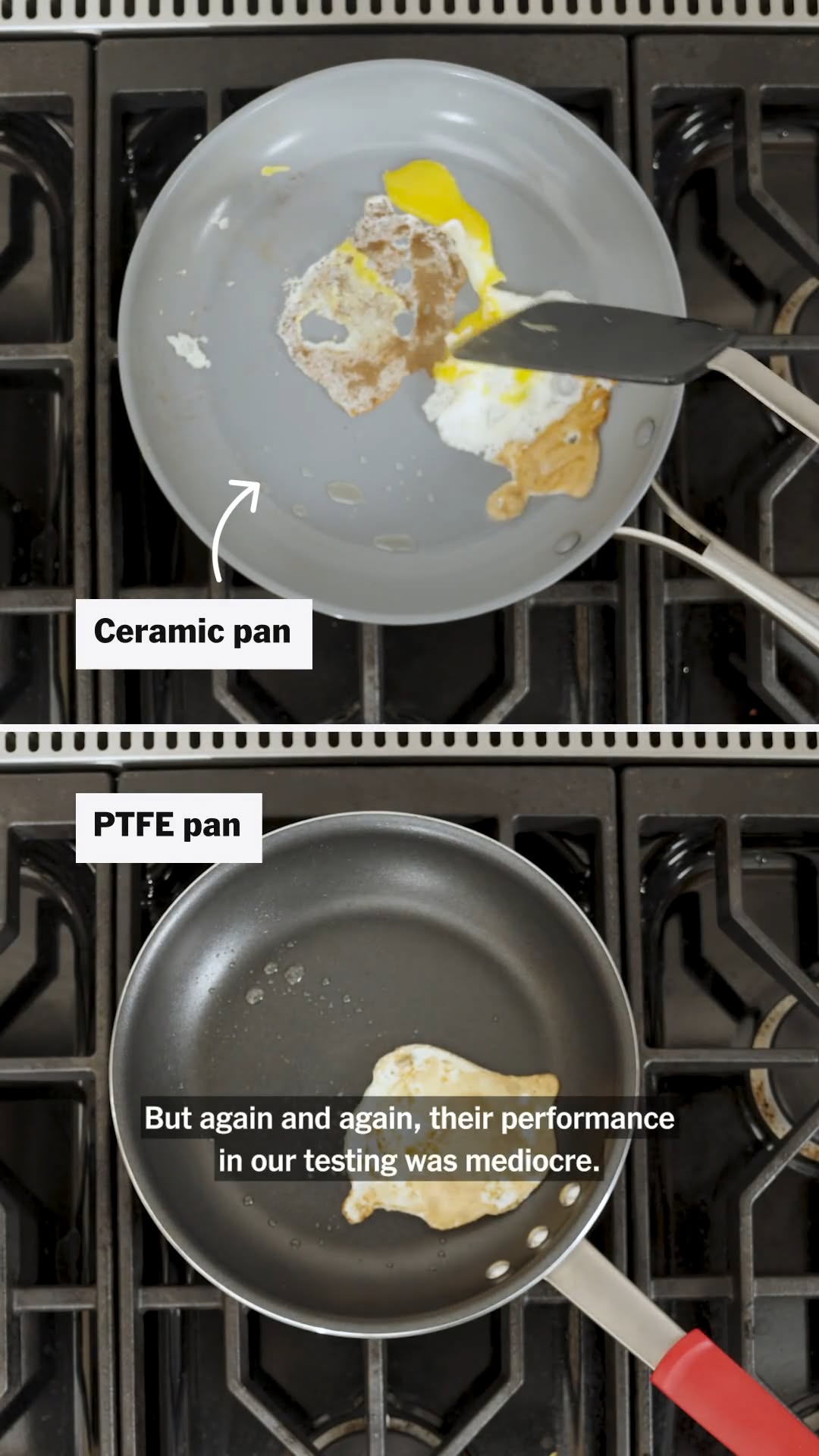
@wirecutter The era of the nonstick pan may be coming to an end. Pans with PFAS-based coatings have been the undisputed standard in nonstick cookware since the mid-20th century. Now, amid environmental and health concerns with PFAS (per- and poly-fluoroalkyl substances, or forever chemicals), marketers are pushing ceramic as a clean, green, nontoxic alternative.
Does it live up to the claims? Out of the box, sure. But good luck keeping it that way.
At the link in bio, Wirecutter explores the thorny questions about PFAS in cookware: whether you should leave it behind, possible alternatives, and how to think about and care for the nonstick cookware you may already own. (Tip: If your nonstick pan was manufactured before 2015, you should toss it!)
Why you should ditch nonstick pansfrom @wirecutter
[01]
Overview
A writer from Wirecutter explains why they don't recommend ceramic nonstick pans, demonstrating their poor performance and short lifespan compared to PTFE pans. She debunks marketing terms like "nontoxic" and discusses the lack of safety data for ceramic coatings, then addresses the health concerns of PFAS in traditional nonstick pans. The video concludes by recommending durable alternatives like cast iron, stainless steel, and carbon steel, showing they can achieve a nonstick surface with proper technique.
The Best Teflon Alternative Is Giving Up on Nonstick Cooking
Verbal hook · 30%
We don't recommend any ceramic frying pans.
Visual hook · 15%
A close-up shot of food sticking badly to a pan while being scraped with a spatula, demonstrating poor nonstick performance.
[06]
Hook template
Steal this for your own video
The Best [popular product/solution] Alternative Is [counterintuitive action]
— The Best Protein Powder Alternative Is Giving Up on Supplements Entirely
— The Best Standing Desk Alternative Is Giving Up on Ergonomic Furniture
— The Best Budgeting App Alternative Is Giving Up on Tracking Your Spending
[07]
Hook and payoff
The promise the opener makes, and how the video pays it back
Hook
A provocative, counter-intuitive thesis statement that invalidates a widely accepted solution, forcing the viewer to question their assumptions from the very first second.
Payoff
An authoritative Call to Action that directs the now-informed and motivated viewer to a trusted resource for more in-depth information and specific recommendations, cementing the presenter's role as a credible guide.
[08]
Narrative framework
The structural pattern this video runs on
Framework
The Paradigm Shift Argument
To persuade an audience to abandon a popular product category by systematically dismantling the leading "alternative" and re-framing the problem to position a traditional, more durable solution as the only logical choice.
1
The Alternative's Failure
Systematically discredits the most popular alternative by demonstrating its poor performance and lack of durability through direct, visual evidence. This validates the viewer's potential frustrations and proves the alternative is not a true solution.
2
The Marketing Deconstruction
Exposes the marketing claims of the alternative as unsubstantiated or misleading. This beat introduces doubt and uncertainty about the alternative's primary selling points, like safety or eco-friendliness.
3
The Core Dilemma
Re-establishes the known flaws of the original product/problem, framing the situation as a choice between two poor options. This agitates the problem and creates a sense of being trapped, making the viewer desperate for a real answer.
4
The Superior Path
Introduces a completely different category of solution that sidesteps the problems of both the original and the alternative. This is presented as a more fundamental, reliable, and intelligent choice, breaking the established dichotomy.
5
The Empowerment Proof
Overcomes the primary objection to the new solution by demonstrating that, with the right technique, it can achieve the desired results. This empowers the viewer, giving them the confidence and knowledge to adopt the new paradigm.
Themes
Health & Safety
Consumer Advice
Sustainability
Product Testing
Techniques
Direct-to-camera address
Comparative demonstration
Expert commentary
Post caption
The era of the nonstick pan may be coming to an end. Pans with PFAS-based coatings have been the undisputed standard in nonstick cookware since the mid-20th century. Now, amid environmental and health concerns with PFAS (per- and poly-fluoroalkyl substances, or forever chemicals), marketers are pushing ceramic as a clean, green, nontoxic alternative.
Does it live up to the claims? Out of the box, sure. But good luck keeping it that way.
At the link in bio, Wirecutter explores the thorny questions about PFAS in cookware: whether you should leave it behind, possible alternatives, and how to think about and care for the nonstick cookware you may already own. (Tip: If your nonstick pan was manufactured before 2015, you should toss it!)
Text overlays
title · beginning
The Best Teflon Alternative Is Giving Up on Nonstick Cooking
contextual · throughout
Ceramic pan
contextual · throughout
PTFE pan
branding · middle
Lesley Stockton
WRITER AT WIRECUTTER
contextual · middle
"Nontoxic"
contextual · middle
"Clean"
contextual · middle
"Green"
contextual · middle
GreenPan via Instagram, Caraway via Instagram, CeramiClad via Instagram
call-to-action · end
Read more of our reporting on nonstick pans on Wirecutter.
Transcript
We don't recommend any ceramic frying rank. They're built as a PFOS free alternative to Teflon, but again and again tier performance in our testing was mediocre. Maybe we should give up on nonstick rank, period. Many ceramic pans start out pretty slick when new. In our testing, they started to lose their slickness within a matter of months. And if you've considered getting a ceramic pan because they're nontoxic, clean, or green, know that these marketing words might not mean much. We don't really know that much about the safety of ceramic coatings. They haven't been around long enough to be studied in-depth, and many companies don't disclose all of the materials used to make them. But we do know that PFAS, also known as forever chemicals, are associated with an increased risk for a range of health issues. Experts say that exposure to PFAS from cooking is likely to be very low. But research about long term impacts from low exposure is still evolving. Given this, plus the environmental and public health concerns around PFAS, you could just let go of the idea of nonstick cooking. Instead, cast iron, stainless steel, and carbon steel pans are all really durable. And with some technique, you can achieve a reasonably slippery surface on these pans. Head to Wirecutter to learn more about our non stick pan testing and our recommendations for PFAS free alternatives.